Written by Matt Long
A review of the booklet included as part of Deaf Crocodile’s 4K-UHD/ Blu-ray release of Dead Mountaineer’s Hotel (1979), which was originally released in 2026. Deaf Crocodile includes the printed materials, such as this booklet, with every pressing of their releases as of July 2026; however, this booklet was only included with the deluxe edition of this release.
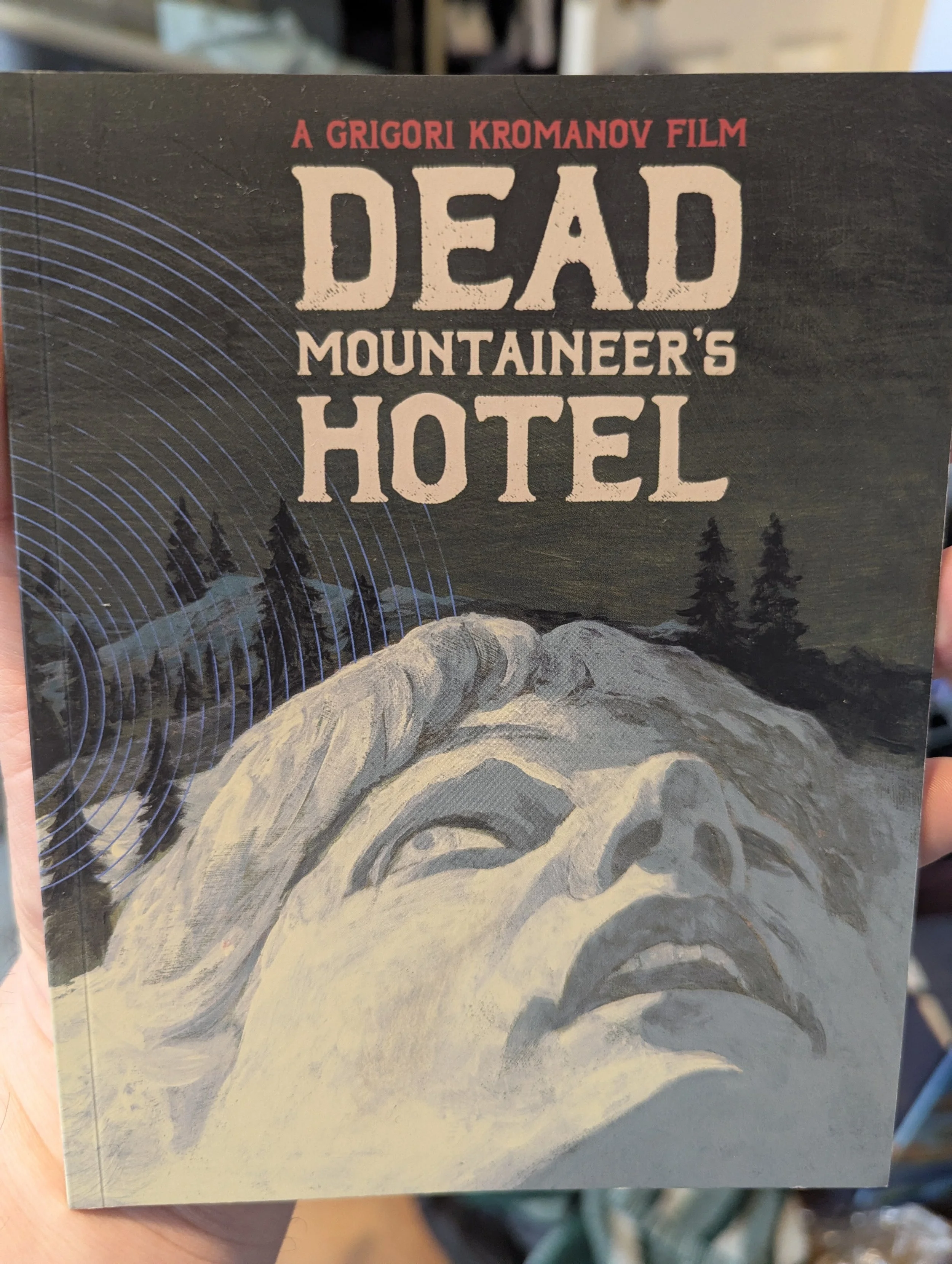
The front cover of the booklet for Dead Mountaineer’s Hotel, released by Deaf Crocodile in 2026.
Professionalism and production quality
This perfect bound 60-page booklet features the striking image on the deluxe edition box set’s cover, representing the mysterious energy of this film. The text and pictures throughout are well laid out; the font size and leading make the text nicely readable, though I’m sure many readers would want the font size to be just one point bigger. The pictures are all printed clearly in high resolution.
The booklet as a whole could have used a light copy edit to improve consistency. For example, serial commas are used in some essays but not others. They might have allowed for each writer to use their preferred style, but there were also some inconsistencies internally like how to stylize the name of the film. One issue is the table of contents listing the “notes on restoration & acknowledgements” as being on page 76 instead of 56. That could be confusing for readers. Other than that, these are very nitpicky points that won’t bother most readers; few pieces of writing are edited perfectly. Overall, this is a strong, very professional booklet.
Grade: B+
Text-to-image ratio
There are 24 pages with images on them and 44 pages with text, several sharing pages with one another. It’s a nice balance of both. The photos are used well to punctuate the essays and provide some context, though when abstracted from a recent watch of the film, it can be hard to connect why some of them are used or given prominence.
This booklet generally met my ideal preferences of providing plenty of space for each essay and every image without a bunch of pages that feel like filler.
Grade: A-
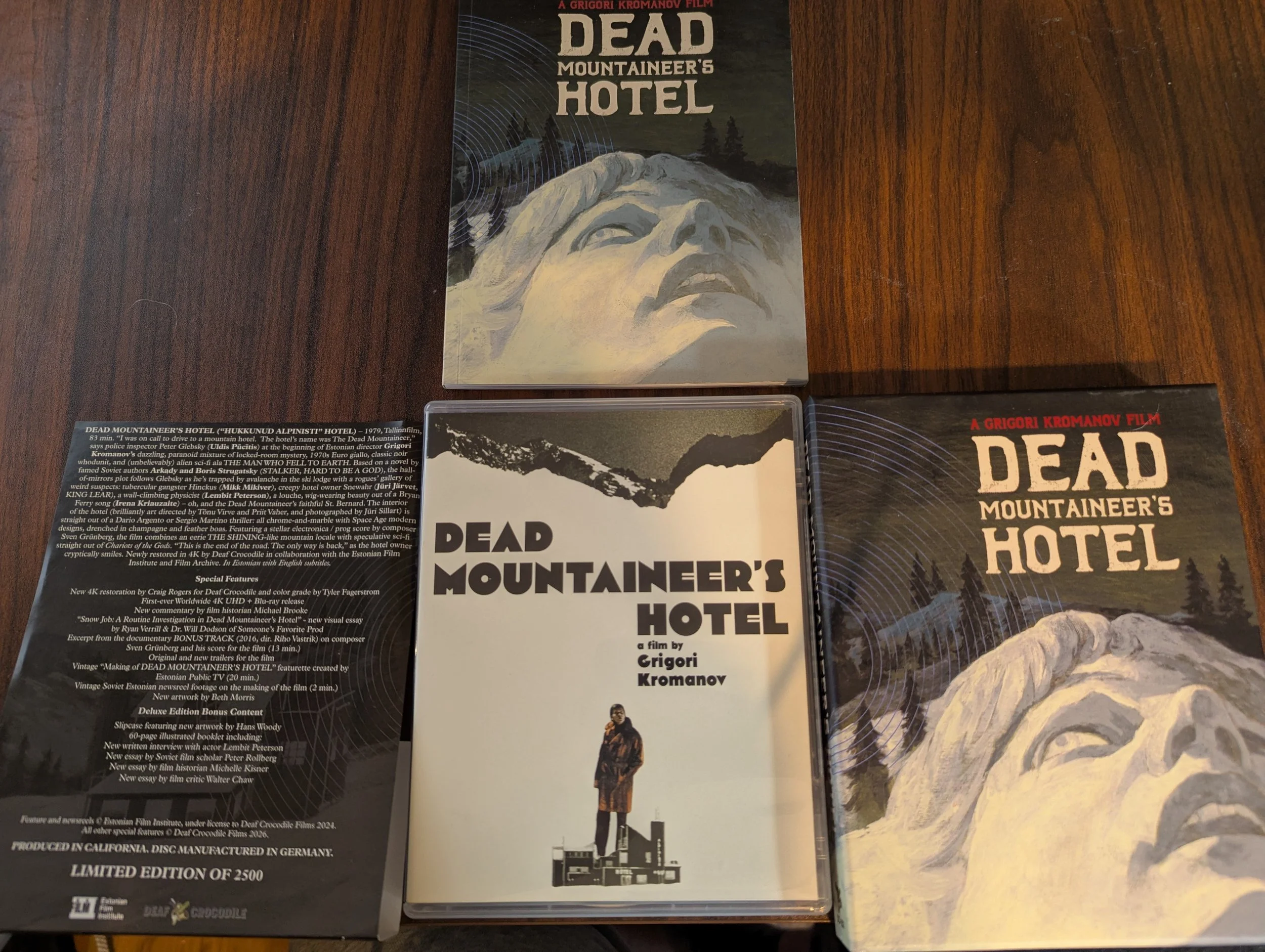
The contents of the deluxe edition for Dead Mountaineer’s Hotel, which is the only way to get this
Content
This booklet features three essays and an interview, along with a table of contents page and a page with restoration notes and other credits.
The first essay is by Peter Rollberg, a Professor of Slavic Languages, Film Studies, and International Affairs at George Washington University. This interesting and helpful essay provides a high-level examination of how this strange Soviet film was even allowed to happen. Rollberg breaks down the film with six categories: An un-Soviet Soviet Film, Style, Science Fiction, Context, Failed Experiment, and Universal Pessimism. It breaks down the kind of films that were made in Estonia and the wider Soviet Union, how this film broke conventions, and how it relates to other well-known Soviet science fiction films like Andrei Tarovksky’s Solaris and Stalker. Framing the examination of the film with how it defied expectations of what Soviet films needed to be was a particularly illuminating angle. It also examines how it looks ahead to a future without Soviet rule and instead fueled by universal capitalism, which was still science fiction at the time but has become a reality. I found the movie to be a little outside my reach, so I really appreciated the context that Rollberg’s essay provided for my next watch.
The second essay, “Three Different Rooms in the Same Place: The Many Realities of the Dead Mountaineer’s Hotel” is written by Michelle Kisner, a film critic, freelance writer, and physical media advocate. This is the only essay with a unique name in this booklet, which I appreciated, and as someone who struggles with choosing titles, I appreciated Kisner’s effort.
This essay compares the work as it travels from its literary origins to the film adaptation and finally a video game. It shares some of the same broad ideas as Rollberg’s, like analyzing the Strugatsky Brothers, but Kisner fits a lot into this essay that takes a unique angle. She takes an interesting approach by examining the character of the inspector Peter Glebsky as he fits into the detective genre. This film is many things—science fiction, horror, detective story, among more genres—so it feels like a necessary examination to consider the inspector’s place in this strange story. There’s also an interesting examination of double identities that goes into how the Soviet Union changed from the time of the source material novella’s publication in 1970 and this film's release in 1979.
Kisner also looks at a 2007 video game adaption that was created by a Russian game studio, which she notes features more opportunity to explore the space of the hotel itself, though the game seems to be more an adaptation of the source novella, not the film. She concludes by comparing the three works to find what themes are consistent across them. It’s a big essay that covers a lot of ground, and Kisner handles it with a very readable style, seamlessly tying ideas together.
The third essay is by Deaf Crocodile stalwart Walter Chaw. Chaw’s contributions are always appreciated. His unique style of writing conducts us through the film, delving into the writer’s memories and impressions of both the film and other related ideas. I’m likely going to re-read this when I re-watch the film, at which time I might appreciate it more because there are some incredibly thoughtful ideas in this essay. As of this reading, the other two essays made a stronger impression on me, but again, I’m excited to really consider Chaw’s ideas when it’s time for a re-watch (lately when it’s far colder than it is now).
Finally, there is a written interview conducted with Lembit Peterson, the actor who played physicist Simon Simonet in Dead Mountaineer’s Hotel. I appreciated Deaf Crocodile’s effort to get this interview with someone related to the film, which is not done even for many contemporary films. Peterson provides interesting insight into director Grigori Kromanov’s style along with discussing what he’s been working on in more recent years. Given the film’s age, the opportunities for this information won’t always be here, so I appreciated the interview’s presence.
Grade: A-
Creativity
I appreciated the interview that broke up the three essays otherwise included. The addition of original poster art near the end was amazing, a very nice touch to include. I learned a lot from this booklet, but I wasn’t particularly surprised by the choices of what was included, and the essays, while each unique and with their own merits, weren’t incredibly distinct from one another. It likely wasn’t possible due to licensing, but getting some translated text from the original story, for example, would have been an interesting supplement that provides real context in how this work was translated. Overall, I liked what was included, but it didn’t match the unique creativity that fuels Dead Mountaineer’s Hotel.
Grade: B
Grade summary
Professional and production quality grade: B+
Text-to-image ratio grade: A-
Content grade: A-
Creativity grade: B
Final thoughts
Overall, a very good booklet with a strong collection of essays. This is a film that demands context while knowingly remaining inscrutable, so these essays and the interview helped me appreciate the film more. Shouldn’t that be what these booklets are doing? It might be a case of the sum being stronger than the individual parts, but either way, this booklet provided significant context into what this unique film was doing and the significance of it even existing as is.
Overall grade: A-
The Dead Mountaineer’s Hotel limited edition is available direct from Deaf Crocodile along with your favourite independent retailers, including Rough Cut Video in Canada.
Check out more articles and reviews, or read interviews from the“What’s your idea” interview series.