Canadian International Pictures’ “Hookers on Davie” 4K-UHD/Blu-ray booklet review
Written by Matt Long
A review of the booklet included as part of Canadian International Pictures 4K-UHD/ Blu-ray release of the seminal documentary Hookers on Davie (1984), which was originally released in 2025. Canadian International Pictures includes the printed materials, such as this booklet, with every pressing of their releases (to the best of my knowledge).
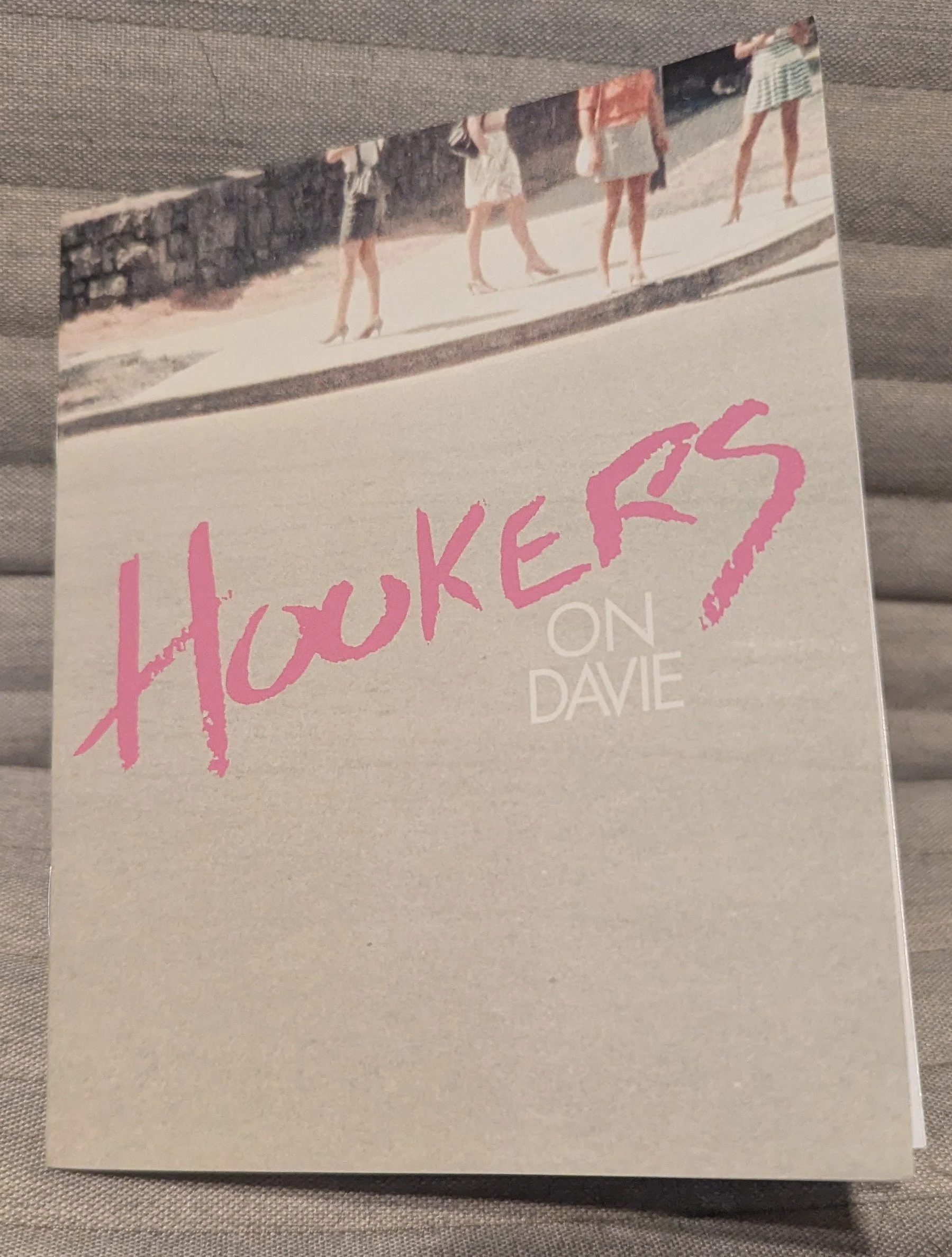
The front cover of the booklet for Hookers on Davie (1984), which was released by Canadian International Pictures in 2025 on 4K-UHD and Blu-ray.
Professionalism and production quality
This is a high quality booklet with saddle-stitch binding. The images, largely sourced from the movie or promotional materials from the 1980s, have excellent resolution if any inherent limitations with the source material are disregarded. The text is readable with a very clean layout, though the font size could be a point or two larger to improve readability. There are no obvious spelling or grammar errors. By the nature of the paper used, the pages show some wear after use, but nothing significant so far.
Grade: A-
Text-to-image ratio
This booklet had an ideal ratio, in my opinion. The 24-page booklet fit 3 articles in its pages, so it used space wisely to hold lots of text while still punctuating most pages with relevant images of the filmmakers or the subjects of Hookers on Davie and the other films of Janis Cole and Holly Dale.
Grade: A+
Content
The first essay is “A Cinema of Care: The Films of Janis Cole and Holly Dale” by Cayley James, an arts administrators and writer based in Hamilton, Ontario. The booklet notes “an earlier version of this essay was published by Cinema Scope Magazine in 2022”. This insightful essay outlined the documentary work of the two filmmakers, focusing on “three essential films from the duo: P4W: Prison for Women (1981), Hookers on Davie (1984), and Calling the Shots(1988),” detailing their journey from students at Sheridan College in Oakville where they were already shooting controversial documentaries, including Thin Line (1977). I didn’t know much about these filmmakers going into this, so I appreciated the context.
James effectively explains why the caring approach they took with their subjects, a “core cast of characters, varying in age from 19 to 41, who work the streets without pimps.” A majority of the essay was spent discussing P4W and the time up to that movie, so comparatively, the time actually spent discussing Hookers on Davie felt shorter than I wanted given this is a booklet for Hookers on Davie, not the films of Cole and Dale.
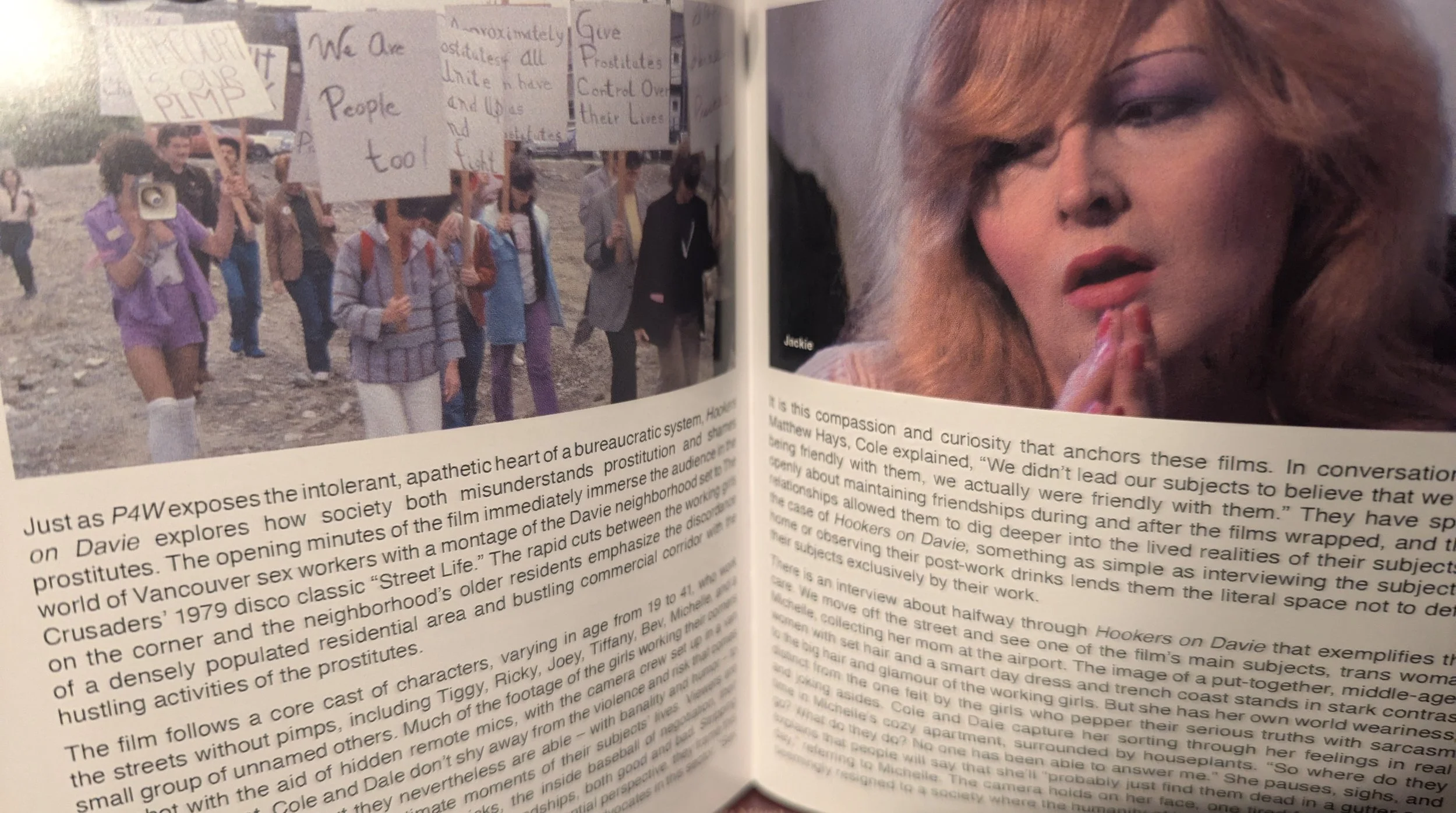
The booklet’s essays offers incisive and interesting overviews of the careers of Janis Cole and Holly Dale in an overall very well-made booklet.
The second essay is a two-page article called “Looking Back at the Seminal Hookers on Davie” written by Adrian Rui Hung, a Singaporean artist and journalist based in Vancouver. The booklet notes “an earlier version of this article was published by Stir in 2022.” This worked as an effective balm to my request of the previous essay to give more information about Hookers on Davie. The essay describes how the movie was filmed within the context of “Mayor Mike Harcourt’s self-described “war on hookers” [that] effectively began in 1981,” along with explaining how any viewers familiar with that part of Vancouver today would not recognize the streets depicted. I wanted any information I could get about what happened after the documentary ended, so I appreciated the detail this provided on a high-level. I only would have wanted an article like this to get as much space as the other two essays so that more attention could have been paid (if possible) to print more information about the actual people featured in the movie.
The last essay, written by Kay Armatage, is called “Janis Cole and Holly Dale’s Cinema of Marginality.” It is an interesting essay with a more academic tone compared to the other two, which makes sense given Armatage’s considerable accomplishments. It reminded me of a more in-depth version of James’ earlier article, which I actually appreciated because James offered a very interesting overview of what made them special as filmmakers, so getting more information about how they made their films worked for me. My only concern is that (similar to how I felt about “A Cinema of Care”) this essay worked better as an overview of the career of Cole and Dale rather than an essay devoted to Hookers on Davie. Even more than the earlier essay, Hookers on Davie was not the feature of this essay. The packed discs include two of their short films, but I can’t actually watch P4W or Calling the Shots now, so I’m left wanting to watch these movies without being able to. Hopefully CIP can help with that problem sooner than later.
Grade: B
Creativity
Like the rest of this Blu-ray package, I appreciate CIP for putting this remarkable Blu-ray together. I will definitely return to this disc. I would have appreciated a little more creativity with the booklet, though (which is, admittedly, being said with no knowledge of any possible constraints. The articles chosen were relevant and it’s important to support Canadian writers, but ultimately, it left me wanting a little more. Some things that I think could have enhanced the booklet include:
· a page featuring a map of Vancouver with areas featured in the documentary highlighted
· an interview with someone in the area now to comment on the differences (or similarities)
· a short update on what happened to the subjects of the movie
I understand these things might not have been simple or possible, but I suspect I would have found myself compelled to return to the booklet with some of these options and if the features included were a little more dynamic.
Grade: C
Grade summary
Professional and production quality grade: A-
Text-to-image ratio grade: A+
Content grade: B
Creativity grade: C
Final thoughts
This amazing 4K-UHD/Blu-ray release by CIP is one of my favourite releases of 2025 and my favourite of CIPs for the year (so far. I still need to dig deeper into some others). The writing was uniformly strong, and the essays offered important context into why these filmmakers made this book back in the early 1980s. I really appreciated the broader update featured in “Looking Back at the Seminal Hookers on Davie.” The booklet is worth reading after watching the film or honestly, it might even work better being read before watching to give you context into the filmmakers.