Written by Matt Long
This booklet is included as part of Vinegar Syndrome’s 2025 4K UHD and Blu-ray deluxe edition limited release of Let’s Scare Jessica to Death (1971).
Professionalism and production quality
This is a forty-page perfect bound booklet that has stiff matte paper with the slightest hint of sheen. It’s sturdy and well designed. The pictures aren’t printed in high-quality, but the washed out look fits the source material. The content could have used an edit to fix some mechanical issues and improve consistency, but it’s nothing that drastically distracts from the reading experience. But why are movie titles italicized while book titles are left unitalicized? It’s an odd choice of style, assuming it’s intentional. There’s also a weird thing that happens occasionally where paragraphs are split up at odd times, like within a quote. It’s like they were working with a template for what the content needed to fit into instead of tailoring it for the actual content.
The booklet does not contain a table of contents and also doesn’t have any biographical information about the essay writers. Both features would have benefited readers while also providing stronger context for the material. To be honest, this score kept going down as I looked at it more closely.
Grade: B
Text-to-image ratio
There are 23 pages with images and 19 pages with text, not counting the film title on the front and back cover or the three pages dedicated to the three titles of the essays. I appreciated that the essays were given ample space and don’t feel constrained, but it’s certainly heavy with images, some of which are oddly laid out, like images spread across two pages with the featured actor’s body right in the split of the page.
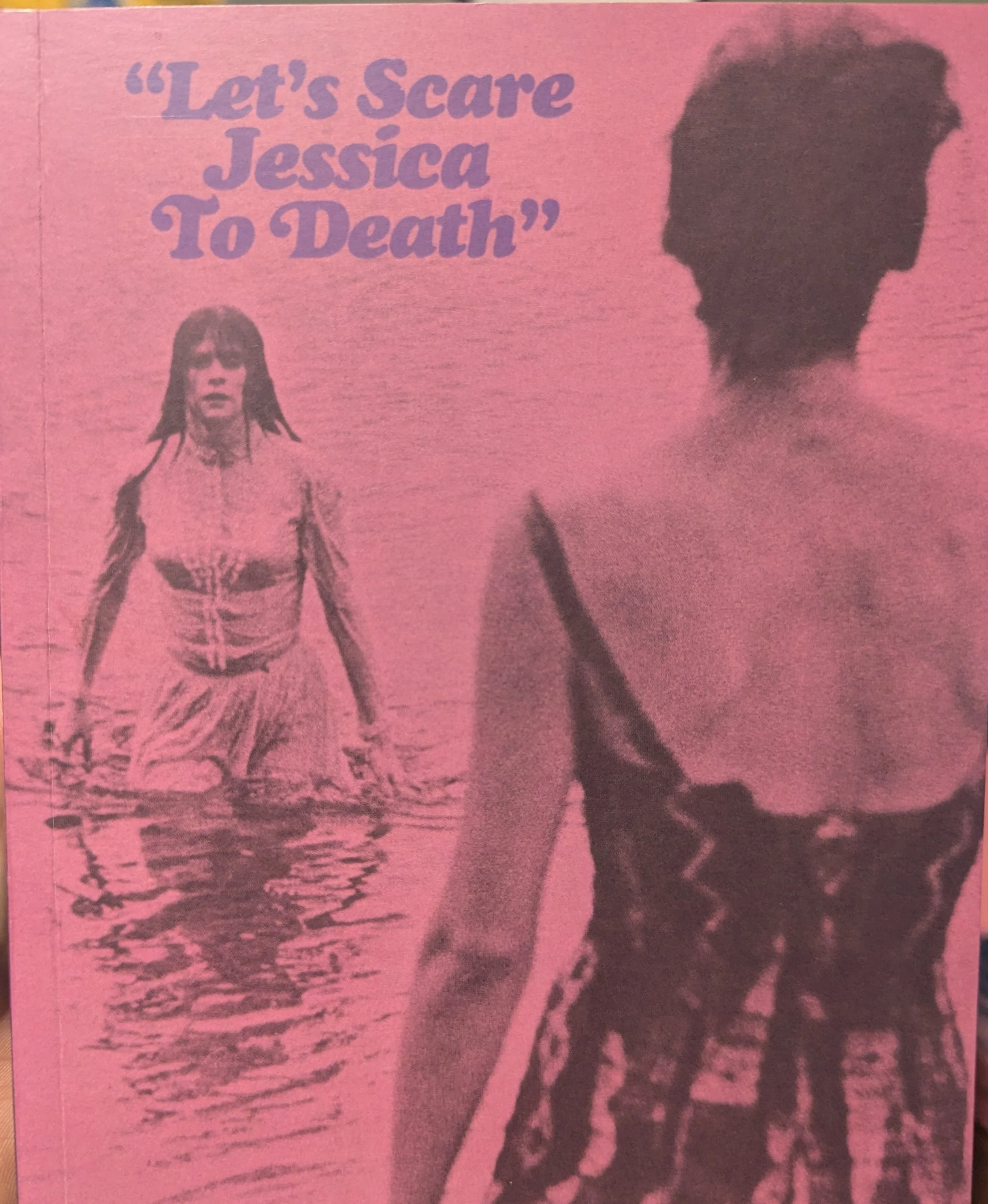
The cover of the booklet for Let’s Scare Jessica to Death.
Grade: C+
Content
The first essay is “Malefiori: Madness and Seduction in ‘Let’s Scare Jessica to Death’” by Molly Henery. Henery’s analysis of the film focuses on the women and the role of women in horror before the emergence of the final girl trope. It’s an interesting angle, though a lot of the essay does turn into a retelling of the plot, including a focus on the impact of director John Hancock on the film. Henry explains how the film connects to two of the other major women-focused horror stories: The Haunting and Carmilla. It’s an altogether interesting and well-written essay, though I wish it had have gone deeper with the initial premise of focusing on how women are depicted in horror films before the final girl.
Next up is “At Least I’m Safe Inside My Mind?” by Quatoyiah Murry. Murry’s essay focuses more on this film’s place in the horror cinema canon and how and why it’s different, but much of the essay veers between plot synopsis and more information about Hancock and the actual production. It’s an essay with good information to be gleaned, but it doesn’t hang together as a singular piece because it doesn’t have the strongest throughline.
The last essay, by Jason Bailey, is “Act Normal: The Unreliable Narrators of ‘Let’s Scare Jessica to Death.’” Similar to the other two, the essay somewhat functions as a plot summary with themes previously mentioned like the connection to the book Carmilla, but the essay does offer the more specific focus on how Jessica and Emily both function as unreliable narrators within the film. It’s an endlessly rewatchable film precisely because you can’t be 100 percent certain of what did or did not happen, so it’s a good touch for the film to focus on that element. It also offers some comparisons to other depictions of “troubled women” from around this time, noting how many of the era's acclaimed directors like Robert Altman and John Cassavetes explored similar themes in their work.
Grade: B
Creativity
I appreciate that the essays cover different material so that it’s not a repetitive read. It fit my expectations of a Vinegar Syndrome booklet, which can have strong material but don’t generally go beyond the standard format of sticking some essays together.
Grade: C
Grade summary
Professional and production quality grade: B
Text-to-image ratio grade: C+
Content grade: B
Creativity grade: C
Final thoughts
A good read but the information can be unfortunately repetitive. It’s not exactly the best value as a forty-page book compared to some of their peers in the boutique Blu-ray business, but if you have the limited edition, give it a read if you’re revisiting this classic.
Overall grade: B-
Check out more articles and reviews, or read interviews from the“What’s your idea” interview series.