Creating The Physical Media Advocate: What’s the idea with Ryan Verrill (part five)
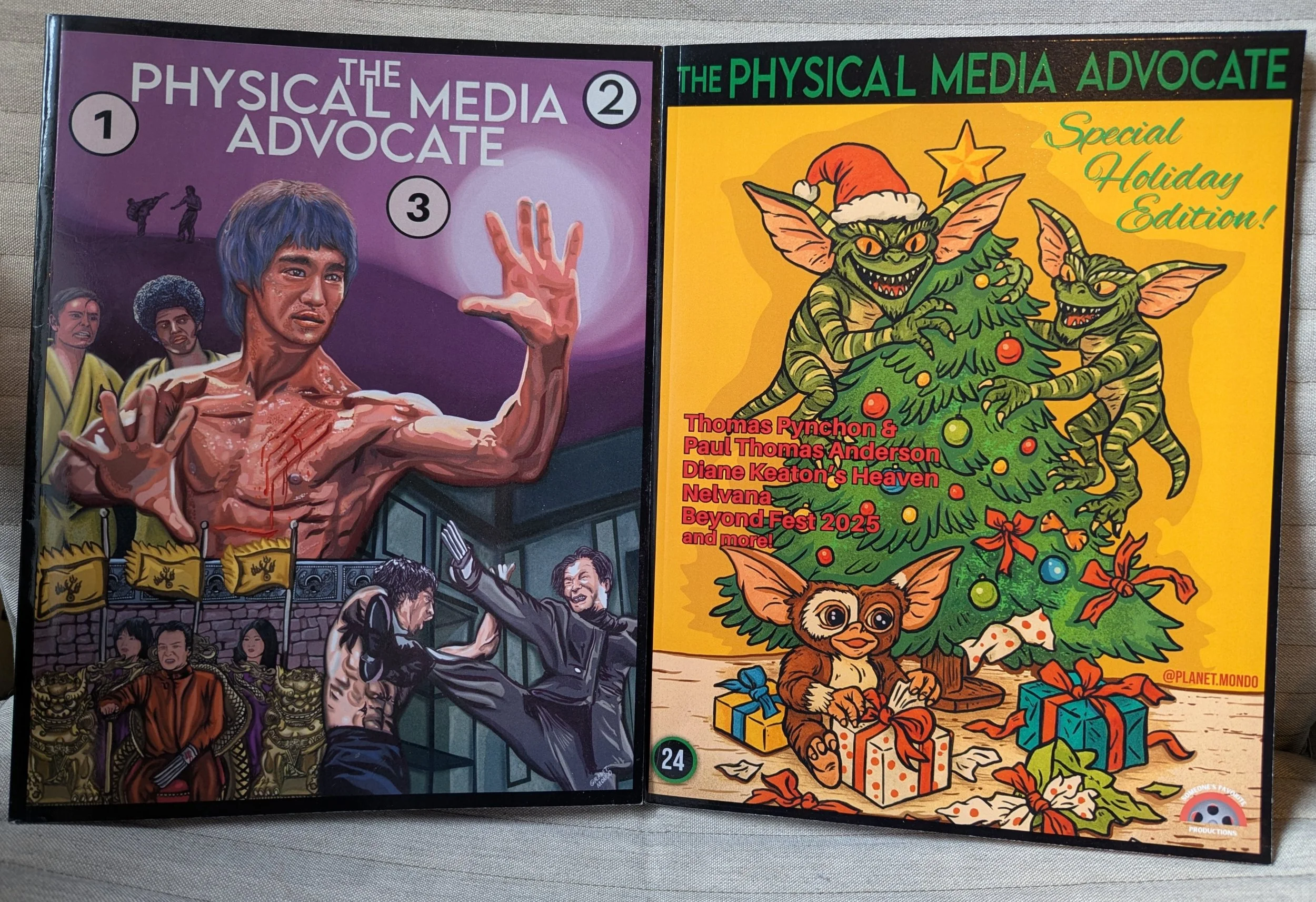
Ryan Verrill’s magazine The Physical Media Advocate is a love letter by the physical media community for the physical media community, celebrating the many things it means to be a physical media advocate. Pictured above are the first and most recent issues (as of publishing).
In part five of our conversation, Ryan Verrill of The Disc-Connected shares the story of his magazine The Physical Media Advocate, including it’s origins, the production schedule, and his ambitions for future issues.
How did The Physical Media Advocate come into existence?
I got invited to a class essentially to be a better movie podcaster. I was invited with Mike White, who does the Projection Booth podcast, which is massive and one of those podcasts that many of us strive to be. Mike is one of those people that is inspiring with research. It was Mike, Chris Stachiw, who works closely with Mike and runs the Weirding Way Media podcast network, seven other people, and myself.
Essentially, it was going to be a 10-week class where each week was themed in some way to talk about how we could literally make our technical quality better, or how we could reach out to people better, or how you can respond better. Every week, we would focus on one of our podcasts and the other people in the class would listen to it and give constructive feedback and share what they liked and thought we could do better. Some of those weeks were like, if you want to go into the world of monetization, what can you do? We talked about the cynical world of placing ads on podcasts. We talked about running a Patreon or charging for live events, which I would love to break into someday.
The week about the Patreon really stuck with me because I had one at that point. I started my Patreon eight or so months before this class, but I wasn't looking to make a lot of money through it. I wanted a way to have a group of people that could feel a little more invested. I wanted to have a Discord community attached to it because Discord seems to be the place for people nowadays to really get granular with who they're speaking to. It's a much more personal avenue of communication because you can have so many subdivided areas within a community.
“People overwhelmingly responded positively. I was so confused because it was just a six-page PDF. Why are you responding this way? And it turned out because it was in a different format, it felt more personal. They saw the value in it, so the next month, it doubled in size.”
One of the things that came up through this discussion about a Patreon was that you could have a tier where people could get some sort of newsletter, or you could have a tier where people get access to a certain thing that they can't get at another tier. I wasn’t trying to restrict people from it, but it's going to be a lot of work, so I understand putting it behind a pay wall. I said, “Screw it. Let's try it.” I know a lot of these people follow the show, but maybe I can do some interesting things in a monthly newsletter to make this worth following.
And so, literally while the class was running, I started the first Physical Media Advocate. That very first one was, I think, six pages. It was just a PDF, and it had some of the more notable releases and an article or two. That was all me. I had it set up in a way so that it was a supplement of information. If you watched the show, this was bonus information or more personal thoughts on things because you don't get enough and you want a little bit more.
People overwhelmingly responded positively. I was so confused because it was just a six-page PDF. Why are you responding this way? And it turned out because it was in a different format, it felt more personal. They saw the value in it, so the next month, it doubled in size. I was like, “This is so cool. I'm getting the energy back from people. Let's put more into it.” I had contributions. I had Fran Simeoni from Radiance highlight one of their upcoming releases, and he gave me a top five list of Italian comedies in one of those first couple issues. People were like, “This is amazing. When can I get this in a paperback?” I was like, “That's cool, but that will never happen because I can't print anything and send it to you. That's crazy to consider.”
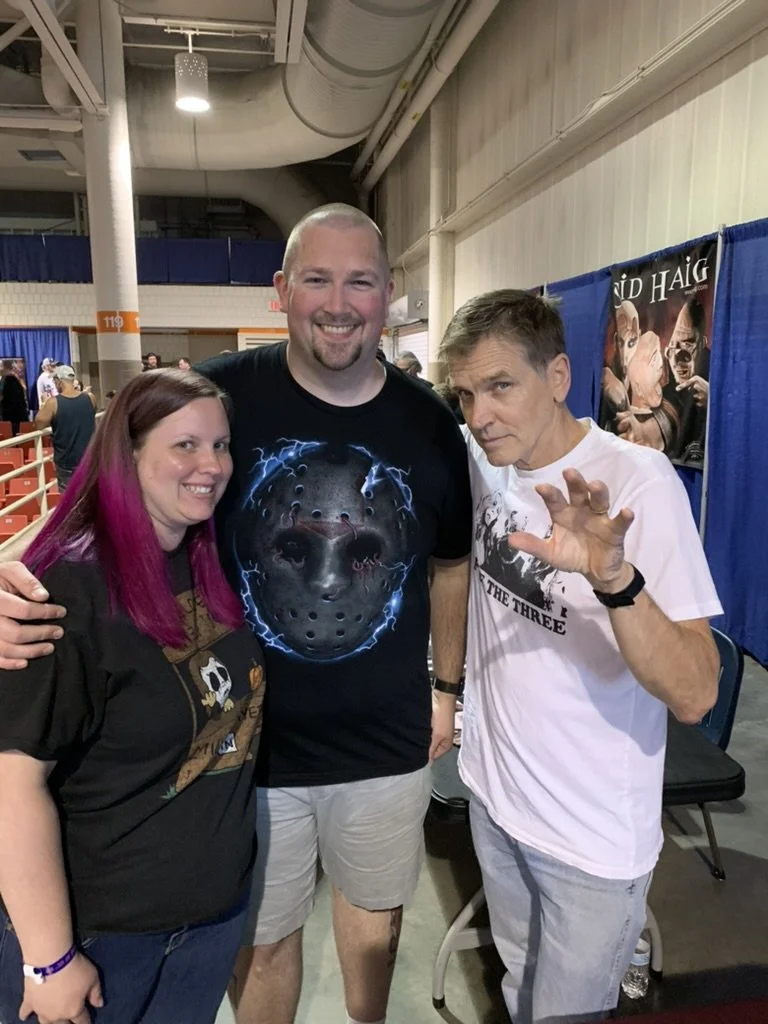
Ryan and Miss-Connected with Bill Moseley AKA Chop Top from The Texas Chainsaw Massacre 2 at Kansas City Crypticon (photo is the property of Ryan Verrill)
I did that every single month for five months, and it kept getting longer and longer and longer. The first one was six pages. The second one was 10 or 12, and then they were hitting about 18 pages every month for a couple months. And then finally, I think it was the fifth or sixth month, it got to 24 or 28 pages, and I was like, wow, this is so much work to format every single month. And now it's at a point where I could actually see this as a zine. I could picture holding it in my hands and it being substantial enough to print.
I looked into what I needed to use online print on demand suppliers, and I think it just needed to be at least 24 pages every month. I was doing that consistently for two months in a row, so I thought let's try it and see if people want to buy it. And not only did people want to buy it, suddenly people were like, you’ve got to print the first five that you did, so I had to go back and combine those. They were like a compendium of sorts because those were not long enough, so I combined them and made it so that they could be printed.
I’ve started saying this is a monthlyish magazine because it's very difficult to get this done in 30 days. But it has somehow turned into pretty much a monthly magazine. We take off one issue a year now.
People also asked, “Could I ever see this in a store?” so I reached out to some physical media stores, and now it's in some brick-and-mortar stores all across the U.S. and even a place in Canada. I'm in talks with a couple other countries about getting it in some other stores. It can be bought on Amazon worldwide. Some people have chosen to subscribe to it through my Patreon so they get every single issue.
How do you gather the material for each issue now?
I have somehow created this thing where there are people that want to contribute and are providing genuinely meaningful film analysis and critique in ways that feel important and overlooked if it doesn't have this outlet. I have people that read an issue and say, “Man, I feel like I would be at home in an issue of this. Would you ever consider writing about this if I did it?” And I say, “Yeah, let's try it.” There is some quality control. I have turned people down. I still want things that go in there to be good.
I've got a friend drawing a custom comic for every issue. I never saw that happening. I've got a physical media store out of Indiana that is sending me soundtrack release dates so that we can get those highlighted as well every month. I've got a producer on the ground in Italy that is providing production updates on supplements that he works on.
These stories aren't being told anywhere else. These are capturing film analysis that isn't happening anywhere else and providing supplemental materials to supplemental materials. In a lot of situations, the writers are telling stories that literally cannot be told anywhere else because nobody else is putting the time into that. Those stories are important and if we're not telling the stories behind the scenes, those are in the process of, in a way, becoming lost media as well.
My buddy on the ground that does the production for Disc-Connected finding me guests, Jeremy Long, is a maniac. He goes to eight showings a week of upcoming films that are getting early releases in Los Angeles or rep screenings, and a lot of times, those are getting Q+A's that are such magical lightning in a bottle moments. It hurts knowing that they won't exist anywhere else, so Jeremy is recording those and then writing an article about them.
That is just one of many things that are regular contributions every single month. I've got Rachel Bellwoar highlighting an actor or director that is celebrating a birthday in that month. She'll talk about a release she loves with them on it, or a movie she would love to get a physical media release, so it all comes back to film and physical media in some way.
“The Physical Media Advocate as it exists right now could not exist without another one of my closest friends now, and that’s Mr. Stan Giesea.”
We're just doing everything we can to make these seem valuable for a very cheap price. These magazines go out for $10 (USD) and that's only because I'm literally losing money at that price. I can't make them any cheaper or I would. You can buy them digitally or on paperback, and they both have different values. When you buy it digitally, everything is embedded with links to a Wikipedia page to learn more and links to go purchase items. I spend hours putting links into every single picture for most of the releases that are highlighted, and that is so much time and work, but that’s what I would want to get out of it. I set the example of quality in something that I wished existed.
The main thing that I want to point out here is The Physical Media Advocate as it exists right now could not exist without another one of my closest friends now, and that's Mr. Stan Giesea. He has taken on a role that he makes literally no money from, but he is actually the creative director of the entire magazine. He is choosing layout options. He is setting most of the magazine and writing articles. He is making contacts with people that are from the old video store days that he knew that are getting people to contribute. He knows a couple artists that do the cover art. Without him, it literally could not exist because it is so much work. Stan deserves all the attention for The Physical Media Advocate.
It's a very professional magazine, and I love the almost punk ethos of building community organically and getting contributions from anyone interested in being part of it.
I can’t pay people, but they're getting author credits so people can go on Amazon and see that they're listed as an author for this magazine and they have physical proof of something that they've written.
It is literally bringing people together and it's just one of those things where I've suddenly turned into this cog in the middle of these weird machines that are connecting the right people to make things the best way they possibly can. And for that, I am so immensely grateful.
I love the variety in the magazine. Your July 2025 issue was the black and white issue, and there's a really touching piece in there about Clerks connecting fans’ relationships with these movies, the relationships we have with the physical releases of these movies over the years, and how we’ve grown up with Dante and Randal, and finally connecting it with the writer’s own friend. I found myself truly moved over it.
“He pitched this sort of depressing story about his childhood friend and “Clerks”... I think it’s one of the most important pieces that we’ve had in the last couple issues.”
That one is special. We've had two different cover artists for the magazine throughout its run so far. One of them has done literally almost every single issue, and then I've had one guy who's done cover art for two issues only. The cover artist for those two issues posted somewhere online that he was doing the cover art for the issue, and his brother, David Winnick, saw it and was like, “That's really cool.” The only reason he's in the magazine is because he saw that I had posted that the magazine was out there and I tagged his brother. He DM’d me and said, “Hey, I've written a couple things. Would you want some of my writing in there?” and I was like, “I can't pay you for it, but I’ll check it out.”
He pitched this sort of depressing story about his childhood friend and Clerks. I said, we're working on a black and white themed issue, and I would not want anything different but to have that be a piece in that issue. I think it's one of the most important pieces that we've had in the last couple issues, so I'm glad it reached you the way that it did.
I'll say thank you on behalf of all the writers out there and editors in general. It's great to have real people like you giving people chances when they need it.
That's what I've really tried to go for with the magazine. It has gotten stuffy a couple times because that has a place too, but a lot of these are very personal stories written from the idea of things like “I worked at this specific video store, and I want to tell you about that.” Who else is going to accept a story like that?
What does your production schedule look like?
It's very backloaded. The last week of every month is a lot of frantic editing and placing, and the last two days inevitably are me being behind and Stan going “come on, let's go” and me working my tail off to get all those links embedded.
There are some things that we're trying to curate a little bit now, because this has become sort of an institution for some people. Every five issues, we're going to have a themed issue. In October, we're obviously going to focus on horror for the most part. In November, we're going to do a holiday themed issue this year, and then January [2026] will be the fifth issue since the black and white issue, so January 1st will be another themed issue.
“All these voices behind it deserve to be recognized because without them, the magazine ceases to exist... I think every single magazine has something that is meant for pretty much every reader. I try to not make them too focused, even when our themes are going to be all-encompassing.”
We're already approaching people to say, “Hey, I know you love this thing. Do you want to write about this in the upcoming issue of this magazine?” So we’re getting some things a little in advance, but holy hell, we're a barely-getting-by-by-the-skin-of-our-teeth type of publication. Sometimes we're getting our cover art 10 minutes before I submit it to print. We’ve gotten some of these articles maybe a day and a half before, so we’re resetting the final layout, and that can mess up so much because you need to change the table of contents and then figure out the layout of what page is going to have what article, how long is it going to be, and find pictures and all that.
I send everything to Stan and then I review, make sure that it's been copied over appropriately. Stuff gets missed because we're only two sets of eyes, but I am still immensely proud of what we get out there. It seems like it doesn't bother that many people, so we'll keep getting by by the skin of our teeth.
All these voices behind it deserve to be recognized because without them, the magazine ceases to exist. I can't write an 8,000 word essay on a Larence Olivier movie. I've seen hardly any of his films. I'm just proud to be a conduit to get it out to people that genuinely will appreciate it. And like Someone's Favorite Productions, which this in a way falls under every single month, I think every single magazine has something that is meant for pretty much every reader. I try to not make them too focused, even when our themes are going to be all-encompassing.
Black and white was such a change because we have such a colourful magazine, so we thought, let's do something fun with it and make it this kind of noir-tinged thing and all the articles will be focused on black and white things, but that doesn't mean that they're not for everybody. When you're talking about black and white, most people are going to assume that it's only pre-code titles or something, but no, we have a really deeply personal article about Clerks and a cover from The Lighthouse along with focuses on silent films.
I do things like silly word searches and anagrams and crossword puzzles every so often because sure, we need to fill pages, but also, it's interactive. It's something that you're going to remember. I did a word search for the biggest film festivals, and a lot of them are film festivals that people just forget about because they only know about Cannes and TIFF and maybe one other. By highlighting 15 film festivals, people go, “Wait. There are other film festivals? Maybe there's one near me. Maybe I'll go visit one.”
I could gush about it for so much longer. I hope that shows the passion behind the publication because it is hastily thrown together, but it's done in a way that is curated and done with love and a genuine sense of purpose behind the passion.
There's almost an irony in that your brand is about physical products but most of your output is digital, so I imagine having this piece of Someone’s Favorite Productions coming out tangibly being very satisfying. Plus, something in the magazine could be repurposed later as part of a boutique release.
Because of the position that I've been in, I've already been able to pitch certain things for physical releases. They're looking for essays for booklets, and I can say, “I've got an essay that was printed in a magazine that, say, only 200 people got to read. This deserves to be seen by a lot more people. Let's put it in the release. I'll get permission from the writer and let's pay them for it.”
I run a podcast network, so I've been able to pitch some of the network’s podcast episodes for releases and we put the episode on the disc. It's been incredible to see what voices I can lift and get out in the world just by being involved.
One of the things I love about your brand is that you don't make people feel dumb in the sense that you don’t focus on just mainstream titles or just cult titles by the boutiques. Everything gets equal interest. I thought I had a pretty decent knowledge of movies—I’ve seen a few thousand movies easily—yet I realize through boutique labels how mainstream my knowledge is, in a sense. And then a recent issue of your magazine has Burt Reynolds on the cover and a very interesting piece about The Longest Yard, which is in a spot of being the kind of movie I know but not one I’ve seen.
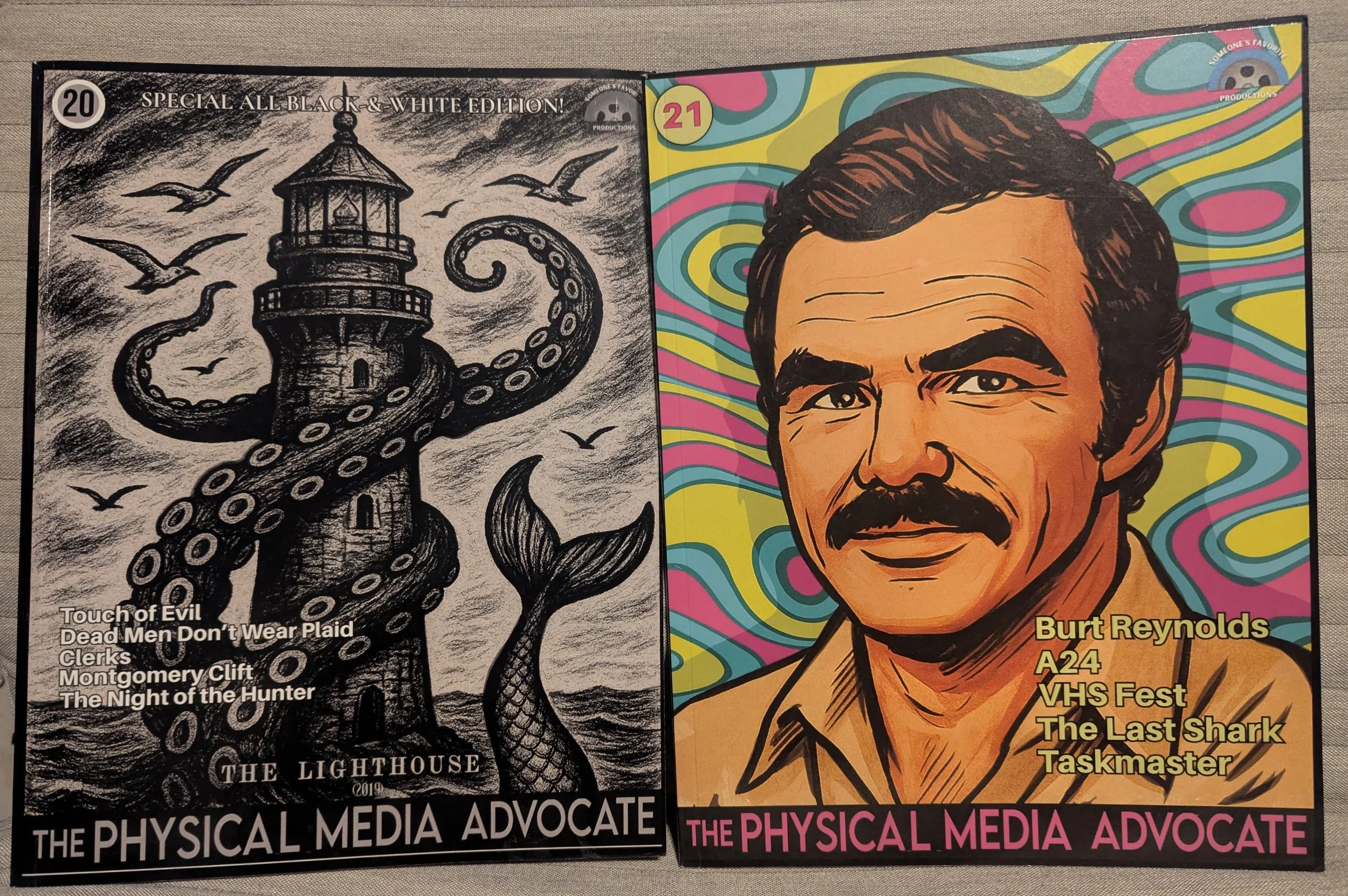
“We wanted a very vibrant issue after the black and white issue. The cover art for that one is psychedelic almost.” (Ryan Verrill)
The other big thing was we wanted a very vibrant issue after the black and white issue. The cover art for that one is psychedelic almost. But Burt is sort of an odd fringe actor, I guess. He's well known for a couple movies and has, I don't know, 60 more that people had no idea that he's in and have never seen.
Are there still things you want to change or do with the magazine, or have you found what works?
There are a lot of things that we want to do with it. I kind of want to do something like a Sports Illustrated swimsuit issue, as an example. A couple times a year, I would love to just surprise drop a special issue that is focused on an actor or focused on a boutique label or focused on, I don't know, a physical media format, and just do 50 pages of very curated written pieces. I wouldn’t have to do the normal articles that we do in every issue so release dates aren’t taking up pages, which means I can lift more voices.
I won't reveal what it's for, but we have an opportunity next spring where we're doing our first one of these for an institution. They have recognized the magazine and essentially, we're doing a focused issue that, for a set amount of time, is going to be for them. I can release it publicly afterwards, but it will be on a very specific subject. We're treating this as a test trial of whether we should do more of these every year.
Should we always have two or three of that we're building and we just wait until we feel like it's done and we're not beholden to a release date? It's a way to highlight a subject without being set into these very specific limitations, so it allows more of that creativity. That's one way.
We're also talking with another group that is looking at maybe doing a regular zine and having it be a side of our zine that we put together, which is mind-blowing to me that somebody would even consider that. But I don't even know what else to do with the magazine other than just to get it into more people's eyes. So, if anybody has ideas, I'm always open to ideas. If you’ve got something you'd like to pitch, tell me. If you have a physical media store near you, I want it in that store. I'm constantly reaching out to stores.
These magazines are on sale in Scarecrow Video in Seattle every month, and that to me is mind-blowing because they're a mecca for a lot of physical media lovers. Before I die, I'm going to Seattle to visit Scarecrow Video because they have 150,000 home video releases to rent and watch. Just that they exist there means the world. I'm losing money selling them in Scarecrow, but it's so worth it just to be a part of that institution and that life, and to have that connection, because that partnership has led to a couple things behind the scenes, too. It's one of those things where it doesn't make me any real money, but it elevates the idea of film and physical media, and that alone is important.
The conversation with Ryan Verrill continues in part six, in which we discuss Ryan’s podcast network Someone’s Favorite Productions.
Watch Ryan live every Thursday on Re-Connected, and follow him on your social media of choice, including Instagram, to keep up with everything he does.
Ryan is the co-founder of Antenna Releasing, a distribution company “specializing in curated theatrical engagements, and robust, filmmaker-forward physical media releases.” Learn more about them here.
The interview was recorded using Google Meet in August 2025.
The transcript was edited by Matt Long, with additional copy editing by Anthony Nijssen of APT Editing.
All photos are the property of Matt Long unless otherwise noted.