How design and plain language can save lives: What’s the idea with Karel van der Waarde (part one)
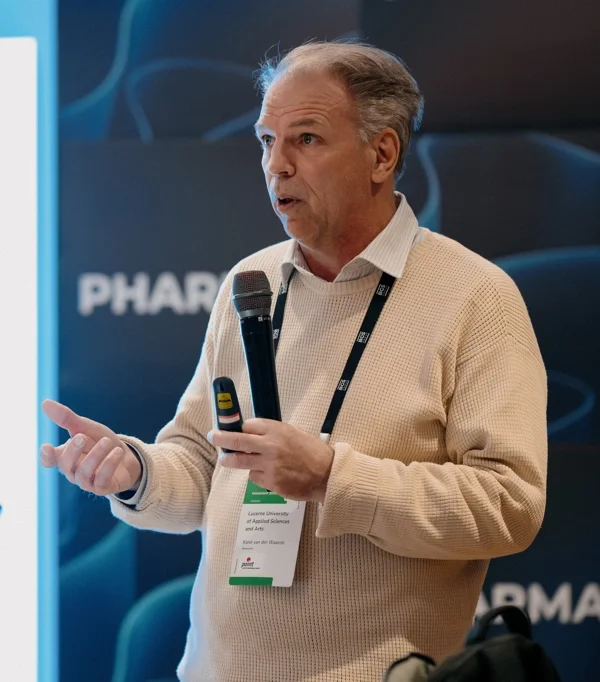
Karel van der Waarde (pictured above in April 2026) is a plain language expert with credentials like IIID vice-president for Education and Research and a board member of the International Plain Language Federation.
In part one, we discuss Karel van der Waarde’s path to becoming an expert in design and plain language, including his influential early work with child-safe packaging.
What course are you teaching?
Design management. It’s a global group from all sorts of countries at the University of Applied Sciences and Arts (HSLU). It trains students to provoke change in organizations, not by doing it themselves, but by making prototypes or motivating others to help develop something.
One example of a project found that Switzerland does not have a leather industry. They burn a million animals every year — they're dead, of course — but basically those skins are lost. What's happening then is that they burn these beautiful, undamaged skins. Farmers who want to keep them have to transport them to either Italy or Germany and hope that they are treated correctly and that they get their own skins back. If it goes into a factory, you cannot know if the leather that comes back is really made from the skin that you provided.
The students looked at the whole system, from why do some farmers work to why is there no leather industry in Switzerland? What they came up with is you don't need a huge factory. You just need two or three containers to make sure that the hides are prepared and kept. You put those containers high up in the mountains and you move them around, and local farmers can prepare the skins of their own animals locally. That process is supported by an attitude of “yes, we can do this. We've got the container, we did the prototype, we worked with these people. All the steps are worked out.”
I also make sure the students understand they can motivate farmers to say, look, yes, it is still a little bit expensive, but the more farmers who take part, the more containers there are, the easier it will be, and you can put a stamp on it that says “made in Switzerland.” That's a valid sales argument.
Essentially you’re challenging students to look at problems in our lives and our society and understand what's happening, as well as taking the step of actually pushing for that change.
That's it, yeah. One of the other projects the students worked on was vaping for 13 year olds. They invited the classroom of 13-year-old kids to come to the university and have a good day out, but also to interview them. There’s nothing like a 13-year-old. You’ve got everything from 13-year-old boys who behave like eight-year-old innocents, to 13-year-old girls who have pretty good awareness of what's happening in the world.
One of the questions was, “How do you know that smoking is accepted in society?” and one of the kids said, “Look at the floor. Cigarettes stubs are everywhere and we find that normal.”
“I made some prototypes and tried to sell those, but the problem is not child resistant packaging. The problem is the information that comes with medicines.”
It's a great answer.
That's a perfect answer. But if everybody throws their vaping plastics on the floor, then we have a problem.
What inspired you to focus on information about medicine for patients in your research and career, and how does that tie into what you studied?
I did a bachelor's in product design as a product designer, where I made prototypes for child resistant packaging that required the coordinated movement of adult hands. Basically, any movement with a coordinated move of squeezing and turning and pushing with this distance can’t be done by children because their hands are too small.
Your research was fundamental to bringing child resistant packaging into the market?
Yes. I made some prototypes and tried to sell those, but the problem is not child resistant packaging. The problem is the information that comes with medicines.
During my masters-study, I did a project on oral contraceptive packaging. Oral contraceptives are taken by very healthy women — sexually active, not obese, no high blood pressure, not smoking, perfect heart condition — or else you can't get it prescribed. Because it is only prescribed for very healthy women, it's not a medicine, so I moved it away from the medicine area to a cosmetic area. I made a nice, compact box that fits in a handbag or in a rucksack or whatever they want to carry it in to move it away from the medical realm.
“The second thing it taught me is to talk to people who take these tablets... Nobody ever asks a patient... ‘Can you take your medicines? Did you have any problems with taking them?’”
Medicines are not nice. If you look through a woman's handbag, there's always two or three medicines in there with lousy, cheap cardboard boxes or blister packs floating around. It is a more acceptable design as a hard case such as a powder compact. Such a powder box can contain a reminder and information about what to do if something goes wrong. This helps to take tablets on time, and it keeps the main information with the tablets.
It’s a very effective way of informing women about the benefits and risks of contraceptive pills. I was honest to say, look, they're not very healthy. You need to be aware that there are fairly severe risks, and if you don't feel comfortable about those, please reconsider. That was not acceptable by the industry, of course.
The second thing it taught me is to interview and talk to people who take these tablets. After talking to the industry, all sorts of doctors and pharmacists about medicines, nobody seems to do that. Nobody ever asks a patient beyond doctors asking, “How do you feel,” but not, “Can you take your medicines? Did you have any problems with taking them? Does the medicine suit your lifestyle?”
I then looked at those awful, very large paper leaflets. Nobody ever reads them because it's just simply too much, so I thought, could that be done better? What's the reason that these leaflets are so poorly designed? Doctors get perfect information with full colour brochures and animations, and they get visitors from the pharmaceutical industry to tell them how good their products are, and then it goes to the patient with a lousy leaflet or lousy instructions, and then we blame the patient if they don't take the medicines correctly.
The pharmaceutical industry supplies information to doctors, then doctors supplied information to patients. Is there somewhere in that chain that is the key to improving the situation?
We need to look at this from at least four different perspectives. A key first perspective are the regulations and legislation. That's slightly different in Canada and the U.S. and in Europe, Japan, Australia, but all of them are very poor. There's no place in the world where patients get decent information about medicines. If you present well designed information in a video or in a proper leaflet, then it's illegal because it doesn't fit the legislation. It's very simple. If you don't follow the regulations, you don't get a license to sell the medicine.

Karel speaking at a conference in April 2025.
The second thing, apart from the regulatory considerations, are the medical aspects. You only get medicines approved and used if they fit into a medical protocol. If a patient happens to have this disease and is that age and is that overweight and is whatever else happens, then this medicine is preferred above these other three. Individual circumstances are shoehorned into some sort of medical protocol.
The third thing, of course, is that medicines must make a profit.
The fourth is it needs to be as digitally advanced as possible. That’s not so much for the patient, but the registration process and the editing process and the whole development of information process in the organization and outside is structured in a centralized way standard way.
So it’s legal, medical, financial, and digital perspectives first. The fifth perspective is to consider the use of medicines by patient. Nobody talks about whether patients get better or not or if patients feel better, or if it is effective. Nobody seems to care about them.
What do you mean by that?
If the industry or the regulators or the profits cared about patients, they would give proper information and clear instructions. They would make sure that if you take two or three or 15 medicines that are related to each other or can be related to each other, that different types of information would be available. This requires different visual formats on paper and online, information made for different types of reading, and is based on the experience and knowledge of people. At the moment, these factors are ignored. So supposedly there is only one format that suits every one?
A good example is HIV patients in London. These are highly educated, clever guys between 15 and 80 years old, highly aware of what's happening. They have no problems taking medicines, because they know how dangerous it is if they don't. They are supporting each other, and are very aware of the options, risks, and benefits of different treatments. These highly motivated and knowledgeable patients receive exactly the same information for the rest of their lives: same text, same format, same level of detail.
You have to provide the most important information on the top layer, and then you go down to the scientific information if you want to know it, but we provide all the information in one go and hope for the best. It simply is not effective.
I've done a literature review on it; about 400 studies have been done since 1992. Not a single one is positive about these European leaflets, yet the European medicine agency and the FDA still believe people read them and are happy with them.
The information is there in some way, so they can say they are doing what they need to do, I guess. When I think about patients not being a priority, it makes me think about how we say there is medicine to treat cholesterol or we're trying to find medicine to fight cancer. But what goes unsaid is we're fighting cancer in patients. We are managing the cholesterol of patients. And because it goes unsaid, perhaps it doesn’t get thought of the way that it should.
It reminds me of The Uses of Argument. Steven Toulmin is an absolutely fascinating guy. This book is a tool. It has five essays. The third essay is interesting because it shows argument structures. If you make a claim, what's your evidence? And for every claim, there are conditions, so you need to reduce your claim to a manageable area. For medicines information, it is necessary to reduce global claims and state that it is only applicable in Europe or only applicable for women.
“The fundamental thing that we do wrong in legislation is that we treat all medicines as being equal.”
But he also says that for every claim you make, the warrant is the unspoken and accepted underlying reason for the claim. And that’s exactly what you said. In the medical world, the assumption is that we talk about patients, but the reality is that we make claims about diseases. And if you make a claim about the disease, that's fine. But the unspoken warrant — and the reason that you make that claim — is we do this for patients. But that's nowhere to be seen in literature. Talking with patients is rare, and even when we do talk with patients, we put them in a pigeonhole because that makes it easier to frame a conversation. Examples of these pigeonholes are “low literacy,” “vulnerable,” “elderly,” and “non-adherent.”
I imagine it gets difficult quickly to look at cases too specifically, so it's probably easier to try to eliminate the entire factor of patients by creating “objective” instructions. But when you look at patients with any sort of complexity…
Absolutely, and that’s not even talking about more difficult medicines for Alzheimer and all sorts of mental diseases, but very simple Ibuprofen is already impossible to explain, and that’s an everyday medicine we all interact with.
I think the fundamental thing that we do wrong in legislation is that we treat all medicines as being equal. A medicine is a medicine, so it needs to be licensed. As soon as it's licensed, it's an approved medicine, but that means that you have to provide standard information about a medicine. The standard structure for all medicines is identical. It doesn't matter if it is a medicine for one day or for three days, like an antibiotic, or for the rest of your life. It's the same leaflet, the same information, and that's insane. If you have type one diabetes type one and you need to use insulin, the insulin is likely to be the same for the rest of your life, because there's no cure yet. But still, we give the same leaflet 12 times a year for the next several decades.
The annoying thing is that we know how to give good instructions. Look at HelloFresh, or IKEA, or Lego. If they don't give perfect instructions, their phone lines are red hot immediately. On medicine boxes, there's not even a phone number. There's a postal address so you can write a letter.
What I'm doing in commercial life is I interview patients about their medicines, asking what they need, what they want to have, and how they want to have it, and how to deal with that. I interview nurses and pharmacists and doctors to see what they provide, and I write about it, I teach about it, and I hope to influence a few regulators.
The legislation is reconsidered every 25 years, and we are now at the point in Europe that they're reconsidering the medical legislation regulations. I reacted with about 40 pages of comments. This report was heavily annotated and supported by research. I’m not sure if anyone read it.
If it’s every 25 years, an average scholar has two chances in their lifetime, possibly three, to influence legislation that is going to fundamentally affect generations of people.
I'm getting more people around me who I work and cooperate with who feel the same frustration and focus on change. The issues, of course, are always based on regulations, profits, medical considerations, and the latest digital technologies.
Consider if an industry has just invested a phenomenal amount of money to update their digital content management systems. The pharmaceutical industry is global. If something happens in Korea, then the Brazilians need to know immediately, so there are huge information systems dealing with each product. These systems are based on the information about a single medicine.
If you’re dealing with a side effect that occurs in Korea or in Japan or wherever, do we need to change the label in Chile? If it happens in Europe, do we need to change the leaflets in all 24 languages immediately, and how much time do we have for that? The regulatory systems need to converge, but that will take decades.
Thank you for reading the first part of this interview with Karel van der Waarde. In part two, we discuss his vision for the future of medicine and ISO standards.
The interview was recorded using Google Meet in December 2025.
The transcript was edited by Matt Long of What’s the Idea Editing
All photos are the property of Karel van der Waarde.