How design and plain language can save lives: What's the idea with Karel van der Waarde (part two)
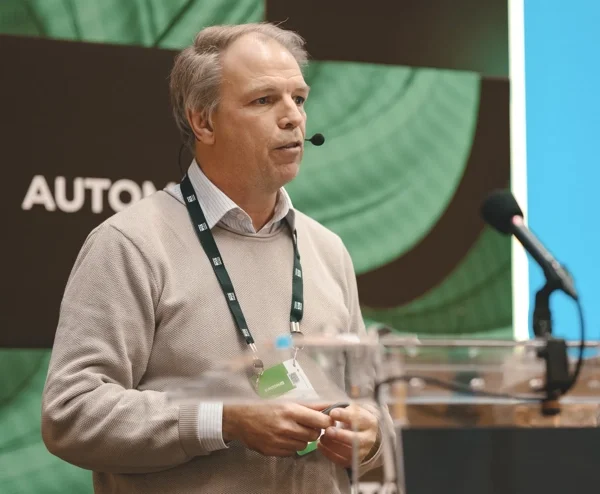
Karel van der Waarde (pictured above in November 2025 in Vienna) is a plain language expert with credentials like IIID vice-president for Education and Research and a board member of the International Plain Language Federation.
In part two, we discuss Karel van der Waarde’s vision for what the future of medicine could look like, the difficulty of getting there, and the influence of the ISO standards.
You mentioned that drugs are all handled the same way in terms of packaging, labelling, and so on. What could it look like in a different world?
It depends how far you want to look forward. I was working for a Swiss company that wants to print medicines in a similar way that you can print a photograph on a cake. You use the same sugars as you print, which are amazingly small dots with sugar, and you add a little bit of medicine to that. I can print your name Matt Long in black sugar or black ink that is edible, and I can put exactly the amount of medicine you need in that.
But I can also mix medicines that way. At some point, you're likely to use two or three or four at the same time. The only thing you would have to do is eat a little bit of rice paper and swallow it with a bit of water, but the text will state “Matt Long; Monday, December the 15th at 12:00 noon, eat this strip that has all your cholesterol, blood pressure, heart rhythm medicines,” all in the same strip, personally printed for you by a pharmacist.
“The role of a pharmacist is getting extremely important for what’s called polypharmacy, which is when people... get instructions on how to integrate medicines into your life pattern. ”
That is not possible yet, of course, but that would mean that pharmacies do not sell boxes anymore. They go from three-dimensional boxes to thin envelopes with your individual medicine printed in it. That's a long way away, but for some medicines, it will happen, and that will certainly be developed in the rich countries
The second thing is that if you go to a doctor and the doctor examines you, it's highly likely that you get prescribed a medicine. You never get the advice to take a 2-hour lunch break and take it easy; put your phone away for two hours, eat healthy, go for a walk for at least an hour, and do yoga or relaxation techniques for half an hour, instead of rushing through your lunch. You stop at 12:00, you come back at 2:00, and you haven't touched your phone. That would mean avoiding a lot of medicines already. But that's not the advice you get. You keep working as you do because you’ve got some medicines to keep you going.
In some countries already, the prescription form is sent to the pharmacy digitally, but in most countries, you still get a bit of paper, and you have to go with a bit of paper to a pharmacist and say, “Can you dispense these medicines for me?” What an ancient system. The doctor prescribes medicine and, if you agree with it, medicines are delivered to your home before you arrive home already. The pharmacist is not necessary for a lot of medicines, and certainly for medicines that are for chronic diseases like diabetes type one, or cholesterol, or for things that are long-term.
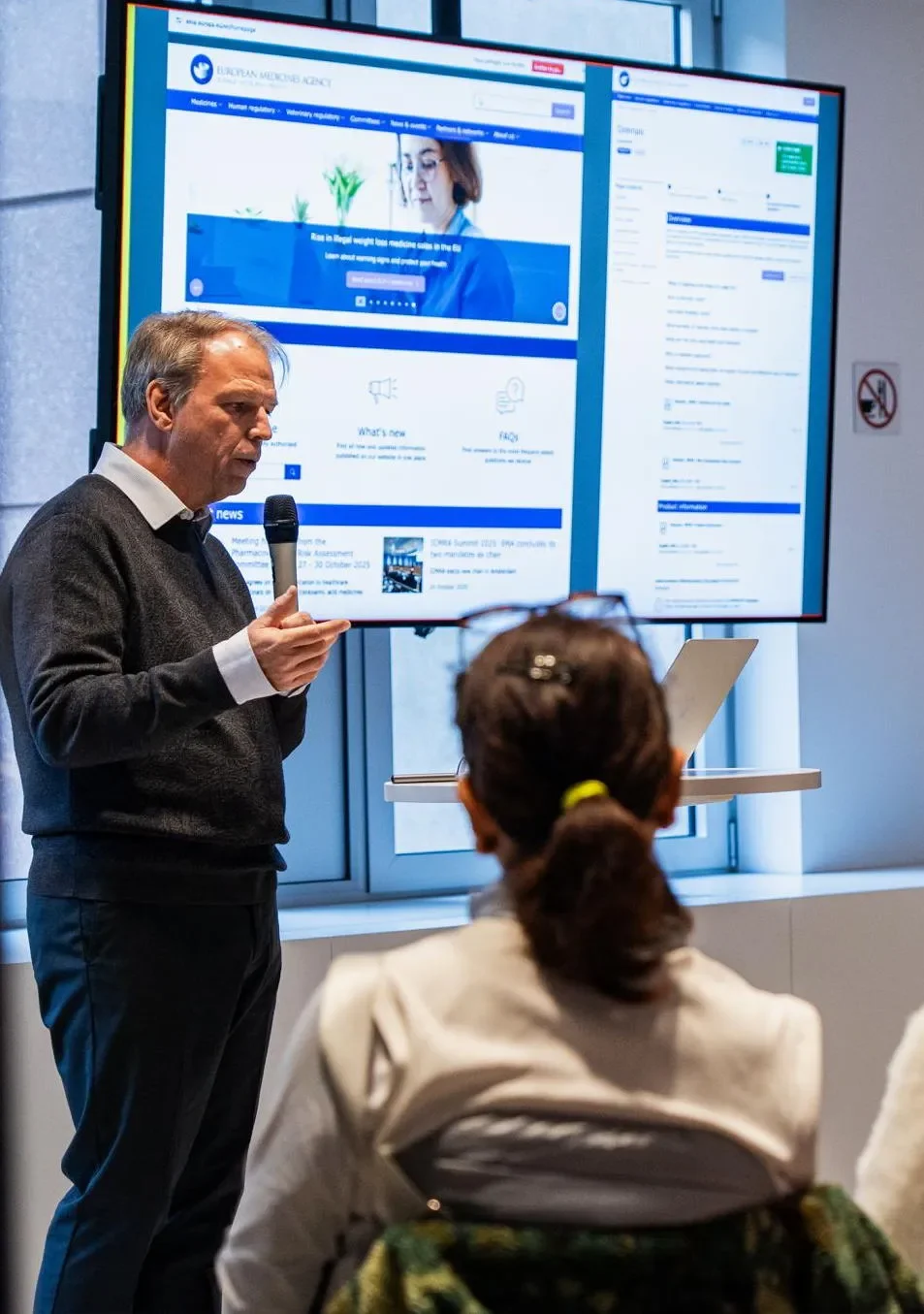
Karel presenting at the PLAIN conference in Brussels in 2025.
Why do you need to go to a pharmacist? The role of a pharmacist is getting extremely important for what's called polypharmacy, which is when people take more than one medicine at the same time. You would then have to go to a pharmacy not to pick up your medicines — because they are at home already — but to get instructions on how to integrate medicines into your life pattern. Now you're talking about an interesting role for pharmacists. Instead of dispensing medicines, they help you to take medicines, because dispensing and checks can be done by drones or whatever parcel delivery service. It would mean that we free up the time of the pharmacist to talk with patients.
If patients knew that the pharmacist was there as a resource to help them through this vitally important part of their life, it would be a huge relief.
Exactly. I hope it will change in that direction. The second thing, of course, is that we need to make use of the Internet. Something I was saying by 1985 was you can provide medicine's information digitally. What you get now is a PDF of the old pamphlet on your phone, and that doesn't help. The only thing that's usable is that you can use the search function.
If you have accessibility problems, even that might be difficult.
I just heard a very sad story about a guy who has Parkinson’s disease that was getting worse, and that meant he couldn't use his phone anymore because he was shaking too hard. This meant that he couldn't use his bank account anymore because the bank was linked to his phone. He got warning after warning after warning that he had to pay all sorts of monthly payments, but he couldn't use his phone. He had the money, but his problem is that the phone does not react to his Parkinson’s disease anymore. He got in real financial problems because he got Parkinson’s.
Can we just deal with people instead of numbers? The figure for insufficient health literacy in the U.S. was 88%, and in Europe, over 47% are health illiterate. I'm getting upset about it because the measure that was used to find out if somebody was health literate was one question. Do you fill in the forms for your insurance yourself? If you say yes, then you're clever enough. If you say no, somebody helps me, then you're health illiterate. That isn’t a fair measure at all.
“Another example is the use of the words ‘patient journey’. A journey usually means you’ve got something to aim for. For many patients, it is not a journey... Where you will be in a month’s time is completely unknown, so to talk about the “patient journey” is putting it in the wrong context.”
There's so much skepticism around medicine now right, so understanding health literary and combating that skepticism is very important.
Yeah, with the whole discussion about vaccinations. Do you give a vaccine to a patient? No, you give vaccine to a healthy person. The whole terminology and the way we talk about it needs changing.
When you’re in hospital, you've got the visiting hours. The visitors are the people who go to a patient and spend some time with them. We call them visitors, but I think those are the people who actually take care of that patient after he or she leaves the hospital. They're now actively excluded from the treatment in the hospital, but they should be included because they take over afterwards. They're not visitors. They're part of a treatment team. As soon as you call them visitors, you exclude them.
Another example is the use of the words ‘patient journey’. A journey usually means you’ve got something to aim for. For many patients, it is not a journey. It is an odyssey. It is a search for ways forward. You reach the next hurdle and see what can be done. Where you will be in a month's time is completely unknown, so to talk about the “patient journey” is putting it in the wrong context. It happens all the time when you look at these things. When people live with illness, the word “journey” is the wrong word.
A third example is the word stakeholder is just colonial. You can say it's a participant who benefits financially, or it is a participant who has a medical background, but not stakeholder. That's absolutely a wrong word.
These examples just show that we need to be careful with words such as ‘patient’, ‘visitor’, ‘journeys’, and ‘stakeholders’. Their meanings do not help conversations about health because they place people at an inappropriate starting position.
Are you involved with the new ISO standards or language medicine?
I'm part of IIID, which is the International Institute for Information Design in Vienna. I've known Christopher Balmford — who was the main initiator and convenor — from Melbourne for 15 years.
Before that, there was Robert Linsky, who was member of a board of one of the three plain language groups in the U.S. He was trying to get the design, digital, and the writing parts together. They wrote to me saying that the plain language part one ISO standard must have a part about design, because design influences how people read, but the deadlines were very tight.
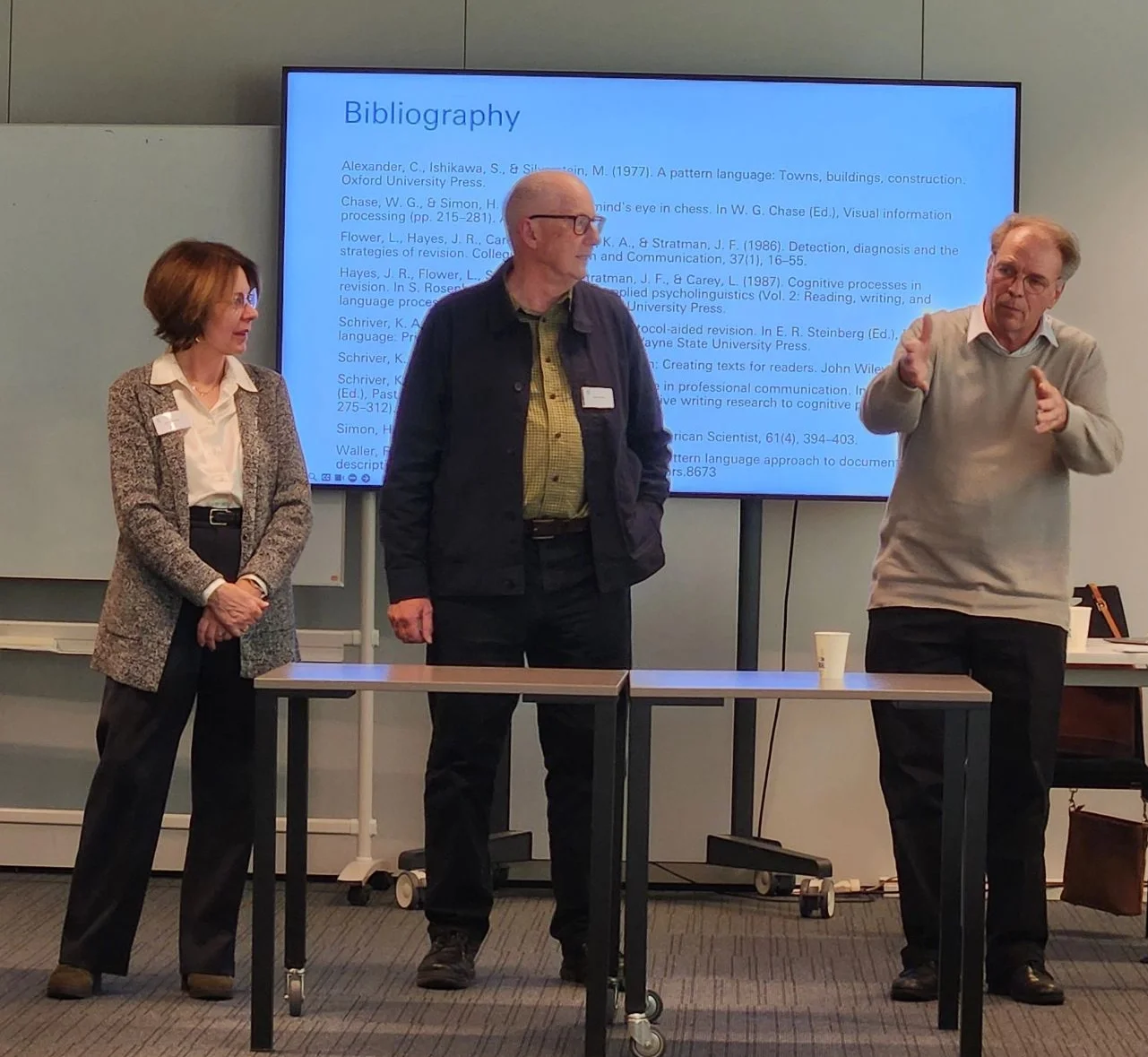
The Brussels Plain Language Conference in 2025 was a three-day event that brought together experts from around the world and across various organizations, including the legal plain language organization Clarity.
I emptied my desk and wrote one or two paragraphs about design in part one. I was writing together with Rob Waller and a few others in the U.S. and in England for part five, about document design. We are now working on part six about document reviews. Part 6 describes evaluation methods with readers, in combination with software-reviews and expert-reviews. A readability formula in Microsoft Word is not very reliable, but people still use them because it gives an indication. Asking experts and following guides provide a more solid assessment, but the most reliable way to review if a document reaches its aims is to interview people. Simple and short conversations will reveal what is effective, and what needs to be modified.
With the ISO standard, they need a website for supporting documents. This website must still be there in 2045, 20 years time. How do we program that? Are we going back to HTML 5.0 with cascading-style sheets because this is likely to work in 20 years?
From my own small website, I understand how manual this work can be, and it’s very easy for the information or the whole website to disappear. How do you ensure you create a website that will still work 20 years from now, let alone further down the road?
I'm afraid that very few people think about it that way. There’s a colleague of mine looking at archives of designers in the Netherlands and until the 1980s, everything was on paper, and the famous Dutch designers put their archives into a museum where you can see the work of the famous Dutch designers. Fantastic.
The younger generation has got hard disks and all sorts of digital files and websites. How do we store those and how do we read them? How do we deal with that? The pharmaceutical industry has made a very clear choice. They don't keep physical archives, which is understandable but upsetting.
I guess it's an industry where you need to follow the current regulations and the current information, so it could be argued it doesn't really matter what was designed in the past. But there might be a few hoarders that read this that have some Tylenol or Ibuprofen packaging from the last 50 years in their house.
If they do, please give them my phone number. I would love to see it.
“If a pharmacist has time to do a house visit... That would save probably 200,000 people in Europe who die every year because of poor medicine use. Ten percent of all hospital admissions are caused by medicines. ”
You were speaking earlier about more complex case, which seems so significant, because you can prescribe one medicine, but as soon as it gets complex, your case might need more attention.
When you get older, it gets complex. I did a very sick — sorry for the pun — study of collecting the medicines in the house where the last person has died. It’s usually the elderly woman still living on their own at 80, 85, 90, whatever their age was. The whole house is full of medicine because you don't throw away medicines that might still be useful. Especially with the elderly, the medicines of the partner who passed away a few years earlier or decades earlier are all still kept. I went through that with a pharmacist separating these medicines trying to find out what happened, and it is just unbelievable. Some medicines are used too often. Some are completely contra-indicated, and some are mainly there to alleviate side effects of other medicines.
That's why I mentioned earlier if a pharmacist has time to do a house visit one day a week, you get a pharmacist to your home looking at all your medicines, having a suggestion, and can say, “These ones are out of date and not usable anymore or unsafe, so I'll take them with me,” or “These ones are okay, but you really have to ask your doctor why these two medicines are necessary.” The doctor can get a digital note on WhatsApp or email saying, “I'm worried.” That would save probably 200,000 people in Europe who die every year because of poor medicine use. Ten percent of all hospital admissions are caused by medicines. Let's reduce that by a bit.
You're going to save patients, it's going to reduce uses of hospitals, and it will decrease the immense burden on the caretakers.
We don't make sure that caretakers understand. The same is true if you need to give medicine to your children. It's awful. You give some sort of chemical to your child and hope. Your child is three, four, and the leaflet says five or six. The pharmacist said, “Yeah, but your child is a healthy weight,” so it's safe, but if your child is underweight, whose advice do you follow? How do you know that you've done the right thing?
The first instruction in the manual should be to have a break before you start. Be relaxed, slow down. Medicine needs to be integrated to your life. Ask a pharmacist or sit down and consider how you're going to do this. A very simple example is one tablet has to be taken once every two weeks. What's the chance of you remembering it? This one lady said to me, “I know that I have to take my medicines because it's the day that I've got to put the paper waste outside, so if I should put a paper waste outside, I take my medicines.” That's a completely regular system because the paper people come every two weeks, but there's one week a year that they come one week later or earlier.
The stupid thing is if you go to an airport and you get your luggage label printed, it’s individualized, cost-effective, and global. I wish we had something similar for information about medicines.
Admittedly, luggage and travel are simpler problems than medicine, but it speaks to the mission of plain language. The information needs to serve the people that need to use it, like the people taking the medicine or the caretakers.
That's a very good summary, because what we're providing now is not what people want or need. It's not helpful.
Thank you very much for meeting me and sharing all this fascinating information.
Thank you for reading this interview with Karel van der Waarde. Visit Karel’s website to learn more.
Read more interviews from the “What’s the idea” interview series. For something similar, check out my conversation with Gael Spivak on her changes to the ISO plain language standard’s communication plan.
The interview was recorded using Google Meet in December 2025.
The transcript was edited by Matt Long of What’s the Idea Editing
All photos are the property of Karel van der Waarde.