The adventure continues with the Shelf Shock Rewind Awards: What’s the idea with Ryan Verrill (part three)
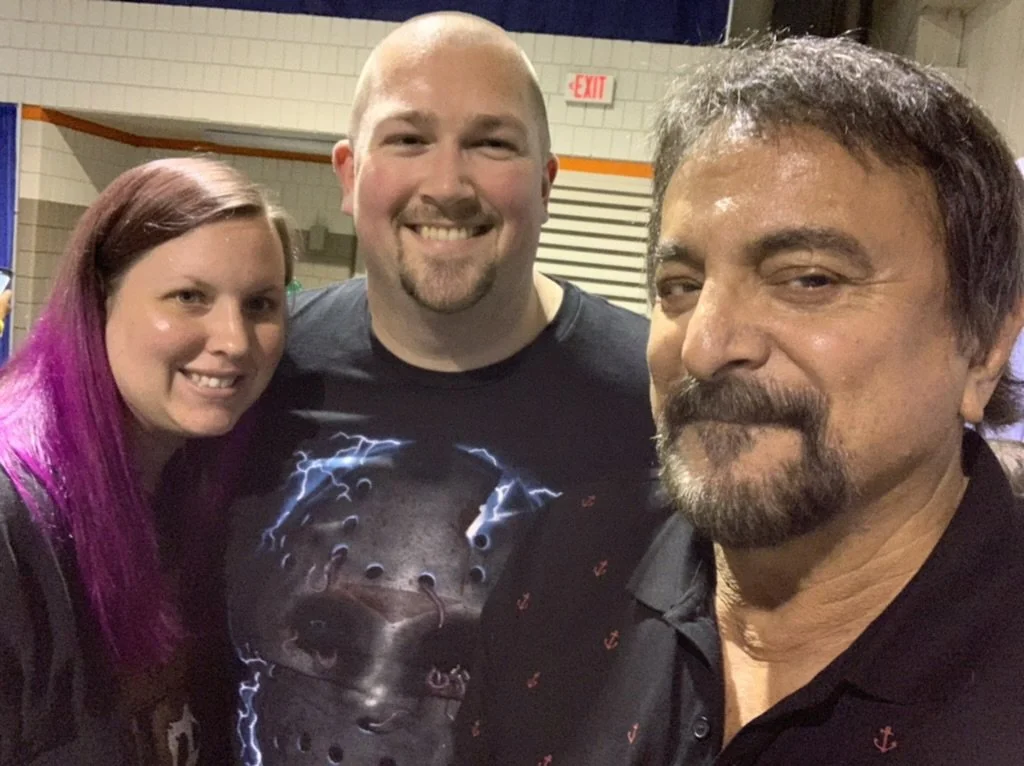
Ryan Verrill and Miss-Connected (above, middle and left) accompanied by horror icon Tom Savini at Kansas City Crypticon.
In the third part of my conversation with Ryan Verrill of The Disc-Connected and Someone’s Favorite Productions, we discuss highlights of interviewing filmmakers and industry specialists for his channel, along with launching and hosting the Shelf Shock Rewind Awards, an awards show celebrating the best of physical media.
You mentioned earlier that you brought Brad Henderson on as an early interview. How did you get to know Brad?
I think he had asked me a question about something else. At the time, he was sort of like the public persona for Vinegar Syndrome because they were not this huge company yet. They were certainly larger, but they were no Arrow Video or Criterion or anything like that. Brad was somebody that would come on and hype up releases that he had produced extras for or helped acquire, and he was going on podcasts and stuff, so I thought, “Hey, maybe he's accessible.” I just reached out and he was open to it. What's crazy is literally in the last two hours, I've been texting Brad. Nowadays, we talk on the phone frequently. I do so much for him, and it literally all started with those first couple DMs on Twitter.
“I love doing these interviews, and some of the interviews have created many of these professional relationships that my life would be very different if I had never done them”
With your interviews, you have this space to honour people and be genuinely interested in them, which I believe both the audience and your guest can feel. Do you have a set schedule for interviews?
I had a set schedule for posting them for the longest time. I really tried to keep myself to posting an interview and my live show every single week. Then I started working in this industry and it's impossible. So now, even as we speak, I've got six interviews completed right now. I have to find time to edit them, and that alone is intimidating to the point where I am stuck and can't get to it. It's not like I can do it while I work for the government, and when I come home, I'm doing things that I miss during the day, like catching up on calls and stuff like that. My schedule is just very, very full, but if I could, I would absolutely be posting one every single week.
I would do four or five in a span of a couple weeks and then get them all edited and scheduled to be able to go up for the next month. That was great, but now it's impossible. I love doing these interviews, and some of the interviews have created many of these professional relationships that my life would be very different if I had never done them. And it's led to being able to speak to some of my heroes and people that have inspired me for years, or even filmmakers that I've discovered in the last five years that have become some of my favourites, and I can have them on my show. It is not something that I ever imagined could happen, and I’m grateful that it's been able to develop to this point
Were there any interviews in particular that were really instructive or important in your journey?
One that I would point to is the interview I did with Error 4444, which is a boutique Asian exploitation-focused label. The two people that run the label are, to sound like an old guy yelling at a cloud right now, two kids that are 23 to 27 years old now. They just had an idea and ran with it. I think because I interviewed them so early in their cycle, they still had that sparkle in their eye about it. They were still in love with what they were doing and now they probably hate it all. That seemed to be a very inspiring episode. A lot of people watched that and fell in love with the company and with their passion for it, through the questions that I asked them and the way that I was able to frame that whole conversation.
“This filmmaker that I love is just a person with a family, and it’s okay to just have a normal conversation. That sort of broke down a lot of my mental barriers.”
One of the big ones was being able to have somebody like Sean Baker on the channel a couple times. I reached out to him, and the only reason I was able to talk to him and get a response is because he had followed me on Instagram. I don't pay attention to the followers or the counts or anything on these posts, but because it's Sean Baker, it always showed his name. So after a while, I was like, why does this name always appear at the top of the likes list? I clicked on it and went, “That's a very different thing…” I was like, “Hey, I don't know if you do stuff like this. I don't know if this is weird. Would you be willing to come on in for an interview?” And he went, “Yeah, of course. Let's do it.”
We got the timing done. Then, when we started the interview, I was beyond nervous. The first thing I said was, “Thanks for doing this,” And he goes, “I watch your show and I come to you for news, and stuff like that.” I was just starstruck in a weird reverse way. I was like, “What? You're Sean Baker. Why do you come to me?” That made a lot of the nervousness melt away. I found out through these conversations that he's just a dude. This filmmaker that I love is just a person with a family, and it’s okay to just have a normal conversation. That sort of broke down a lot of my mental barriers.
I've had filmmakers that I've loved that I never would have imagined would have said “yes” to things. I've made it a point to look for people that follow me because they get my messages. I've also got a friend on the ground in Los Angeles that goes to some of these events, so he's able to ask people and pitch the show and be sort of a producer. That has been a little tool in my belt that I can use.
It's been interesting to see what people respond to. I've seen a couple of these interviews where I'll have a huge jump in subscribers because it'll just hit the right viewers and it'll get shared with the right thing, or somebody that's involved in the interview will share. That's rare.
But a lot of the time, again, these interviews have a very engaged audience. People know that when they come on here, if they're from one of these physical media labels, that my audience is ready to purchase. And if you can talk about a certain release, they know that it's going to matter to the audience. If we're able to announce things on the show, it'll get the consumers hyped like crazy.
That has led to random things happening, too. On my live shows over the last couple years, I've been able to have surprise guests for a fifteen-minute conversation that I never imagined would happen. I've gotten people like Mike Hunchback, who is a producer of these discs, but a lot of people don't know him for that—they know him as the bass player for legendary punk band Screeching Weasel—and have him pop up randomly on my show. I don't even promote it. I'm just like, “Hey, we're doing our live show Thursday night with this random guest and he's a film professor. We're going to talk about this.”
And then I go, “By the way, surprise. Here's Mike from Screeching Weasel. Let's talk about Dirty Work for 20 minutes.” That is something that makes people say, “If I keep watching long enough, this random thing is going to happen.” It’s a really cool experience to be able to communicate with him live because we have the live chat feature. Again, it’s this very interesting dynamic of a channel that I've grown to love. I’ve fostered an environment of acceptance, but also encouragement. I'm still astonished that I get so few hate comments, that I get so few things that I've needed to delete over the years. I think on YouTube specifically, I've only ever had to delete five or six comments in five years. And to me, that's amazing.
“It's been affirming in so many wild ways that what we're doing behind the scenes is actually important and actually moving the needle a little bit and is actually changing people's opinions of these things in a way that I never dreamed possible.”
Yeah, absolutely. The Internet is such a negative and toxic environment a lot of the time, so that’s kind of unbelievable. But it’s fantastic that your space allows someone like Sean Baker, who is a celebrity championing physical media, to participate in the show. Similar to you, he values being respectful, open, and is interested in experiencing the world and championing and sharing in the delights of the world.
After developing the channel, the live show, and the interviews, where do you go next?
Because the people at these labels started to get to know me, the next thing that was a big milestone for me was the Shelf Shock Rewind Awards. Steven Billings from Chasing Labels, which is another podcast out there, and I were at the same time developing this idea for a physical media awards show. Some of these things will get announced, come out to a little bit of fanfare, and then two months later, it seemed like nobody cares. And some of these things are legendary releases that deserve way more attention than they're getting, so we were trying to think of an idea to highlight these releases.
Knowing that I cover all these things, he said, “Listen, you're super knowledgeable. I've got this idea. Would you ever want to work on a physical media award show sort of thing? I don't know how we would do it, but it's an idea I have.” I said, “Listen, I've got two full pages of notes that I've been trying to develop on this. Yeah, let's combine this. Let's get it done.”
So back in 2022, we spent probably six or seven months coming up with the idea, developing how we were going to do it, deciding what we were going to award, who would be involved, and all of that fun stuff. We decided to treat this as a legitimate award show, like an actual production, and do what we can to get it as validating as possible for these awards, but also validating for us that these are recognized awards at the same time. Not to champion us, but to make the focus on the physical media and keep us behind the scenes as much as possible.
That first year, I think we awarded 25 different categories of things. We reached out to get some people involved to talk about them and to record silly little videos announcing who was nominated and who was going to be winning the award. Stephen and I hosted, and it was incredible. It went over very well.
The following day, Vinegar Syndrome announced via email to everybody, “Hey, these two movies won an award in the Shelf Shock Rewind Awards on YouTube last night, and because of that, they're 50% off for the next 24 hours.” When I saw that, I was like, what in the world? Vinegar Syndrome just acknowledged that we exist. They acknowledged that the awards were a thing. That's crazy. It lit a fire in us to make the next year so much better that we were never going to be able to turn back.
“I have people all over the world doing introduction videos very professionally shot, some doing that from revered theaters in Ireland. I’ve got artists doing introduction videos, and I’ve got acceptance videos for literally almost every single award that I possibly could.”
The second year, Stephen’s wife gave birth, so he was like, “I'm not going to be able to host because I've got so much going on, but I want to help behind the scenes.” I got a different host, and we made this a real thing again. We gave things away. I decided to get some of these labels to do acceptance speeches. I wanted as many of these people involved as I could, so I got… not a lot of them, but Fran Simeoni from Radiance was able to say, “You're holding an award show, and I just got the best new label. That's so cool.” I was recording a video to get his genuine response, and you could see it in his face that it was validating. It meant a lot.
The second year went over even better, and then this last February was the third year. Man, I feel like I'm going to cry. I don't even know how to explain. This year was such a thing. I had my third new host that I've done this with now, and I had the cast and director from a film introduce the award show. I had three different filmmakers that I love be a part of the show and highlight their favourite releases from the previous year. I have people all over the world doing introduction videos very professionally shot, some doing that from revered theatres in Ireland. I've got artists doing introduction videos, and I’ve got acceptance videos for literally almost every single award that I possibly could.
It not only gets eyes on the channel and eyes on me just genuinely appreciating physical media, but every year, we get more of a response from the labels, like Severin announcing “We won seven awards last night. Here's the timestamps so you can go watch the portions where we won.” I've got Grindhouse Releasing sending out five emails saying “We're so proud that we won this award last night. Go purchase the disc because they said it's so great.” It's been affirming in so many wild ways that what we're doing behind the scenes is actually important and actually moving the needle a little bit, and is actually changing people's opinions of these things in a way that I never dreamed possible.
The only hard part here is, like a lot of what else that I do, it's 85% me doing it behind the scenes. It's a ton of work, and now I feel the pressure to upgrade it every year. I don't know what to do next year. It's going to be so much more work and it's only six months away. So here's to 2026 being even bigger, and hopefully I don't die in the process.
How do nominations for the awards work?
Each award has a list of nominations that received the most votes from the CSC [Creators Selection Committee]. The CSC is our Academy. They’re a group of label reps, podcasts, Youtubers, filmmakers, commentators, restoration artists, and more. All people involved in the industry or creating things in some way, shape or form. The releases that receive the most nominations from the CSC are listed, but voters are allowed to write in any nominations they’d like in any of the categories as well.
You're really creating this moment of excitement and legitimacy and honouring the work that they're doing. It's great to hear that the industry is embracing it and people are taking it seriously. I give you kudos for making it work.
“Even the people in the industry that are working their tail off to make these as good as they possibly can understand that without somebody highlighting these things, they’re just a blip in history.”
Thanks. It is so much work behind the scenes, and I still don't understand how this last one was pulled off the way that it was, but it's like, Joe Lynch was live in the YouTube chat excited about who was going to be winning. To me, a filmmaker like that being a part of it live is crazy. The second year, one of the people that has been most inspiring to me in this entire industry, Lee Gambin, was in the chat live as it was happening to see if he won some things, but also, he gave us compliments over and over. At one point, he even said, “You should do this every six months.” I laughed so hard and said, “My god. We could never.”
But it goes to show how important it is that these things need highlighting. Even the people in the industry that are working their tail off to make these as good as they possibly can understand that without somebody highlighting these things, they're just a blip in history. They're not something that is going to be held on to.
I don't know how many people are going back and watching the Shelf Shock Rewind Awards live stream from three different years, but I would hope that they would go back and say, “I just heard about this in 2026. Were they doing this earlier?” And when they find it was the fourth year, maybe they’ll go watch the one from two years ago and find out what releases were great that year. That, to me, is exciting. That, to me, is important. And I think it serves why YouTube is a really good platform for this, because as of the moment at least, they're not going back and deleting old videos. They're up there forever and people can stumble upon them and hopefully go make a shopping list and realize, “Damn, I missed out on this incredible release that looks like it was made for me, and it won four awards. Yeah, I need that thing.”
They’re kind of a work of genius in the ecosystem of what you're building because it adds that layer of legitimacy, and it collects so much information about the best releases for people. There are new people all the time trying to get into this hobby.
I hope so. Again, I don't pay attention to the stats, so it could be that nobody's watching them, but I really hope they are fantastic.
I know I've listened to them after the fact.
I'm proud of them. Again, the growth from the first year to the third year is… I don't even know how to explain it right now. I've got people writing comedy sketches to do the nominee videos, and I'm getting people that are, like, names, people with huge followings, and they're just like, “Yeah, I desperately want to be a part of this.” That is so fun and so exciting and makes it so much more real. So yeah, it's mind-blowing.
The conversation with Ryan Verrill continues in parts four through six.
In part four, we discuss how he started producing on-disc supplements and the boutique Blu-ray industry.
In part five, we discuss his magazine The Physical Media Advocate.
In part six, we discuss Ryan’s podcast network Someone’s Favorite Productions.
The next Shelf Shock Rewind Awards will be held February 15, 2026! Check out the previous Shelf Shock Rewind Awards on Youtube:
Watch Ryan live every Thursday on Re-Connected, and follow him on your social media of choice, including Instagram, to keep up with everything he does.
Ryan is the co-founder of Antenna Releasing, a distribution company “specializing in curated theatrical engagements, and robust, filmmaker-forward physical media releases.” Learn more about them here.
The interview was recorded using Google Meet in August 2025.
The transcript was edited by Matt Long of What’s the Idea Professional Editing, with additional copy editing by Anthony Nijssen of APT Editing.
All photos are the property of Ryan Verrill unless otherwise noted.