His history with cinema: What's the idea interview with Adam Lundy
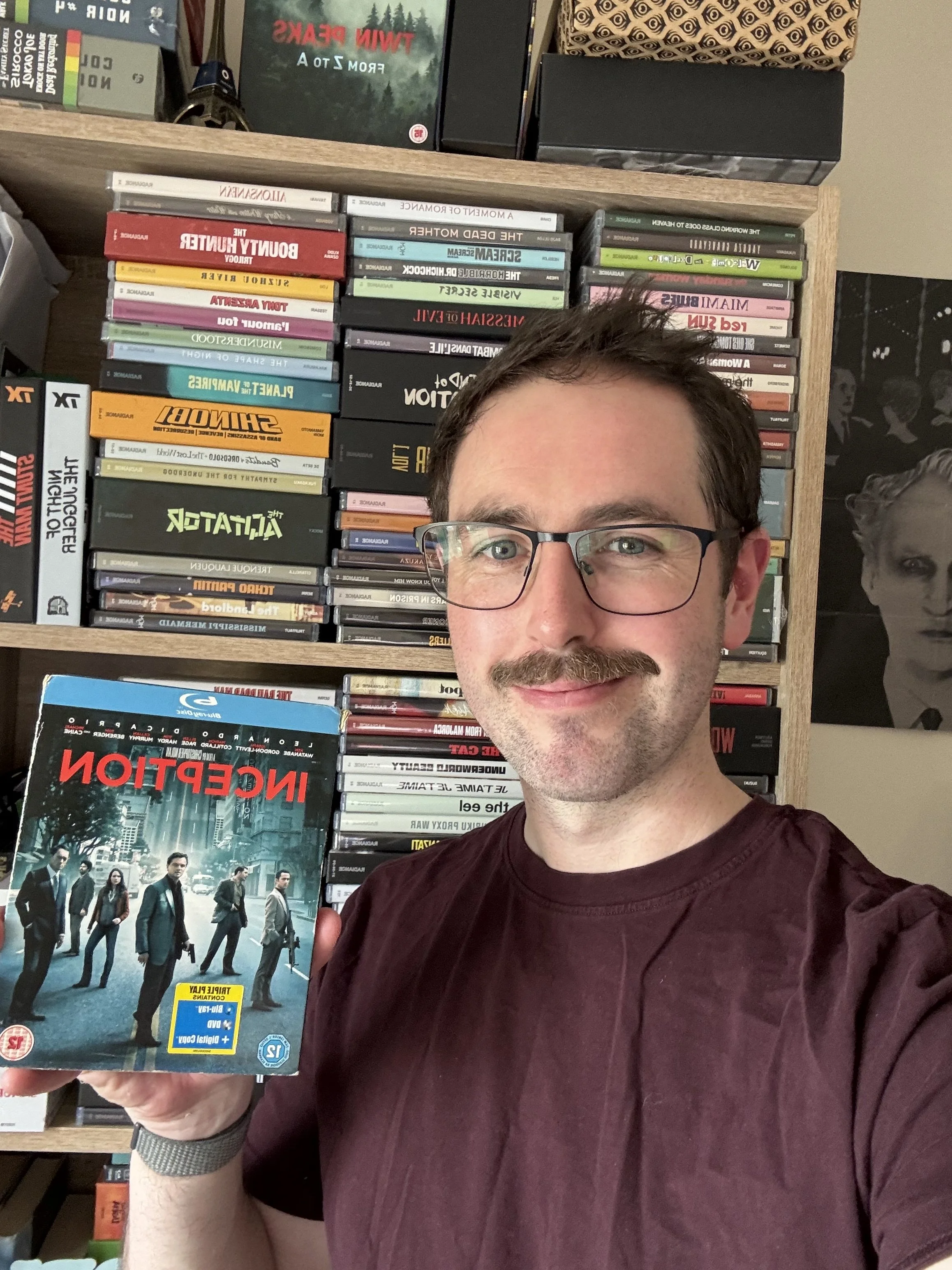
Adam Lundy (pictured above) is a podcast host, musician, cinephile, and acknowledged Christopher Nolan fanboy.
In this interview with Adam Lundy, the host of The Radiance Films Podcast, Histories of Cinema, and They Live By Film, we discuss Adam’s early interest in film and music, the excitement of collecting Radiance Films from the beginning, and the inspiration behind his new project, Histories of Cinema, with Chris Haskell.
Thanks for meeting.
No problem. The kids are asleep, the wife's asleep, so this is Adam time.
What part of Ireland are you in?
I'm down in what we call the sunny southeast. It’s not particularly sunny, just slightly more sunny than the rest of Ireland. I’m in County Wexford. I'm originally from Dublin, the capital, which is where all my family comes from. I spent summers up there with my grandparents, stuff like that, but we moved down here when I was a kid.
You’re close to Kilkenny. Did you go to the Neil Young and Bob Dylan concert in Kilkenny about ten years ago?
No. I wouldn't have been a Bob Dylan head at that stage of my life. I certainly would now, but back in those days, I was a bit too punk to go to a Dylan concert. I would certainly love to go back in a time machine and go now because I heard he sucks live these days.
I wholeheartedly encourage you to go, so long as you're prepared for what it is. If you want it to sound like he’s still in 1965, it might suck, but it’s a great show.
He’s one of those people where I'm like, I should go see him before he croaks. I am a fan, much to my wife’s chagrin.
When did you start playing music, and how did you get started?
I've always been around music. I spent a lot of time with my grandparents during summers and other times growing up. I'm very lucky to still have my grandparents on that side. My grandfather was a musician back in the day in a rock and roll band called The Kings. He played with some cool people. He would tell me stories growing up, and I didn’t know who these people were. He tells me the same stories now, and I'm like, holy shit, you played with the Kinks, or holy shit, you played with Jerry Lewis? What the hell, you played with The Big Bopper? You played with legends! So my early interest in music was through him. He was a guitarist.
I didn't pick up a guitar until quite late in comparison. I was maybe 13, 14 when I started getting lessons. I went to lessons for a couple of months, and then I just taught myself. I don't know any theory at all.
I self-released a couple of albums. They’re all off streaming now, but they're still on Band Camp. They're really bad, so I'm not even going to tell you what they're put under because I don't want you to direct people there. But I've always been into music, and all kinds of music as well. I'm not one of those people who has a specific genre and sticks to it. I just like good music, good songwriting.
What type of music were you into as you're getting into playing guitar?
When I actually got interested in music, like a lot of people in the 2000s, pop punk was my gateway into music and especially playing guitar. I was big into Blink 182, Fall Out Boy, Paramore, groups like that. Then I got into a bit heavier stuff like metalcore and post-hardcore as I got a bit later into my teens. At 17 or 18, I expanded my tastes with hip-hop, and I started listening to experimental stuff.
At that point, what I started doing was looking at lists of greatest albums of all time. That's where I started listening to the likes of Dylan, the Velvet Underground, the Beatles, Talking Heads, stuff like that. By the time I'd hit my early 20s, I listened to everything.
I do the same with movies, and that is one of the reasons why me and Chris [Haskell] are doing this new project. I like to peel back layers and try and find, where did it come from? What was the influence? You end up going back and back and back as far as you can go. That’s something that I generally do.
“It was like a switch just flipped inside me where I was just like, movies are my life now. This is what I’m spending my time doing. I’m going to watch. I’m going to learn. I’m going to film.”
When did you start to take exploring film more seriously?
My grandfather is a big influence there too. He's a big movie guy. When I'd stay with him, we'd usually end up watching something at night, usually just whatever was on. It's not like he had a collection of movies.
There are two moments that I can really think back on as watershed moments. One would be watching Psycho with my grandfather when I was maybe 12 or 13. I watched a lot of movies growing up, but I never watched them for more than just being entertainment. Psycho was the first grown-up movie that I ever really watched and cared about.
When I was about 16, the film that changed my perspective on movies was Inception. I didn't get a chance to see it in theaters, so I asked my parents for the Blu-ray for Christmas that year. I remember distinctly sitting in the living room of my childhood home, watching Inception, and the ending happens. I remember sitting there just slack jawed. It was the first time a movie made me sit down and keep thinking after the credits had gone. I literally just put it on again. It's the first time I ever watched a movie back-to-back since I was probably like a toddler wearing out my Lion King VHS.
When I say that was a turnaround, that was a huge turnaround. Within six months of that Christmas, movies were all I cared about. I started making short films with my friends on the weekends and during the holidays. By the time that summer came around, I had already started watching David Lynch. I'd already started watching Godard. It was like a switch just flipped inside me where I was just like, movies are my life now. This is what I'm spending my time doing. I'm going to watch. I'm going to learn. I'm going to film.
My dream was to be a filmmaker. That was what I was doing this for. I wanted to give someone that experience that I had when I watched Inception. Thinking about it now, it's crazy how much of a switch it flipped. It just became a hyper fixation that hasn't let go in the 16 years since then.
Was there a part of the film making process that you enjoyed the most?
Writing is something I always like doing. Even as a kid, before I was interested in film making, I thought maybe I was going to be a writer. I enjoyed trying to create a narrative structure. The films I was making at the time just heavily ripped off David Lynch and surrealist stuff. I was not breaking any new ground narratively in the stuff I was writing when I was 17, which is obviously not a shock to anyone really. I enjoyed editing, putting it all together.
The part I found tricky was the technical side. I was super lucky that we had a local filmmaker’s group, a youth group, in my town. There was a guy who works in the Irish film network who would run workshops for teenagers who were interested in making films. Despite the fact that I live in a really small town, it was based out of here, so I was super lucky that I had access to actual equipment when I was 17, like proper DSLRs with proper lenses, booms, all that stuff.
I was really privileged from that perspective, but you would draft someone to be your DP or your cinematographer, and we're both 17 with no formal training in this, so you and your other friends would have to try and figure out how to get something that I can see in my brain and translate that to what a camera can see, but not knowing what lenses to use, not knowing how to focus properly, not knowing even when you should be cutting to another shot, just complete novice stuff that you learn in film school.
I still have a DVD copy of all the films I made during that period. When I applied for the National Film School to go to college, the guy who ran the film youth group thought it'd be a good idea for me to have a show reel of the highlights of all my films, so he put that together for me. I haven't tried to play it in a long time, probably 10 years. I hope it hasn't gotten disc rot.
About 10 years ago, me and all my friends were over at my house. We were just drinking, just chilling out, and we're like, “We'll throw on all the old movies.” Some of them were not terrible. I did get into film school. They were really happy with my portfolio; it just didn't work out for other reasons.
Why didn’t you end up going?
I had to put it off because film school in Ireland is based out of Dublin. Coming from a small town to try and go to college in Dublin is tough because we don't do student loans. You either go to a college that's nearest to your town and live at home, or you have rich parents. So unfortunately, because of the geographical aspect of it, it wasn't going to work out. It's not one of those things where it's like my biggest regret is I didn't go to film school, because anyone can make a film if you have the equipment and friends to draft.
If you really feel passionate and you win the lottery at some point, or if Radiance limited editions become very expensive on the aftermarket, you can always sell the collection and make another film.
That would be great because I have them all from day one. I'm a Radiancehead. I really don't mean for it to come across like I'm a Chris Nolan fanboy, because I definitely wouldn't call myself a Chris Nolan fanboy, but he made his first film on the weekend with his friends, and it took him a year to do it. So, anyone can do it; you just got to put the effort in, and having a solid script helps too. I feel like the hardest thing really is to get a solid script that you can also film cheaply. If you can get that balance right, then anyone can make a movie.
Totally agree. And hey, I'll go on the record and say that, similarly to maybe your feelings around Nolan, Fight Club was a formative film for me, but I don’t hold that up with huge pride at this point.
Look, we all go through our phase where Fight Club is the greatest movie ever made. I think we've all been there, and also the realization that it's not the greatest movie ever made is also very relatable.
Nolan is important for exactly what happened to you. He makes great gateways between mainstream movies and more serious film. Of course trying to figure out how Inception is possible will throw the right person down the rabbit hole.
“I like peeling back layers and kind of get hyper fixated on things. The last few weeks, I’ve been watching through all the Zatoichi films. I watched one of them, so I might as well finish them while I’m here. I’ve watched 14 of them in the last three weeks.”
I'm sure a lot of people who got into films around the same time that I did probably did the same thing, which was you hear this magical term called mindfuck and then Google “top 10 mindfuck movies.” It's probably one of the most Googled questions from the 2010s. Everything in 2010 was about mindfuck, and that's what would lead you then to David Lynch and 2001: A Space Odyssey and to further afield like Jodorowsky and Maya Deren and stuff like that. Fight Club falls into that category as well. I found out about Fight Club because of a mindfuck movie list.
Jumping back to Psycho, that was a formative film for me too. I can vividly recall the first viewings of it in grade 6 or 7.
My favourite director now of all time is Alfred Hitchcock, so it's kind of a full circle to when I first watched Psycho and I didn't really know who Hitchcock was other than knowing that he existed. I've seen the vast majority of his films apart from the super early ones. They're just kind of studio for hire films he did that I just can't bring myself to watch because they sound boring as fuck.
I like peeling back layers and kind of get hyper fixated on things. The last few weeks, I've been watching through all the Zatoichi films. I watched one of them, so I might as well finish them while I'm here. I've watched 14 of them in the last three weeks.
Speaking of Zatoichi, your Zatoichi episode of They Live By Film was memorable.
Several episodes of They Live By Film are psychotic because of the matchup of films. The one that I always think of and always remember because it's just the most unhinged combo is Fat Girl and The Night of the Hunter.
We didn't really know each other when we started the podcast, so we learned about each other as time went on. We realized that we're three very different people in terms of what we like. We have a lot of overlap. Chris and I watch a lot of arthouse stuff that Zach wouldn't really be into. Chris and Zach watch a lot of extreme cinema stuff that I wouldn't really be into. And then Zach and I love slasher movies and film noir that Chris is not really into. So, we're all very different, but we all have these little overlaps. What They Live By Film ended up becoming, and what it's been for the longest time, was us taking turns of getting each other out of our comfort zones and watching stuff that we would never really have watched if we weren't being forced to do it.
Back to what we were saying about Zatoichi, Chris decided that he wanted to do an episode about Zatoichi, and he had the bright idea of choosing three random Zatoichi because they're episodic. I hated them and Zach hated them because we were like, “This Zatoichi dude, I don't really understand what his deal is. I don't relate to his character.” We had a guest on for that episode as well, The Fanatical Dragon, who I feel so bad for inviting onto that episode. He's a really great guy with a lot of amazing knowledge on East Asian cinema, and he was forced to listen to me and Zach shit all over Zatoichi for two hours.
I decided to start watching the Zatoichi films because of the new project that me and Chris are starting. I texted Chris halfway through the first one and I'm like, “These are good movies. Why did you make us watch these random fucking entries?” I actually really enjoy Zatoichi as a character now. So, if there is anyone reading this who listened to that They Live By Film episode and thinks that I'm a uncultured swine for shitting on Zatoichi, I'm sorry, but I'll put my hands up. I really like Zatoichi now.
We weren't necessarily breaking new ground with cinematic criticism on They Live By Film, but I enjoy our dynamic. Every episode was always a surprise.
I listened to They Live By Film thinking of you guys as basically the movie friends most of us don't have in our day-to-day lives. It's not as intimidating as some shows can be, and most importantly it was fun.
We had fun making it. I don't like talking in the past tense of They Live By Film. I guess I'll address the elephant in the room. We're not ending They Live By Film. We’re going on hiatus for a little while as we all work things out in our personal lives and get realigned. So, I'm talking in the past tense, but I don't mean to. It's just because we're on break. Chris and I have this new project that we're starting to fill the gap, not that Chris needs any gaps filled with his schedule. That dude is busy because he's on about 7 million podcasts.
I'm sure the guys probably do as well; I still have dozens of ideas for episodes of They Live By Film and themes that I want to cover, so I'm hoping we get back to it at some point. We just don't know when.
I was happy to see the Radiance Podcast come back after a hiatus. What made you a day one Radiance fan?
Chris had Fran [Simeoni] on They Live By Film. Chris did a lot of interviews with boutique Blu-ray companies. He has spoken to pretty much every major label apart from Criterion. He met with Fran just prior to Radiance launching, and he said to me, “You should check out this website. It's a new label in the UK, so obviously region B, you might want to check it out. Sounds like it's going to be a cool project.” I listened to the episode afterwards when I was editing it, and I was like, Yeah, this does sound like a really cool project. This guy came from the Arrow Academy line, and I had a lot of Arrow Academy releases, so seems like it'll probably be in my wheelhouse.
I remember doing the first pre-order. I think it was for Big Time Gambling Boss and The Working Class Goes to Heaven and then the pre-order for the Cosa Nostra box set. I never heard of these movies before, but they all sounded cool.
As announcements came on, I didn't set out to be a completionist or to do a podcast. I was just like, “Yeah, this sounds cool. I'll buy it. They're cheap.” Over in region B land, our recommended retail price for boutique Blu-rays is half of what it is over in the U.S. and probably even cheaper again for what it is in Canadian bucks.
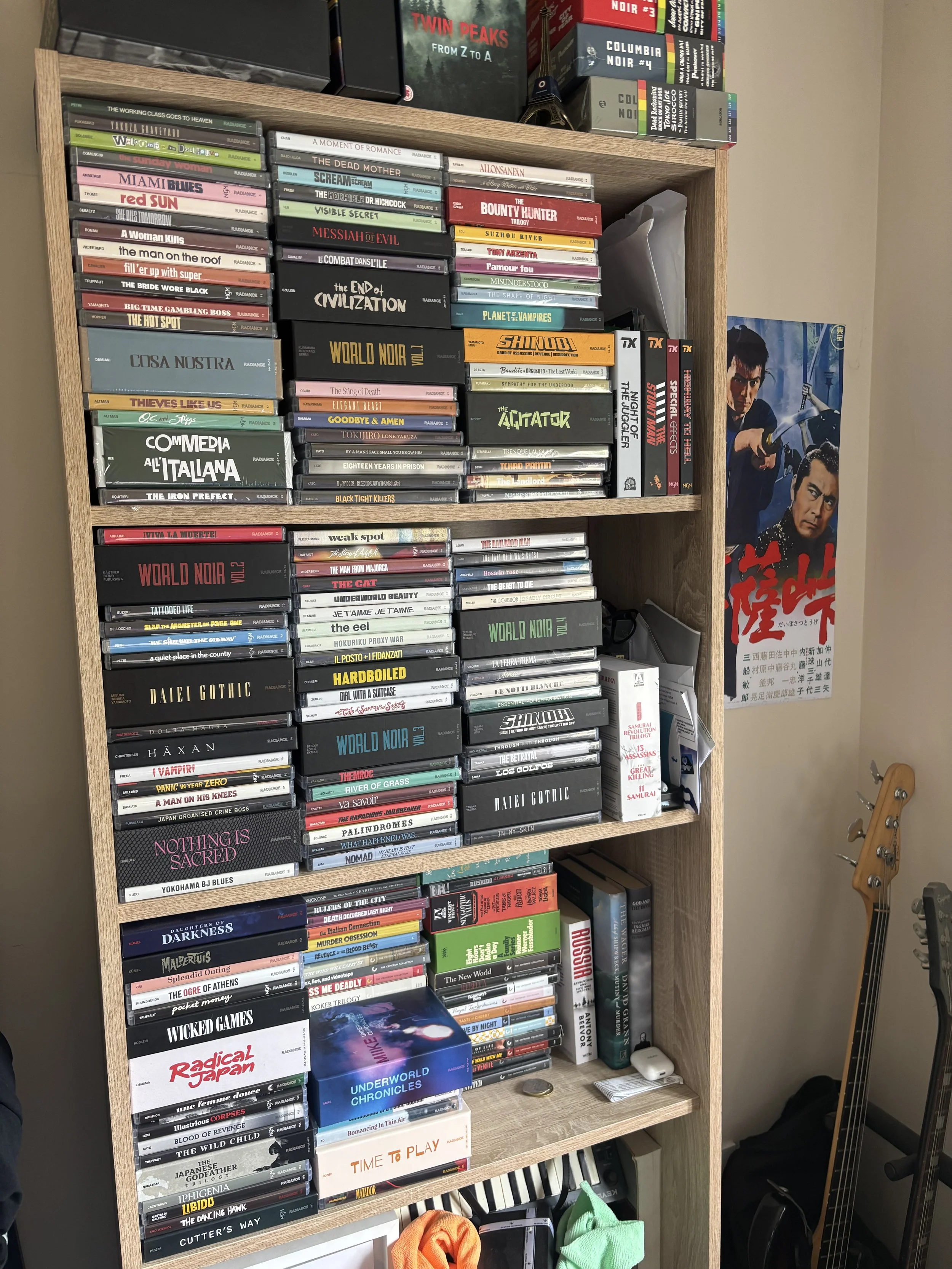
Adam’s complete collection of Radiance Films releases.
As more releases started coming out, I was like, it would be really cool if I kept buying these and became a completionist. I'll never be an Arrow completionist. I got into the game too late. This is a label where I'm enjoying what I'm buying, the stuff that's coming out is really interesting, and it's stuff I've never heard of before. This seems like a really cool project, so I'll keep supporting it.
How did the podcast start?
Eventually I had the idea that I'd start doing a podcast about it. I was really lucky that Fran came on to the first episode. Radiance have been as supportive as they can from afar. They obviously can't get involved from an official capacity, and I wouldn't want them to because I'd feel like that would compromise my own integrity when I'm reviewing or talking about stuff. They didn't come around to tell me to put unofficial in their title like some other boutique labels did, and they shared it on their social media pages when it launched. That was really great.
I still buy everything with my own money. I don't get screeners. Everything I review, I pay for with cash money out of my own hard-earned wages. So, my opinion is purely my own, and it is an honest one. There's plenty of stuff that Radiance has put out that was not my cup of tea, and I wasn't afraid to say, but I will always try and frame it in a way to say I didn't like this, but if you like this other thing, then you might like it.
Nobody told me being a dad is busy, so I had to take a break for about a year just for my own mental health. The big stressor for me at that time was getting guests. I put pressure on myself to try and get amazing guests because I had already gotten really great guests. I'm still shocked that I got to speak to Kim Newman. I think about that all the time.
A lot of the episodes I'm recording now are just myself. I don't need to worry about scheduling. That's allowed me to not stress about it too much. The only guest that I might reach out to is Fran to see if he wants to come back on at the end of the year.
I've been really grateful that there's been people that listen to the podcast that have reached out and commented on stuff to say, “Hey, we don't mind if you don't have a guest. We’re just happy the podcast is here.” Just hearing that feedback has been nice.
I share that sentiment. Is there a film in particular that you would love to see at the Radiance Treatment?
I've mentioned this a million times, and I thought we were going to get close to it last year, whether it's Radiance or anyone. Someone please, please for the love of all that is holy release Los Olvidados by Bunuel on a 4K. I watched that film in 360p on YouTube, and even then it was a masterpiece, but I need a 4K release. I said this to Fran in the very first episode of the Radiance Podcast, and he shot it down pretty quick. There's a lot of rights issues with a lot of the Mexican films. It was actually restored by the World Cinema Foundation a few years ago now, so there is a good print available of it.
Hopefully someone someday can release Los Olvidados. I would love if it was Radiance cause I think it fits their label perfectly, and I think they would do an amazing treatment.
It seems like the impossible releases are slowly but surely happening.
We got the news this week about Ken Russell's definitive vision of The Devils finally seeing the light of day. Nobody thought we'd actually get a full director's cut out into the wild. Seeing that this week, I think anything's possible.
What inspired your new project?
As I alluded to earlier, Chris and I wanted to do something to fill the void. It started as, what are me and Chris going to do on They Live By Film to fill the time while we're waiting to get all our schedules right? We initially said maybe we'll do a director series like we’ve done before. But we needed to kill more time, so I said to Chris, maybe we'll do a Kurosawa series or something.
Then at the start of the year, I started reading this book called What is Japanese Cinema? By Yomota Inuhiko. He's a Japanese film historian. It’s a brilliant book, and I was reading it going, this is so interesting. It talks about what was happening in society and in culture as to what was causing certain movies to get made, what was the knock on effect and stuff. It was a real deep dive, so I said to Chris, “Wouldn't it be really cool if we did a series looking at the history of cinema in a particular country? Maybe Japan would be a good idea.”
We didn’t want to change They Live by Film again because we keep changing the format all the time, and what we want to cover in this series is not the same as what we've been doing. We’re not doing film reviews in this new project. If we don’t want to change They Live By Film, why don't we just start a new podcast and start fresh with a clean slate?
“It’s called Histories of Cinema, which works in two ways... We’re talking about the history of cinema, but its histories. We’re going to be looking at countries, genres, movements, and tracking the history of those.”
We'll approach it differently. We're not going to bullshit about football for 20 minutes at the start of the episode. We're going to actually approach this as a serious topic. Not that it's going to necessarily be strictly academic, per se, but we're gonna approach it a bit more seriously and do lots of research, watch lots of movies. Chris said, “Yeah, let's do it,” so we're starting a new podcast.
Literally 20 minutes before I started doing this interview with you, we recorded episode zero, which talks about the podcast, what the idea for it is, and what the plan for it is.
What’s it called?
It's called Histories of Cinema, which works in two ways for me because it's very obvious by the title what it's about. We're talking about the history of cinema, but its histories. We're going to be looking at countries, genres, movements, and tracking the history of those. It’s also a pun on the Godard film Histoire(s) du Cinéma. Chris wanted to call it that, and I said, “No, that's way too pretentious. People will think it's a French podcast. We can't do that. Let's just translate it and that'll do.” It works for people who are a bit more in the know, but it's also obvious for people who aren't in the know.
That's going to be starting very soon, so episode one or whatever may have already come out, but at the time of recording this interview, episode zero is up, so check that out. It's only a few minutes long.
What can you share about how you're approaching it?
It’s going to be season by season, which again is something a little bit different than what we normally do on our other podcasts. It would be recommended that you start at episode one and listen through, because we're essentially going linearly through history. Each season will follow a new country or a new genre or a new movement.
As I may have alluded to but not have explicitly said, season one is covering Japan. We’re starting in the ’20s when narrative film making became an actual art form in Japan. The reason we chose Japan is because it's an entirely unique cinematic history due to how insular and how specific Japanese art is, from its relation to theatre and woodblock carving and its relation to painting. That relationship with cinema is so different to any other country, especially in the West, that it just seemed like the most interesting starting point to go with.
We’ll talk about each era using foundational films. We will still be name dropping specific films in each episode, but rather than reviewing them, we're more so using them as a jumping off point to talk about what was going on in a wider context.
We do plan on having guests on as well, kind of special guests who specialize in particular areas of Japanese cinema. Chris is very seasoned in the guest getting field.
That's the new project. I'm really excited to do it. We want to provide information, context, history, and knowledge that can help people who are either somewhat familiar or maybe people who are completely new to Japanese cinema and provide them with as much context as they might need to enjoy what they're watching.
When I first started watching Japanese films, because so much of it is so hyper specific to Japanese history and culture, it can be very daunting, especially when you watch period pieces. Even now I'm Googling stuff going like, what do they mean by this? What does that term mean? They're just throwing it around willy-nilly, but what does it mean?
Totally makes sense. I'm participating in the Shaw Project with Chris, where we’re watching a bunch of Shaw Brothers films, and I know more know knowledge would help. Plus with you and Chris’ passion for film, this project seems like a great idea.
We're both really stoked. Alongside it, we're going to launch a completely free Substack. If you’re on Substack, you can subscribe. We're going to be using that as a platform to talk about what we're watching in the lead up to episodes. I always find, especially when I listen to podcasts, I like when I'm given heads up on what the topic is going to be so I can be a bit informed about it. We can also provide some additional nuggets of information that will be supplemental to what we discussed on the podcast.
I'm almost going to be using it a bit like a diary, cause I'm doing a lot of prep for this. I'm watching a lot of films. At the moment, I've watched 181 movies so far this month. Out of that 181, 93 of those have been Japanese films. A handful of those are Radiance, so not related to this project, but the vast majority of those were to prep for this project.
You're putting the work in, and I appreciate that you’ll get me to finally finish stuff like the Silent Naruse or Silent Ozu boxes, so it will be great to get the context and understand them better than I would otherwise.
Dude. Get ready to crack open those sets. Silent Naruse has been a real eye opener for me this year. Both Naruse and Mizoguchi are awesome. Ozu is an interesting guy. We'll obviously get into him a good bit on the podcast because he's such a stalwart of the first 50 years of Japanese cinema. But Naruse and Mizoguchi, I love those guys. They are so interesting to me.
Thank you for that preview of Histories of Cinema and your time. I really appreciate it.
It's been a real pleasure being here, I really appreciate you taking time to talk to me.
Thanks for reading this interview! Listen to Histories of Cinema and The Radiance Films Podcast (both part of Someone’s Favorite Productions).
Check out more interviews from the what’s the idea interview series.
The interview was recorded using Google Meet in May 2026.
The transcript was edited by Matt Long.