Documenting terror in “20/15”: What's the idea with Peter Midgley (part two)
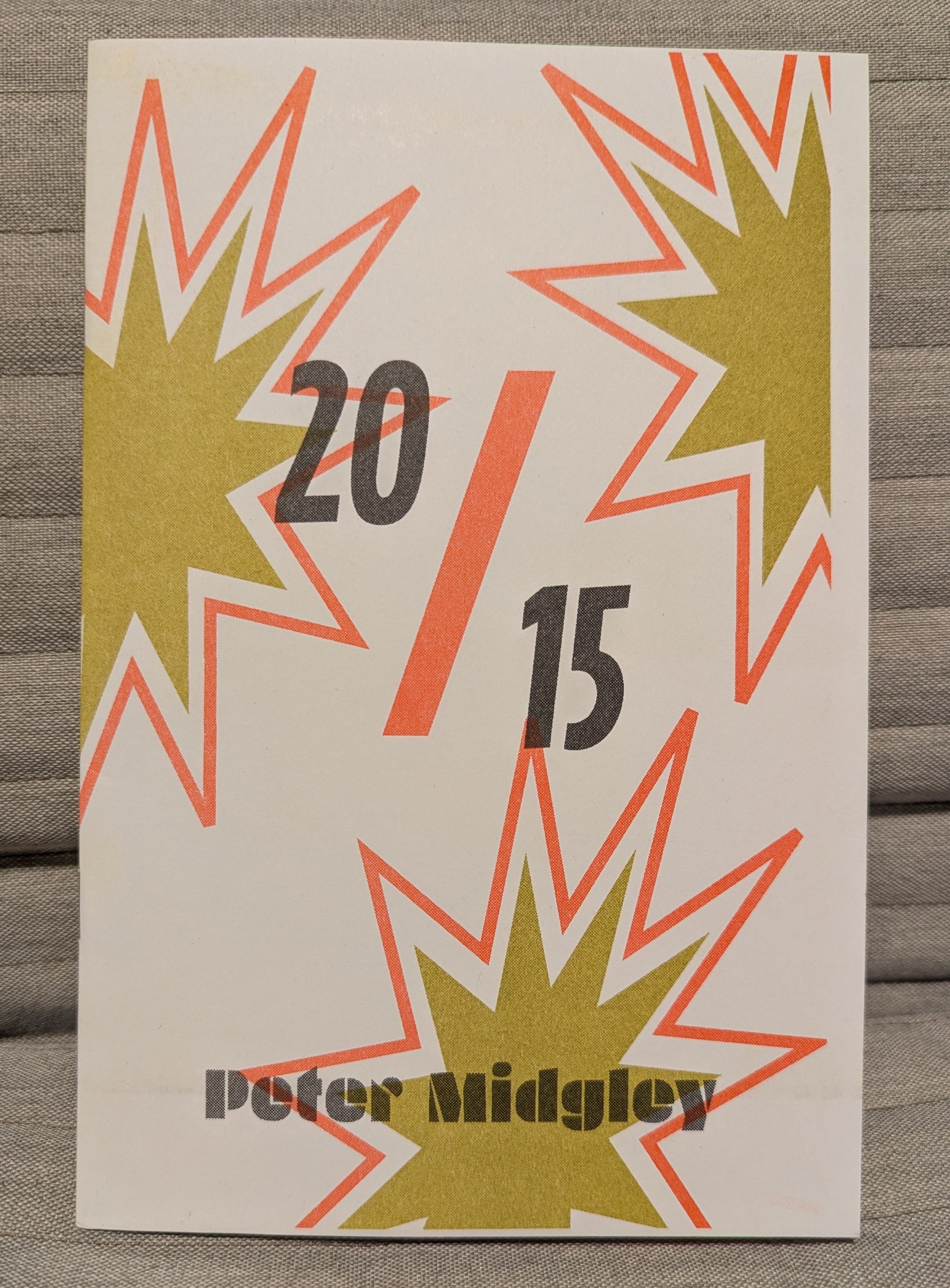
Peter Midgley’s chapbook 20/15 (pictured above) examines how violence, and specifically acts of terror, is documented and discussed through media and lists. (Photo credit: Matt Long)
In part two of our conversation, Peter Midgley and I discuss the process of writing 20/15, Midgley’s powerful examination through poetry of what is, and isn’t, considered terrorism when examining violence.
You mentioned in the first part of the interview that 20/15 was a significant work for you. What inspired you to write that book?
It started after the Paris bombings in November 2015. It seemed like a year in which there was just an extraordinary level of violence happening everywhere, and I thought, okay, let me catalogue this.
“Slowly, things emerged, like who is or isn’t a victim? What words do we use to talk about violence? What is not considered an act of terror?”
So, of course, I did the obvious, and looked at what Google and Wikipedia could provide as a starting point. There were lists. In fact, if you put it all into a Word document, we're looking at about 120 pages’ worth of material. I went, wow. It was all very formulaic: On this date, this happened, so many were injured, so many died. It's all reduced to statistics and most of these lists are written in the passive voice to avoid assigning responsibility to those actions.
Slowly, things emerged, like who is or isn't a victim? What words do we use to talk about violence? What is not considered an act of terror? I was building on these things that I noticed.
What did it feel like to immerse yourself in that subject matter?
Anytime you deal with topics like genocide or extreme violence, it is triggering, and it is obviously a traumatic experience. It affects you deeply when you're working with these things. As it should. And I must say, I got to a point where I looked at the raw material and thought, I can't do this. So I abandoned the project.
But it kept coming back to me, so by early 2016, I was back at it. I had to find a way to distill something else from it, and the poem morphed out of that. I'd finished it by early 2016. Since then, I've obviously worked and refined and polished things. But essentially, it was written by 2016, and I started looking for venues to publish it.
How did audiences or readers receive the work?
I performed the whole thing on stage at an event in 2018, and a few times since. Initially, there’s a shocked silence at the end of it, and then, wow, yes, we really need to talk about this, and the discussion flows. It's been a very positive experience performing it in front of audiences, because there's no doubt it's hard-hitting, but it does leave people thinking. That was the goal.
Every year it feels like it's increasing in relevance, for me at least. 2015 may be 11 years ago now, but it's not gotten better.
I imagine hearing this work read live would remind me of the effect of Gregory Corso reading “Bomb” live or Allen Ginsberg reading any of his epics, how their works can be an assault of words to create a feeling.
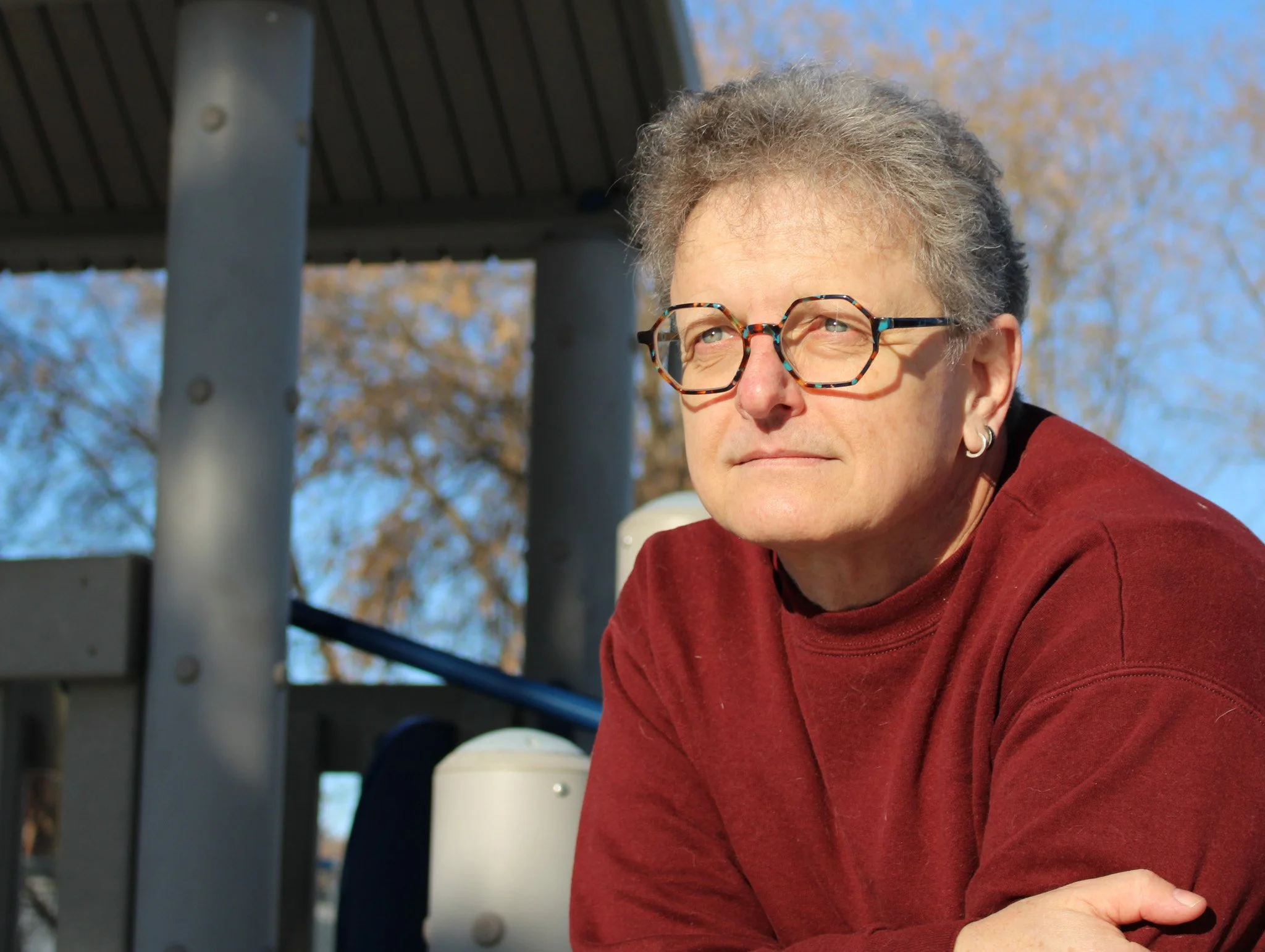
Peter Midgley (pictured above) believes “you cannot remain silent, however you do that. For me, writing is a way of speaking out. Hopefully my words do move people into action.” (Photo credit: Marlene Wurfel)
I'm flattered that you compare it to Ginsberg and Corso. Yes, it's that assault that is needed. You need to pound it in.
How long does it take you to perform?
Between ten and twelve minutes.
As you were getting the book to its final form, were there any major changes to the work? How did you decide on the book’s unique format?
The look and feel of the chapbook is all Matthew Stepanik at Agatha Press. I explained my vision and he did the rest. For my part, I looked at what was not said and tried to imagine how we could make those stories visible. Here's what we acknowledge, and then there's all of this material on the outside. For instance, we do not consider any school shootings to be terrorism, so how do you bring those into the conversation? These are things that sit on the periphery, yet they just push in and pressure everything that you're saying. So, I looked at that and thought, I have to find a way to make this press down visually on the text that is there. It needs to intrude. We need to become aware of these things.
If we look at the recent murders in Minneapolis, Renée Good’s murder happened metres away from where George Floyd was murdered. It's not historical. It's very real. History comes back at us, and that's part of what I'm trying to do here. We can't ignore George Floyd. We're barely mentioning him, and yet the spectre of George Floyd hangs over it all. It's these things that are not mentioned as acts of violence that hang there on the periphery that eat at me; I wanted to bring them in and say, let's make them part of this conversation. Matthew found an inspired way of putting the vision in my head on paper.
“All these lists were clearly produced from a U.S. perspective... I started looking at that and said, let’s turn that gaze a little, because any attack or any violence that happens within the United States is never considered terrorism. ”
Your work and its message have increasingly gotten more relevant.
None of this is improving, but at the same time, what you discover as you read the catalogues of violence is the high degree of passive voice that is used because nobody wants to accept responsibility. A lot of what I was doing was trying to maintain the neutrality of the language but also to make it active. These are emotional moments, but I let it stand in that same neutral language rather than try and wrap it in poetic language, and I just turned it into an active rather than a passive voice so that they are now actors.
How did looking at this global violence from the perspective of Canada affect the work?
I was looking globally to start off with because we're all affected by global events, but all these lists were clearly produced from a U.S. perspective and are very much written looking out from there. I started looking at that and said, let's turn that gaze a little, because any attack or any violence that happens within the United States is never considered terrorism. No school shooting or attack on a Black person; none of this is considered violence or an act of terror. Yet if you look at that definition of domestic terrorism at the beginning, much of it fits with the definition of domestic terrorism. That plays into it.
None of the drone attacks that the U.S. perpetrates on any other nation is considered an act of terror on the people who are there. I was hoping to turn that around and say, let's focus on the U.S. because they carry this violence.
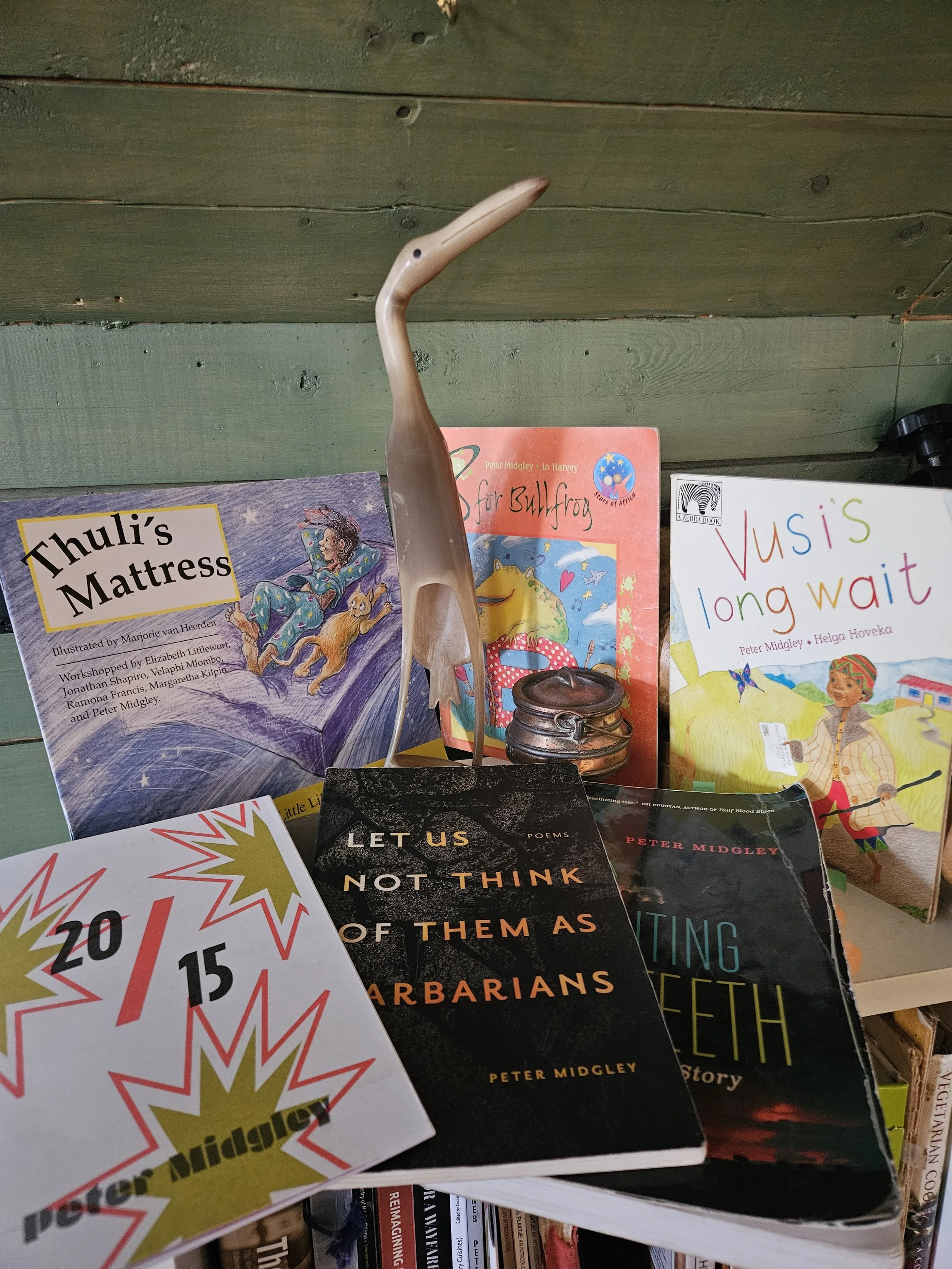
The diverse collection of books written by author and editor Peter Midgley. The bottom left book is 20/15, a chapbook examination on the violence that occurred in 2015. (Photo credit: Peter Midgley)
Part of what I'm doing here is trying to draw attention to look at who's not mentioned. We mention certain victims, but we don't mention other victims, right? Who does not get mentioned? This is why I often bring in children's verses, because you'll have a casual mention of a tricycle that was blown up. But when you think about it a bit more, you go, wait, if there's a tricycle, there's a kid. But no one mentions this. I wanted to show the human side of things. Make the victims of this violence more than statistics. These are not bland individuals. These are people with families.
Is there any thought of doing another book, something based on 2025, for example?
I wouldn't know where to start. I don't know that I want to go down this path again myself. But I think it is necessary.
The question might be slightly misguided in the sense that you seemed to identify a unique moment, in 2015, when things did change.
It felt like that to me at the time, and there's no doubt in my mind we're facing another major shift. I have thought about it, but I haven't thought how you would approach it, because you'd have to do it differently. I can't do a repeat of this. So yes, the thought is there, but I have no idea how I would go about it.
How do you feel now about 20/15?
I think it's still relevant, and I am just delighted that Matthew at Agatha Press took it on after a decade of looking for a home. I think the timing ended up being serendipitous.. The fact that it is out there now is an important statement. It is important to me because I think it says something that's highly relevant to where we are now. It's not comfortable hearing it, but it needed to be said.
The question, of course, is what do you do with this information now that you've read it?
“Silence is not an option, and we need to respond wherever and however we can to make a contribution... As writers, we can address difficult issues in our writing. As editors, we can shape what others say.”
I'll call myself out as a person who needs to do more to speak and stand against the violence and fascism happening in the world. This is a pivotal moment.
Future generations are going to look back at our silences. And if you are silent, you need to be able to tell those generations why you were. Silence is complicity. It's a pretty clear choice. As far as I'm concerned, you cannot remain silent, however you do that. For me, writing is a way of speaking out. Hopefully my words do move people into action.
With the urgency of what you just called out, is there anything you do or recommend doing right now?
Silence is not an option, and we need to respond wherever and however we can to make a contribution. This may mean a physical presence at protests; it may mean speaking up in public if and when the opportunities present themselves. As writers, we can address difficult issues in our writing. As editors, we can shape what others say: do not pass over racist or homophobic or any other questionable content. Question biases, call out fallacies, inaccuracies, misrepresentations, and racism in the writing. Writers and editors are not without agency: speak up.
Look at the book banning that is happening in Alberta right now. That's not directly related to violence, but it is a form of violence on LGBTQIA++ bodies, so I speak out about it. We need to think about and broaden how we define violence and what we say about it. You have to make use of these opportunities.
Thank you for sharing that call out. I think that is very important to hear right now. And thank you for taking the time to talk with me.
My pleasure.
Thank you for reading this interview!
Order 20/15 from Agatha Press, or ask for your local bookstore to order a copy.
Learn more about Peter Midgley via his website.
The interview was recorded using Google Meet in February 2026.
The transcript was edited by Matt Long of What’s the Idea Editing.