Celebrating Westerns with “Tumbleweeds and TV Cowboys”: What’s the idea with Hunter Robinson
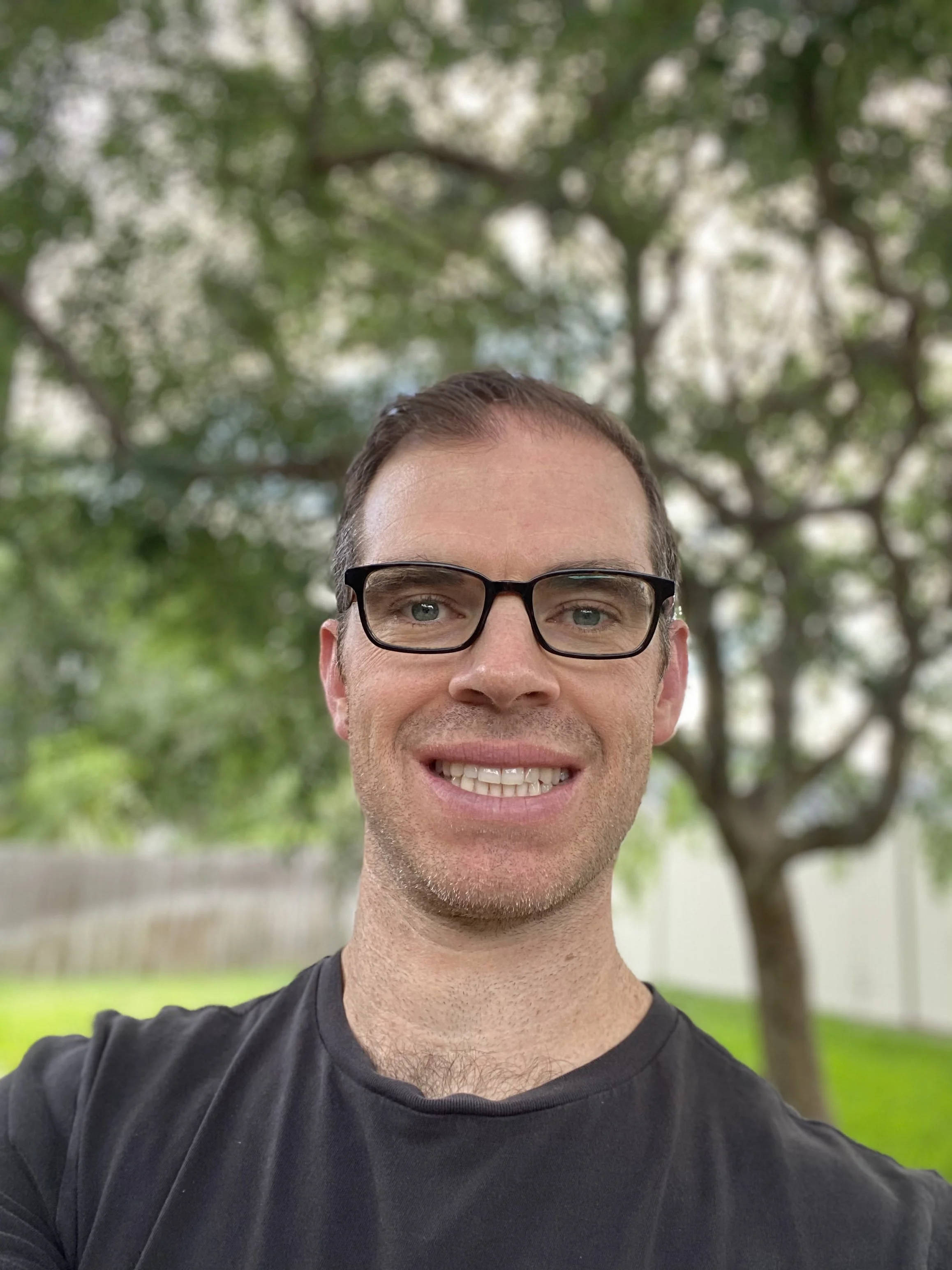
Hunter Robinson (pictured above) is the host of Tumbleweeds and TV Cowboys, a podcast dedicated to classic Western films and TV shows, dedicating multi-hour episodes to the many under-discussed Westerns.
Hunter Robinson and I met to discuss his show Tumbleweeds and TV Cowboys, exploring his lifelong love of Westerns, how he produces his heavily-researched show, and the love of collecting physical media.
Thank you for meeting today.
I'm happy to be here.
What made you decide to start Tumbleweeds and TV Cowboys?
I've been a fan of Westerns as far back as I can remember. I grew up watching a lot of Westerns, especially with my two grandfathers. Both of them served in the military, so we watched a lot of war movies and a lot of Westerns. I was way more into the Westerns than the war movies, which I still am not a huge fan of, especially classic World War II movies. I did take a break from Westerns for a while. In my 20s, I got really into horror movies.
“If it wasn’t for Someone’s Favorite Productions, I don’t know if I would have looked into starting a podcast... I wanted something where there was already an established workflow.”
In my early to mid-30s, Westerns became very nostalgic, very much a comfort food for me. When my first daughter was born, I started having way less time for movies, so I started sampling all these classic Western TV shows and getting more into those.
I also love movie podcasts. There are a couple Western movie focused podcasts, but there aren't that many. And there wasn't one like what I wanted to start, which would focus on movies and TV.
Our mutual friend Ryan Verrill has a podcast network, so I messaged him and was like, “Hey, I'm thinking about starting a classic Western podcast.” We talked, and he said, “If you do this, I'll have it be part of the network.” I scheduled my first recording maybe two weeks after that.
How did joining Someone's Favorite Productions help you feel ready to podcast or able to pull this off?
If it wasn't for Someone's Favorite Productions, I don't know if I would have looked into starting a podcast because I didn't want to put a whole lot of time into the front end of having a podcast, like looking into different places to post, different ways to record, and stuff like that. I wanted something where there was already an established workflow.
What era of Westerns were you watching with your grandparents?
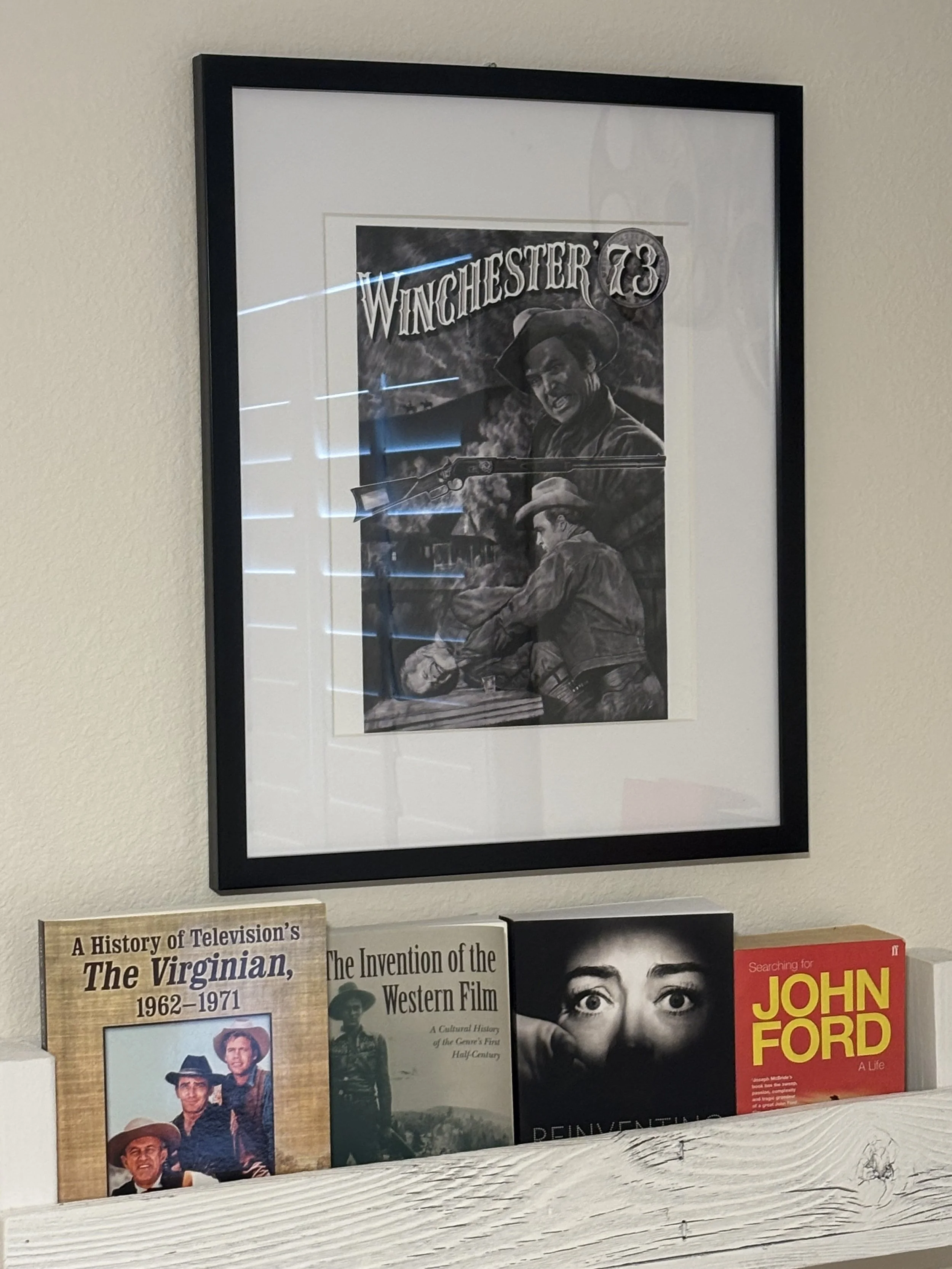
A glimpse of Hunter’s physical media collection.
I would say really the ’40s through the ’60s .We did watch movies from the ’30s, the obvious ones like Stagecoach and Dodge City. We didn't watch very many B-Westerns, like we didn't do Roy Rogers or Hopalong Cassidy or whatever. It was really the big ones. Tons of John Wayne. Definitely the Jimmy Stewart/Anthony Mann movies. Randolph Scott a little bit. We didn't watch him as much, although one of my grandfathers was a huge Randolph Scott fan. They didn't do Sam Peckinpah. We probably watched Ride the High Country, but my grandfathers did not go for The Wild Bunch. That was too much for them.
Was there a movie back then that really connected with you?
This is not a huge title, but when I was a kid, the first Western that really grabbed me was The War Wagon. This is a John Wayne movie with him and Kirk Douglas, and it's got a lot of action, and it's got a fun tone to it. It's fast-paced. That was the first one where I was just like, I could watch 40 of these right now and love it.
When I was in my teens, The Searchers became my favourite movie. When I was a kid, I had a transitional period from movies I liked when I was, let's say, 10. In between 10 and maybe graduating from high school, I was also really into film noir. I was watching a lot of Humphrey Bogart movies and classic Hollywood in general. My parents mostly watched classic Hollywood movies. For my dad, it was ’30s and ’40s comedies. He loves Bob Hope and Abbott and Costello. I didn't grow up watching anything new. It was very rare that I saw a new release.
How do you go about picking titles to cover for the show, and what do you do to prepare for each episode?
Choosing the titles to talk about just depends on the guest. For example, Will Dodson was on Ryan’s live show Re-Connected, the physical media announcements show, and he said, “If anybody out there wants to talk about John Wayne movies, I'm all in.” I emailed him right away. and now we're going through John Wayne's filmography. We started with The Big Trail, his first starring role, and we did an episode on his B movies, and the next episode we're doing is on The Shepherd of the Hills from ’41. With Will, it's whatever John Wayne movie is next on the list.
“People also want to do the biggest movies, and I’m kind of avoiding that. I really want to try to get into more movies that are maybe underseen or talked about a little bit less. I probably wouldn’t do an episode on ‘The Wild Bunch.’”
If someone is a little more into cult movies, there's a very good chance they are going to pick a Spaghetti Western. Some people are into TV, which is a very small percentage of the people I talk to, but I am finding more people who want to talk about old TV shows. A lot of guests want to do ’50s psychological Westerns, that era.
People also want to do the biggest movies, and I'm kind of avoiding that. I really want to try to get into more movies that are maybe underseen or talked about a little bit less. I probably wouldn't do an episode on The Wild Bunch, unless it was somebody from that production, assuming there's people that are still around. Only if it was somebody who really had information that hasn't already been presented, because sharing your opinion or analyzing The Wild Bunch has been done to death. I would rather choose a Rory Calhoun movie from the ’50s, something lesser known.
One of the most interesting things about your show is how academic it is, which must be intentional.
Very much. To prepare for an episode, I'll usually watch the movie twice. If there's a commentary track, I'll listen to that. There are different blogs and websites I'll use to read up on the movie. One of them is TCM.com. Every movie has articles and reviews, and some of them are from the late ’90s or early 2000s, from people that I've never heard of. These people are writing about them in ways that I'm not seeing from people who are writing more currently, so I like to use them as a resource.
There are people who have been on the show who I will ask questions of. There's a guy named Henry Parke, and he wrote a book called The Greatest Westerns Ever Made and the People Who Made Them. He knows the genre so well. I can say, “Hey I'm reviewing this movie, and you've actually interviewed this actor. Can I ask you a couple questions about him?” He’s so happy to talk to me about it.
There's another guy named David Lambert, and he's been on maybe four episodes now, and he's like Henry Parke, but he also knows the real old west history as well. He's an awesome resource.
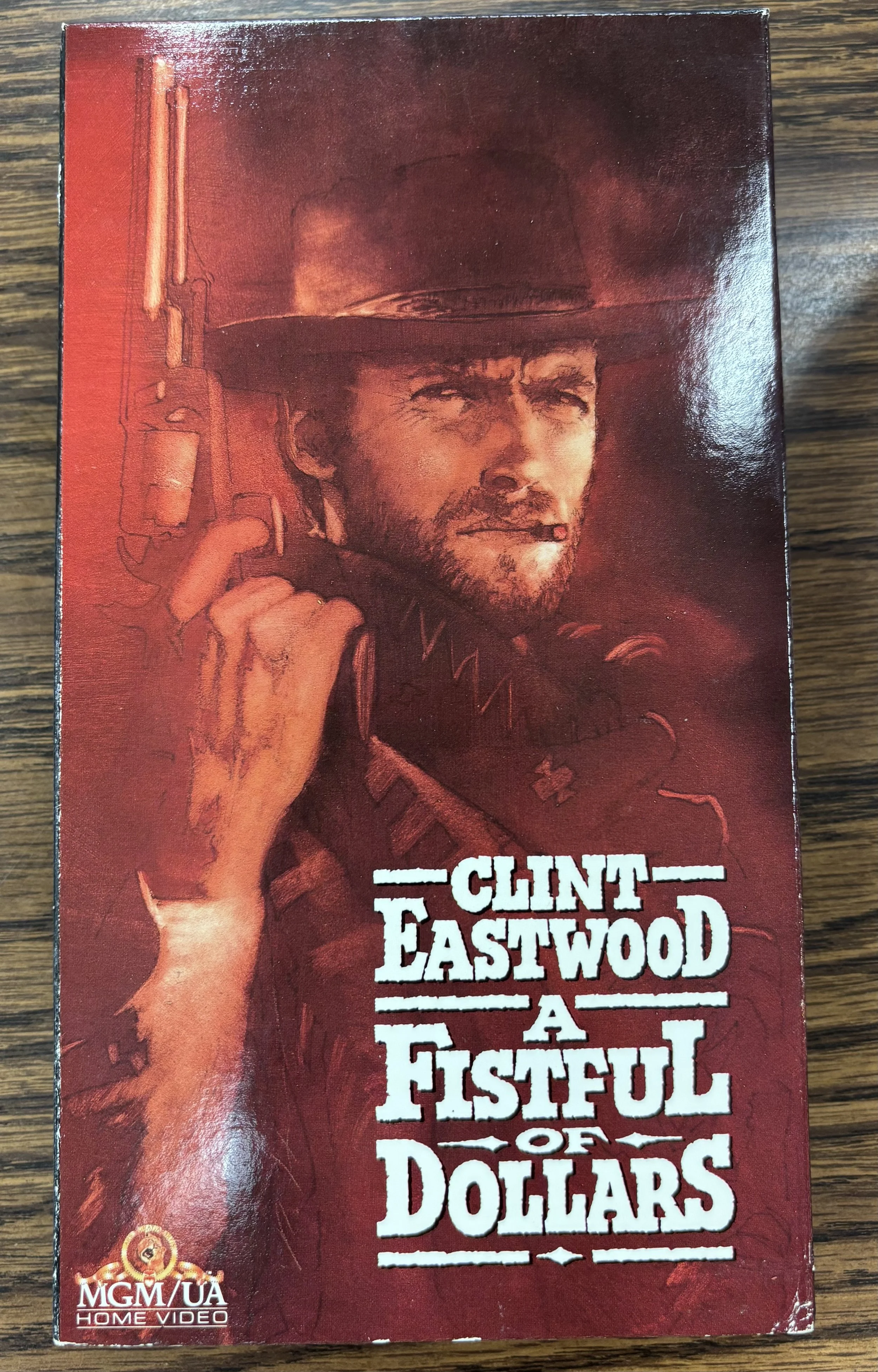
A VHS copy of Sergio Leone’s A Fistful of Dollars, recently acquired by Hunter Robinson from a local library.
This is true about film in general, but one of the specifically interesting things about Westerns is the number of angles that you can look at them through. You can look at them through the lens of American history and how it does or does not reflect reality, or the actors, or the directors, and so on.
Absolutely. I think that's one of the great things about the genre. One thing that I try not to do that I know a lot of Western viewers do is focus on watching it through a modern lens. I really try not to do that. I know there’s going to be issues with the movies based on the era they were made.
I watched Unforgiven recently, and from that disc I watched my first classic Western TV show, which was a Clint Eastwood-starring episode of Maverick. I don't think I'm going to watch all of Gunsmoke anytime soon, but it was really entertaining. It's close to an hour long, which is very similar in runtime to the great Budd Boetticher films.
I love just getting these small stories. I've been going through Gunsmoke, which has its ups and downs and the limitations of being television in 1955 and ’56. But there are some TV episodes of series that I think are just fantastic. I did an episode on Sam Peckinpah’s episodes of The Rifleman, and some of those episodes are awesome. He was a co-creator. There's a backstory to why he's not actually credited as a creator, but I think he wrote six episodes and directed maybe four of them. They're really good. Peckinpah also created a series called The Westerner. I think any Peckinpah fan would enjoy that.
With TV shows, there's as much or more variety as there are with movies. There's going to be stuff like Bat Masterson, which is almost more of a kids show than Gunsmoke is, but it's almost like The Avengers, the British series. It has a weird quirky camp element to it that I think is pretty fun.
Rawhide is just cattle drives basically. There's more to it than that, but one thing that's nice about Rawhide is a lot of it is on location. Gunsmoke can be very stage bound, and sometimes you just want a scene where, for no reason, you see somebody riding on a horse somewhere, just to get out of these sets.
You did that excellent early episode overviewing the eras of classic Western TV shows. That was very interesting.
Thank you. All credit goes to Dan Budnick for that because he knows this stuff so much better than I do. It was basically just me saying, “Can you walk us through this stage?” and he did. It was really great.
“There have been a couple episodes where I’ve known what I’m covering is very obscure. Amanda Reyes and I talked a made for TV Western called ‘The Devil and Miss Sarah.’ This is a very small movie. Only 74 people logged it on Letterboxd.”
How do you expect listeners to engage with the episodes? Do you expect them to watch the movies before they listen?
There have been a couple episodes where I’ve known what I'm covering is very obscure. Amanda Reyes and I talked a made for TV Western called The Devil and Miss Sarah. This is a very small movie. Only 74 people logged it on Letterboxd, so I knew there would probably be zero listeners that have seen this one. The week before I posted that episode, I did say “next week we're talking about a very obscure movie. It's a made for TV movie called The Devil and Miss Sarah. It's on archive.org, and it's the only place where you can find it. I'm including the link in the episode description.”
That was the one episode where, once it published, a couple people actually messageD me saying, “Where do you find this?”
Whether or not you need to watch it in advance, with some movies I don't think it matters. Ryan Verrill and I just did an episode on The Return of Ringo. To me, that is a movie where spoilers or whatever would not affect your enjoyment of the movie. You can listen to that episode and watch the movie afterwards and get the same level of enjoyment.
I probably wouldn't cover it, but if we were talking about Pat Garrett and Billy the Kid, I do think seeing the movie would be required. I would want to do more of a deep dive kind of episode, whereas The Return of Ringo, you can just do a small episode on that. That movie is not trying to do anything too crazy. It's just a very entertaining movie.
How are you generally watching these movies? Do you have a large physical media collection of Westerns?
For the most part, it's going to the stuff that I own. If I don't own it already, I will try to buy it. With TV shows, it's tougher because some of these series ran for many, many seasons. With Gunsmoke, I bought just the first season, but I would really like to get the complete series if I can. I have a pretty good physical media collection now. Someone like Ryan Verrill, his collection would swallow mine whole. It would just crush mine. I might have a thousand or so Blu-rays, so a good amount.
Pluto TV is a streaming service that’s free, but it has ads. It's great for classic Western TV shows. They have a lot of the shows that ran on CBS. YouTube is good. The Watch TCM app if you have access plays some lesser seen, rare Westerns. It might be the only way to watch the William Wyler Western Hell's Heroes, which is not the first adaptation of the “The Three Godfathers”, but it's the earliest existing adaptation of it. John Ford made that story into a movie in the ’40s.
Are there any companies or boutique Blu-ray companies that you think are handling Westerns the best?
I think Kino does it the best, and quantity wise, they release the most without question, especially of Westerns that aren't just gigantic John Wayne movies or whatever. I love Kino’s Audie Murphy sets. They have a couple of other Western Classics sets. It seems like they only released two of those sets. I’d love if they released more.
Arrow’s Spaghetti Westerns are great. They have three box sets at this point that are all really good. And of course they just did theDollars Trilogy on 4K, and they did The Shootist, the John Wayne movie.
A lot of the boutique labels don't really do Westerns though. A few labels have been dabbling in Westerns, like Eureka, but a lot of the Westerns that are on Blu-ray are catalog releases from the studios. Warner Archive is a good one for Westerns. They recently did a Monogram double feature. I don't know that anyone else has ever released a Monogram title on Blu-ray. Olive Films did John Wayne B movies. I think Will Dodson owns all those. When Vinegar Syndrome started VSL [Vinegar Syndrome Labs], I thought they should get into B Westerns, then they released 5 Card Stud, the Dean Martin Western.
One thing I have wondered is if the boutique Blu-ray companies think the Western audiences are aging out of being physical media purchasers. That’s definitely a possibility, because young people, I think, are going to be more excited about Spaghetti Westerns than a Glenn Ford movie from the early ’50s or whatever.
Looking at the scope of the show, are you open to very modern Westerns if that’s your guest’s preference?
“Given the number of titles, it could go on forever. At one point, I did think it would be pretty cool for ‘The Shootist’ to be the final episode. But I don’t know. I feel like as long as I’m enjoying it, I’ll keep doing it.”
I've actually talked about recent movies for Halloween. I'm also a big horror movie guy. I'm not a big fan of this movie, but I had Ryan Verrill, Zach Bryant, and David Lambert for Bone Tomahawk. I thought, it's October, let's do something with more of a horror tone to it.
David Lambert is the most hardcore Western fan I know. He really wants people to go back to the silent era, into the ’30s, but for some reason, he and I have also talked about The Hateful Eight. We did it in a way where we talked about movies that are remakes of episodes of Western TV shows. The Hateful Eight is based off an episode of The Rebel. David Lambert on his Twitter has a video of each moment that The Hateful Eight pulls from, and it's like, wow, he got a lot from this episode of a TV show. The Westerner has an episode that Will Penny, the Charlton Heston movie, is a remake of. The Big Valley has an episode that was remade into this movie called The Hunting Party. The Big Valley is a Barbara Stanwyck ’60s series, and The Hunting Party is really nasty, violent, very much Peckinpah-inspired, so it being inspired by The Big Valley is kind of funny.
Do you have plans for the podcast, like how long it will go for?
Given the number of titles, it could go on forever. At one point, I did think it would be pretty cool for The Shootist to be the final episode. But I don’t know. I feel like as long as I’m enjoying it, I'll keep doing it. When it was weekly, it was a lot tougher for me to maintain, but every other week gives me a break. Now I'm getting ahead again, because I was recording and then releasing a new episode the following week. By the end of next month, I'll have episodes recorded through the end of May. I can then slow down a little bit and not schedule as heavily. I've been scheduling two or three recordings a week, which is a lot, but I'm just trying to get ahead so I can get back to doing one every 10 days or something.
Is there anything else that you've learned from doing the podcast for as long as you have?
If somebody wants to start a movie podcast, one thing I would highly recommend is banking a lot of episodes before you start releasing them. There are going to be cancellations and different things that come up. I have two kids, and sometimes if my wife is sick or out of town, I can't record for a while, or I have less time to edit or to do whatever.
I would make sure that you choose a topic or a genre or something that you can talk about every week. I adore Westerns, but when I've guested on a couple other podcasts, I've been like, “Hey, I know you're bringing me on because I do a Western show, but can we do anything else?”
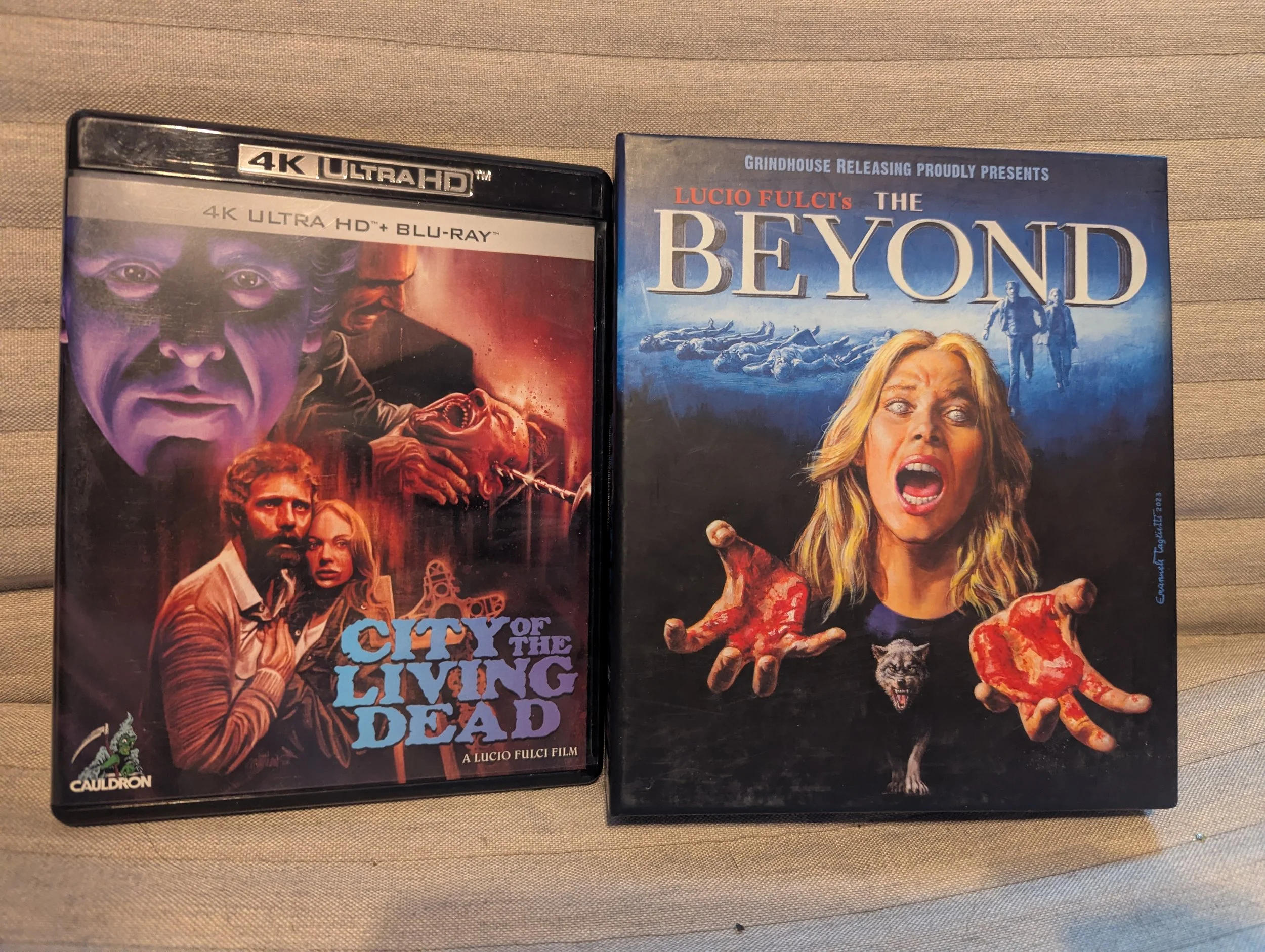
Like a lot of film fans and physical media collectors, Hunter’s taste expands beyond Westerns to the realms of horror, which includes being a big fan of the multifaceted Lucio Fulci. (Photo credit: Matt Long)
I love Unsung Horrors, and they do No Rules November. I've thought about doing that just because there are movies I'd love to talk about that are outside of the Western genre. Don't get me wrong, I can talk about Westerns every week, but if I'm going on someone else's show, it's like, hey, this is a great opportunity for me to talk about something else. I'm going on One Track Mind. Ryan Luis Rodriguez sent me pictures of stacks of Blu-rays, and he's like, “We can do any of these,” and one of them was Casablanca. I was like, “Let's do that.”
I do think that giving yourself a break from the genre that your show specializes in is a good way to refresh yourself and to come back to the genre that you're talking about on your podcast.
In that spirit, what are your go-to horror movies?
I adore Lucio Fulci. I'm a huge Fulci fan. There are a few horror double features that if I'm by myself for three and a half hours, I’m going to choose one of these double features. It's City of the Living Dead and The Beyond, Let's Scare Jessica to Death and Messiah of Evil, or Carnival of Souls and Malatesta's Carnival of Blood.
Those are really good pairings. All awesome movies.
I actually have a huge Fulci episode coming out tomorrow. Howard S. Berger and I talk about Four of the Apocalypse, and it's an epic. He knew Fulci, and just to give you a preview of how epic it is, I asked him to talk about his friendship with Fulci, and his answer was 40 minutes long. It's a two and a half hour long podcast episode on Four of the Apocalypse, which will never happen again for as long as the world exists.
Thank you so much for your time explaining your work.
Thank you for reading this interview with Hunter Robinson.
Listen to Tumbleweeds and TV Cowboys wherever you listen to your podcasts.
Check out more shows from the Someone’s Favorite Production podcast network.
If you enjoyed this conversation, read more interviews from the What’s your idea interview series.
The interview was recorded using Google Meet in February 2026.
The transcript was edited by Matt Long of What’s the Idea Editing.
All photos are the property of Hunter Robinson unless otherwise noted.