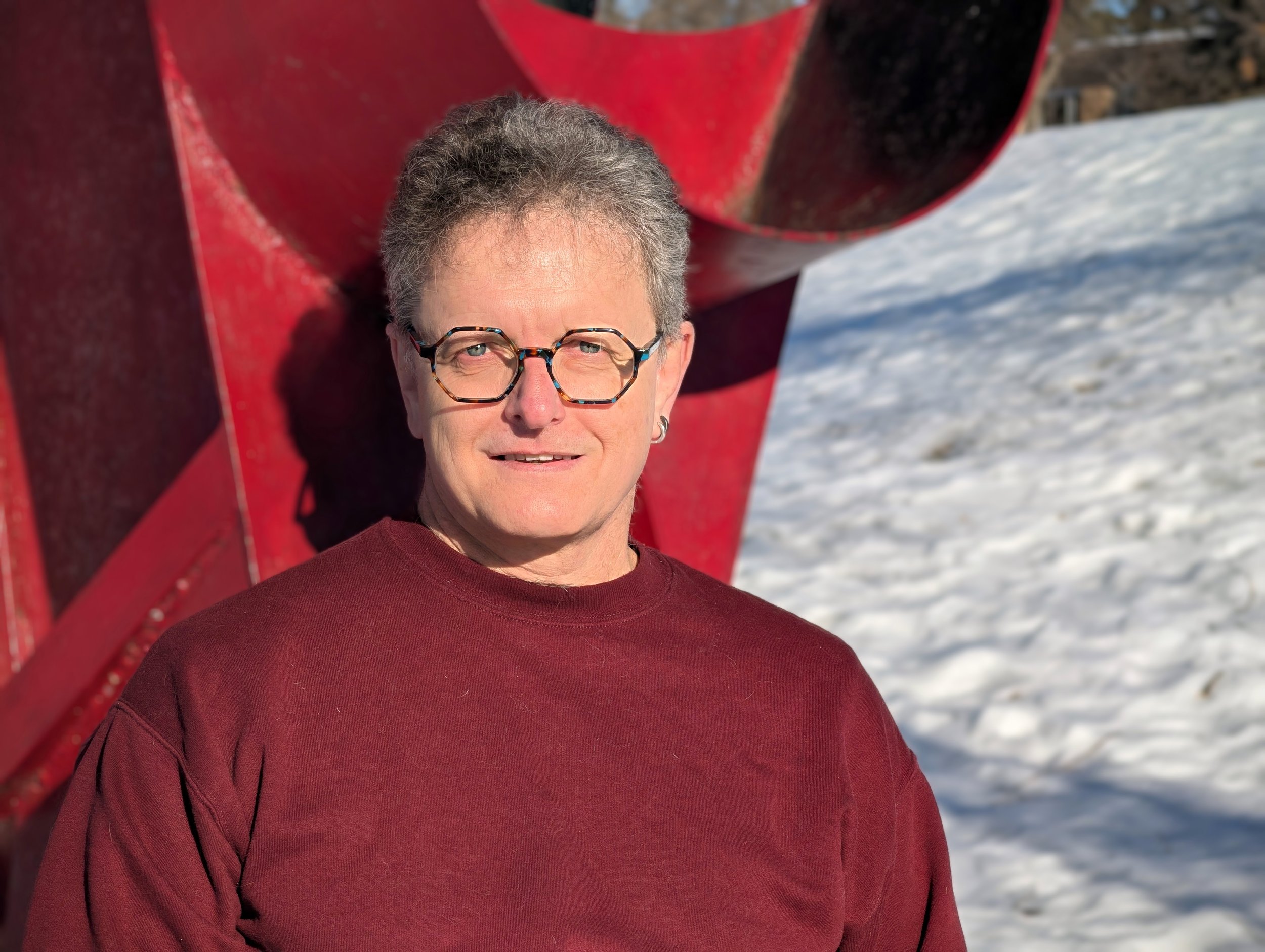
Peter Midgley (pictured above) is a writer and editor based out of Edmonton, Alberta, and the author of the chapbook 20/15. (Photo credit: Marlene Wurfel)
In the first part of our conversation, Peter Midgley and I discuss his path to a life in literature, his philosophies around editing and writing, and the impact of knowing multiple languages.
Thank you for meeting today. I know you as an editor, but you’re also a writer. Is one of those your primary craft over the other?
I don't know that I've ever seen the two as separate. I've been doing both for as long as I can remember. I was probably about 10 when my brother asked me what I wanted to be. I told him, “I want to be a literary critic,” and he asked me, “What does that mean?” I had no clue, but I knew what I wanted to do was to work with words and I’d seen a newspaper columnist who wrote about literature called that, so it had to be a career.
I wrote my first book when I was 12. It was an imitation of books like the Ladybird series, “Lives of Great Composers.”
You were writing mature-sounding works, not superhero comic books or monster stories.
It’s what I was exposed to. I was the fourth kid, and my dad had gotten to a point where he was tired of reading fairy tales. So, he'd sit me down on his lap and read bedtime stories and I'd get whatever he was reading.
“ My mom’s basic philosophy was ‘If you need to figure it out, read a book.’ So if I have a book, I can solve all the world’s problems, right? It was very much that attitude.”
I've never understood “You're too young for this.” I told my mom I was bored once and she gave me a book called Die siel van die mier by Eugene Marais, which is a philosophical study on termites. The translated title is The Soul of the White Ant. I was six at the time.
Where did you grow up?
My first years were in Namibia, which is where I was born, and after that South Africa until 1999.
Do you come from a literary family, or was there a big literary community around you?
We grew up in a rural area where I wouldn't say there was a big literary community, but there was always a love for reading and for literature in our house, and plenty of people engaged in arts and crafts around me—Ma was a florist and a lasting memory is of her reading a book while crocheting and holding a conversation. My mom's basic philosophy was “If you need to figure it out, read a book.” So if I have a book, I can solve all the world's problems, right? It was very much that attitude.
We also grew up in a multilingual home: Afrikaans with my mother and my siblings, English with my father, and Xhosa spoken all around me in the community.
How did your career begin?
My first foray into editing as a career was probably in high school. I needed to find a legitimate industry to work in because the teachers in the boarding school were onto me about selling contraband, so I had to find an alternative. Kids even then wanted their writing edited.
That carried on, and eventually I just went to a publisher and said, “Give me your slush pile.” The editor there pushed the pile over and said, “Let's see what you can do with this. Tell me what's good.”
I worked with her on the slush pile for a while, then it became proofreading or editing. At some point, Theresa Papenfus suggested I meet with Francis Galloway, who was teaching what was then the only course in printing and publishing at the University of Pretoria and was also senior editor in a sister company.
She and Francis mentored me. I never had any formal training, but I walked in and learned skills through whatever knowledge they imparted. I still think editing is mentorship. You can take all the courses you want, you can do that theoretical stuff, but at the end of the day, you need mentors.
What is it about that relationship that you feel is so essential?
You can make an error, and an experienced editor can look at it and say, “Right, you've made a choice here, but did you think how it affects that? Or this? Have you considered this option? Why did you choose that option?”
“The two work hand in hand. They are different skills, but they do complement each other. If you’re going to edit fiction, it helps to be able to say, ‘Here’s a solution.’”
This is what you don't get from reading a textbook. You don't easily get that in any publishing or editing course. Yes, you may get feedback from an instructor, but it's not the same as an editor taking you by the hand and coaching you.
In editing, there's an art to the choices that you make. There are some mechanical choices, but to have somebody care about your work and try to understand what you’re doing must be so valuable.
Yeah. Absolutely. But also, this wasn't just somebody asking “Why did you make those choices” in a private capacity, or in a classroom context. These are people working for publishers, and they want their books to be the best. Their questions are shaped by what's the best choice for that particular book. Did you consider the author's voice? The audience? They're also keeping you aware of who's going to be reading this book and who you are working for.
Have you always been writing?
I've written pretty much since I left school. I’ve written poetry and short stories my entire adult life. The two work hand in hand. They are different skills, but they do complement each other. If you're going to edit fiction, it helps to be able to say, “Here's a solution.” I don't think there's ever one solution, but to say to somebody, “Here's a suggested solution until you've thought of something that works for you…” If you have practical experience writing, that can be very useful.
Or if you say to an author, “Make the house a character.” Have you tried doing it yourself? Of course, you can point to the Stanley Motel in The Shining or the Bates Motel in Psycho, or the room in Charlotte Perkins Gilmans’ “The Yellow Wallpaper,” but have you ever tried writing a piece in which the house is a character? I don't care if it's good, but have you tried it? As an editor, it helps you formulate the advice you give when you have some experience in trying to do it.
It helps to have that empathy and to be able to understand the position the writer is in. You might also be able to understand what a writer or editor is really trying to say or ask.
At the same time, to use sporting analogies, Patrick Mouratoglou never played a game of professional tennis, yet he coached Serena Williams. Serena’s done okay. Mouratoglou was a very good amateur, but injury prevented him from going pro. He didn’t miss some grand piece of wisdom because he lacked professional experience.
I think editing works on that same basis. You don't have to be a Nobel prize-winning writer to be able to edit somebody else. In fact, that may not be your biggest asset, but it helps to try and extend those skills and work with them in complimentary ways.
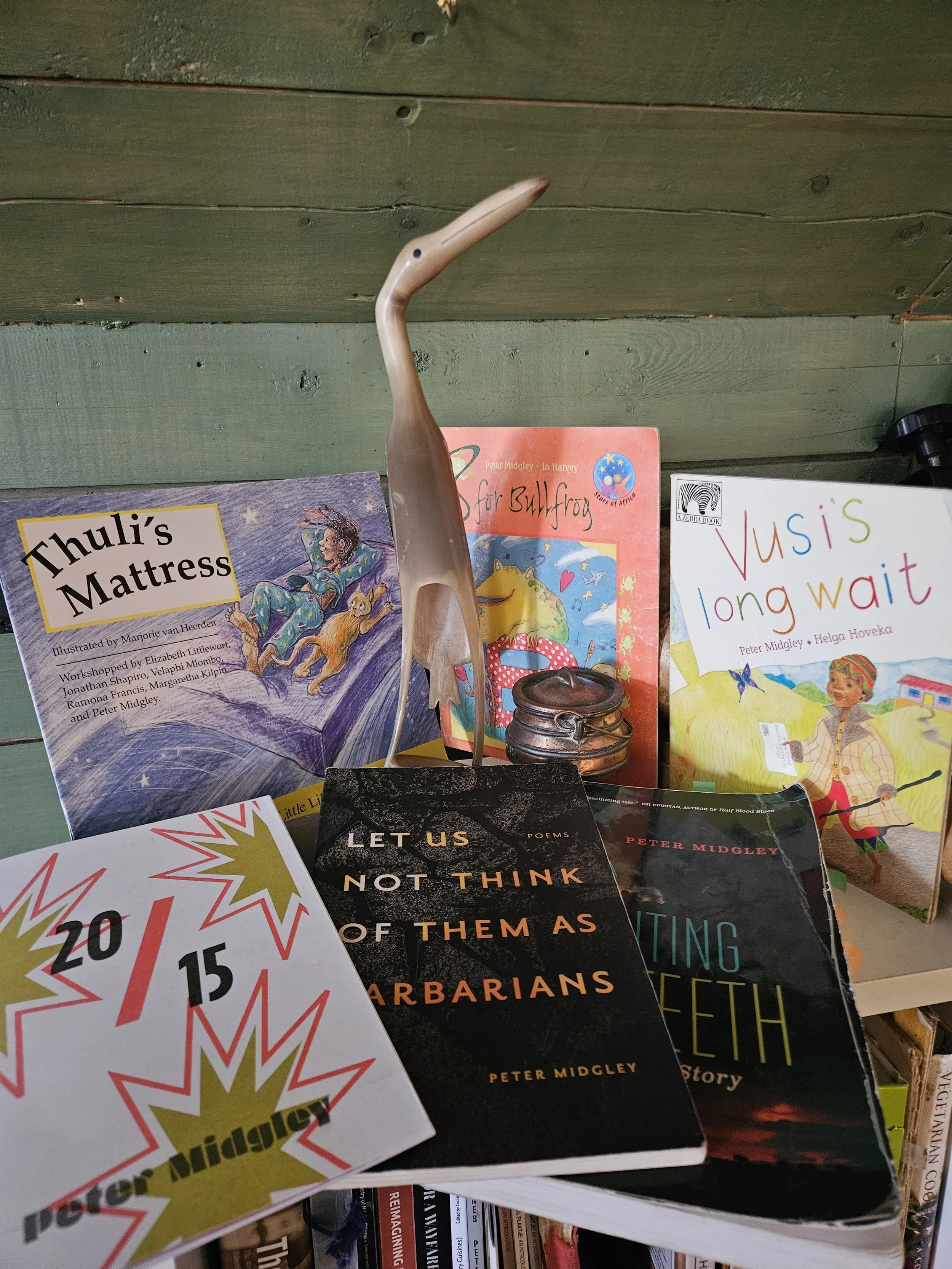
A collection of Midgley’s published works, showcasing the range of his interests. (Photo credit: Peter Midgley)
Do you edit and write the same type of material, same mediums, and so on?
I'm a generalist in both writing and editing. In terms of my writing, I've written children's picture books, I've written for theatre, I've written poetry, I've written non-fiction, and I've written fiction.
At the moment, the bulk of my work in editing is scholarly editing, but I have edited everything from newspapers to commercial documents for businesses and poetry, novels, short stories, and children's books.
Whether being a generalist is good or bad, I don’t know. I just enjoy that variety, and every genre has its own challenges. I'm very engaged in the editing that I do. I am not simply moving commas.
I feel like that goes against the popular notion of what editors do.
It does to some extent. That's what we think, but if you look at the input from some of the big names, it’s substantial. Let's look at Gordon Lish in fiction. Let's look at Max Perkins. These are the classic examples, and Lord knows there's enough to criticize about them and their lives and their relationships with authors, but both were very incisive in how they dealt with the text. They cut deep.
Editors dig down and shape stories at a very fundamental level, and a good working relationship between a writer and editor makes that story better.
Was there a medium that you were particularly drawn to trying as a writer?
I can't say that I've ever wanted to try and write this or that. Sometimes material starts off with me thinking, I'm going to write a poem about this. And then I find out it's a performance piece, or it's theatre now. Or you go, no, this isn't working as poetry, but it really works as prose.
“The work I write is also not always easy work. I take on controversial topics, so I battle to find publishers who are willing to take on what I do. I appreciate those who have taken a chance on me.”
The South African writer Marguerite Poland started off being a children's writer; then she started writing adult books and she's moved away from writing children's books. She phrased it to me once by saying, “I had things that couldn't be said in children's literature.” She wanted to say different things, talk about different things, to a different audience, and for that she needed a different genre. That's pretty much how I approach writing. I need to say different things in different ways and form often matters for that. So you pick a form that will suit what you're trying to say. In terms of writing, I want to write what I consider good literature. I don't care about the boundaries. I write about what's important to me. All the books that I write are about subjects that move me, and I try and pick the form that would work for I want to say with that piece of writing.
Do you bring your work to publishers or magazines?
I've never been agented. I have tried, but it's very hard. It’s really tough finding an agent who will do children’s literature and poetry, as well as adult works in more than one genre. And multiple agents for each kind of writing would confuse me.
The work I write is also not always easy work. I take on controversial topics, so I battle to find publishers who are willing to take on what I do. I appreciate those who have taken a chance on me. I really do. Everything that I have published has been with smaller indie presses. My latest chapbook, 20/15, is by a micro-publisher, Agatha Press. It took me 10 years to find a publisher for it. Let us not think of them as barbarians was done by NeWest Press, while Wolsak & Wynn published Counting Teeth: A Namibian Story and Unquiet Bones.
I also work cross-linguistically. The latest collection of poetry that is at publishers right now is a book I wrote in English and in Afrikaans, but it includes several other languages. There are always languages interacting with each other in my work. We don't live in a monolingual world, yet it terrifies readers when they're confronted with all these foreign words.
Especially with poetry, I want readers to work a little. It's that engagement with the line, with every element of poetry, that makes it such an active form of reading. It asks you to engage at a different level because so often in poetry, you're extending language. The beauty of a good working metaphor is that you sometimes you have to dig to uncover what it means. When I throw in an additional layer, say more than one language, I'm asking you to work harder.
So as an English reader, I cannot just simply skip the non-English text.
No, you can't. Or rather, shouldn’t. I do help you in that I often provide a translation, either in a glossary or contextually, but the translation is not always a word for word translation because translation isn't a word for word exercise. Sometimes it’s about listening for the sound as much as trying to get to “meaning.” There are times where I do leave a poem untranslated so only a reader of that language will be able to access it. That’s conscious. I think you sometimes have to face what is tough, what is difficult, and say, “All right, so how am I going to do this if I really want to read it?”
“Part of what we need to do is to decolonize the mind. We can use these syntactic patterns in English, but why not use them in their original contexts? Why do we have to translate it into English?”
It's certainly not impossible in today's world.
It's not. The point is, I want you to go and dig and work to come to grips with language. Sometimes, words happen in both languages. I remember one of my earliest examples of writing was a poem that I wrote in rhyming couplets where I wrote the first line of a couplet in Afrikaans and the second line in English, or vice versa—but they still had to rhyme. I had to make the Afrikaans word rhyme with an English word and maintain a sound syntactic structure as I moved through the languages. It’s fascinating how we do that, and I want to make readers part of that experience.
Multilingual families will tell you that when they engage in a conversation, they can turn to another member of the family in mid-sentence and simply change over into a different language without breaking their thought pattern. It's that flexibility that I try and bring into some of the poetry that I write.
Part of what we need to do is to decolonize the mind. We can use these syntactic patterns in English, but why not use them in their original contexts? Why do we have to translate it into English when I can get you out of your comfort zone to work out what is being said in a different language?
Have there been any notable instances in your editing career where knowing more languages has helped in particular?
Because I read several languages, it gives me a broad frame of reference. When doing scholarly work, I can say to people, “This concept works in a North American context, but have you thought how this works in an African context? Or in a European one? Does this work beyond North America?” I can bring that perspective because I'm cross-continental as well as trans-linguistic. I can bring a perspective into the editing that is not necessarily there for other editors.
That's a great skill to be able to offer your academic clients.
I don't know that I always get it right, but I certainly ask the questions. I don't know that you need to have the answers; you just need to know how to ask the questions. Because I edit in more than one language and because my clients are from multiple cultural and linguistic backgrounds, I constantly need to confront concepts that are unfamiliar to me. Getting clarity is doing the work of an editor.
“We’ve been speaking about multilingualism, and that’s a form of diversity. There are so many forms of equity and so many inequities that exist around us. It’s not about moving one group of people to the side and replacing it with another. It’s about creating space for everyone.”
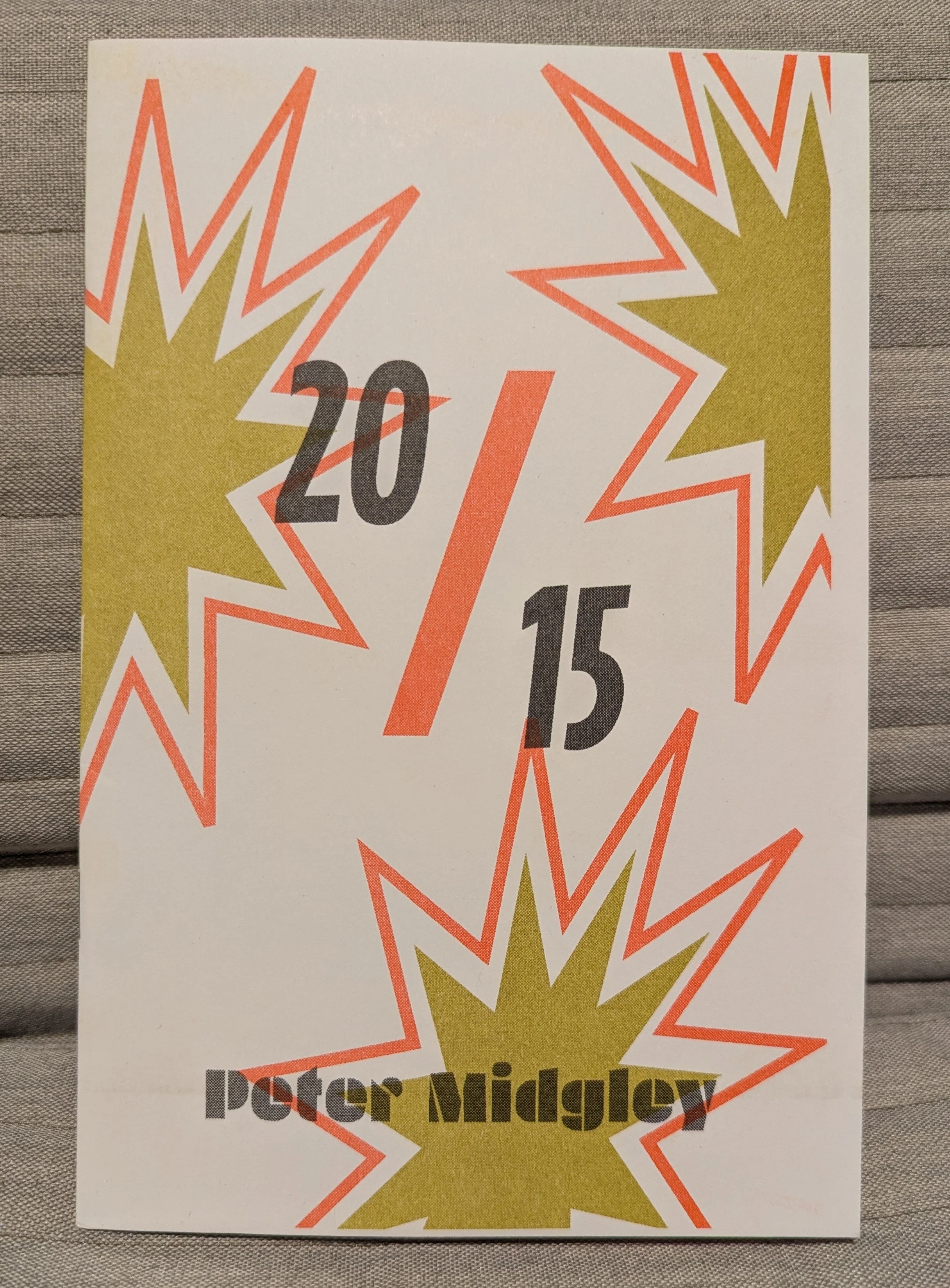
Midgley’s chapbook 20/15 is his latest published work.
We met through your work on the equity, diversity, and inclusion committee with Editors Canada. What got you involved with that committee?
Those very words equity, diversity, and inclusion. We've been speaking about multilingualism, and that's a form of diversity. There are so many forms of equity and so many inequities that exist around us. It's not about moving one group of people to the side and replacing it with another. It's about creating space for everyone.
It is coming to that understanding that we're living in a world that’s not about exclusion. It's understanding the terms of belonging and understanding where that space is. The philosopher and leader of the Pan Africanist Congress, Robert Sobukwe, in his opening address at the inaugural Pan-Africanist conference in 1959, noted that “everybody who owes his only loyalty to Africa and who is prepared to accept the democratic rule of an African majority being regarded as an African”and he ends by inviting people to join in that sense of oneness and belonging: “Here is a tree rooted in African soil, nourished with waters from the rivers of Africa. Come and sit under its shade and become, with us, leaves of the same branch and branches of the same tree.” I first encountered the words in the banned literature that was circulated clandestinely while I was at university in apartheid South Africa, and the message became foundational for who I strive to be.
Ndumiso Dladla, a contemporary African philosopher, extends that metaphor of the table. The original tree has died, he says, but the table has been made from the wood of that very tree. Then he echoes Sobukwe’s thoughts, saying there's space for everybody at the table, but you have to realize it is a tree made from African wood, and they’re the fruits of Africa that are served on there. If you are willing to accept this fundamental premise, there's space to belong.
In other words, it's not about removing one person or shunting people aside. It's about understanding the terms on which there is space at a table and working within that framework. Equity becomes very important for attaining that vision. It's about making space.
So yes, that's why I want to be involved in these committees. I believe in diversity. What has shaped my entire adult life is working in that kind of inclusive environment and working towards attaining it. This is, in part, why the state of the world as it disturbs me so much, because we are not working towards that.
If we look at what's happening right now in Alberta with the banning of books, this is being done very consciously to the exclusion of two-spirit LGBTQIA++ people. It's clear where this is going. It's about exclusion. We cannot ban books because we make people lesser humans by taking away books that deal with the specifics of their lives.
Thank you for reading the first of this interview. In part two of our conversation, we discuss the process of writing and publishing 20/15.
Learn more about Peter Midgley via his website.
Order a copy of 20/15 direct from Agatha Press, or request a copy from your local bookstore.
The interview was recorded using Google Meet in September 2025.
The transcript was edited by Matt Long of What’s the Idea Editing.