Delivering movie supplements with a healthy love of puns: What’s the idea with Will Dodson (part two)
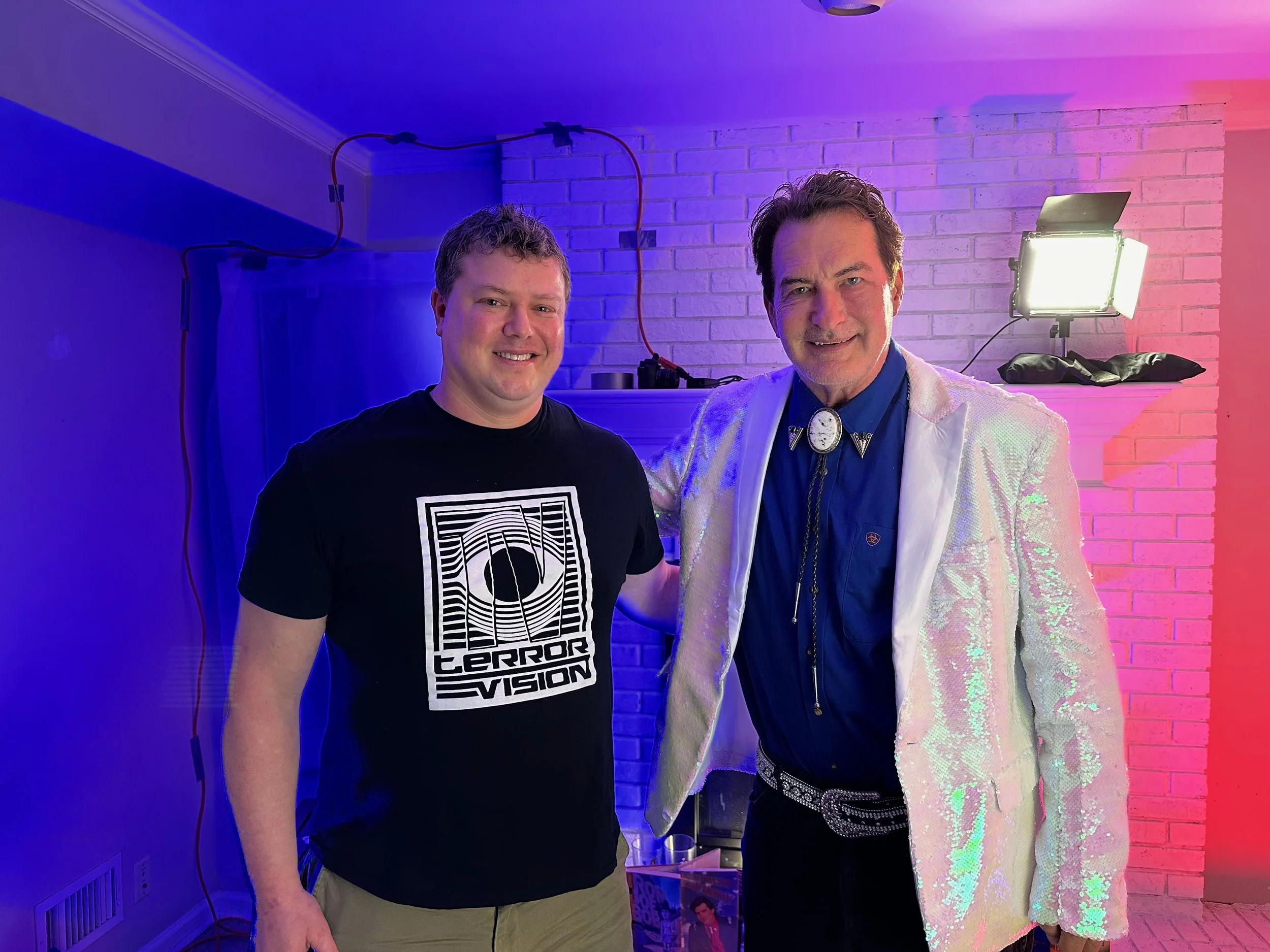
Will Dodson (left) with Joe Bob Briggs (right) on the homemade set made in Will’s living room to interview Briggs for Terror Vision’s release of Gator Bait (1974).
In the second part of my conversation with film professor Dr. Will Dodson, we discuss his approach to producing movie supplements like commentaries and visual essays, his process for researching the obscure movie he’s assigned to work on, and the projects he’s most proud of with Someone’s Favorite Productions.
You mentioned that you connected with Ryan [Verrill] after you wrote American Twilight. How did you guys start producing supplements together and create Someone’s Favorite Productions?
It’s amazing what Ryan's built out of nothing. I discovered him because I was looking up a Mondo Macabro title that I was trying to find and stumbled across an interview he had done with Jared Auner. I watched a couple of interviews that he had done and was like, “This guy really does good interviews,” so I reached out to him.
It just so happened that I'd also been doing a little bit of research on the new YouTube genres of unboxing videos. There's unboxing videos of literally everything that you can buy, but the unboxing videos for Blu-rays are particularly sensual. I had just done a presentation at the Society for Cinema and Media Studies conference about unboxing videos and podcasts and this new kind of paramedia that was about the business of collecting. It's about the movie, but it's also about the supplements and the packaging and the presentation and how it fits on the shelf and all of the things that go into collecting. And of course, having been a collector my whole life, I was like, “This is my tribe.”
It started with interviewing about the book, and then he invited me onto the live stream, which seems to be a good fit. We have a good chemistry. Every time I'm on, I get some nasty comments about my politics and then some nice comments about some jokes, so it’s perfect.
Doing that research on unboxing videos was really my first foray into social media. I had stayed off of it, not because of any moral issue, but because I didn't want to get addicted. But again, in the process of promoting the book, I got an Instagram account and I got Twitter. It just so happened that a boutique producer in a tweet asked for people who had knowledge of a particular subject. I can't say what it is because it hasn't come out yet—it hasn't even been announced—but apparently Ryan and I both messaged the guy the same day. And when we found out about it, being the bigger person, I said, “Why don't we do it together?” Ryan agreed and the label agreed. It was going to be a featurette, but we ended up recording an audio commentary for it. That was almost three years ago and it still hasn't been announced, but I think it's going to be late 2025.
The first thing that we actually made together was a visual essay, and I was very resistant to it. I could not figure out how to write it. It just wasn't natural for me. I had to let go of all of the sort of academic structure of argument, support, explanation, whatever, and get into a more classical essay form, real essay writing. That was for Saturn’s Core for a movie called The Zombie Army. We did a thing called “Incubators of Death: The Asylum in Horror Cinema,” incubators of death being a phrase associated with art, the theatre of pain. I was not very confident working on the writing and suggesting images to Ryan, and he was figuring it out. To his credit, he learned fast. He's a really good editor now.
I wasn't sure how I felt about it, but after we got good feedback from Saturn's Core and I let it sit for a while and looked at it again, I was like, wow, that turned out pretty well. That's kind of good. And strangely enough, visual essays actually pay way better. None of it's very much, but every single company we've worked with, they pay more for visual essays than they do for audio commentaries.I don't know the reason.
“Some academics say, “There’s too many commentators who are just heaping love over the movies and talking about how much they like them instead of really analyzing them dispassionately.” But who wants to listen to that?”
When I first started collecting DVDs, I would listen to things like director commentaries and cast commentaries, then maybe I’d get to the academic features or commentaries. Maybe that promotional angle affected it, because those cast and director supplements can be pretty fluffy. It’s fantastic that serious thought is now being put into the supplements.
The cast ones especially, nobody's going to say the truth. Nobody's going to be like, “So and so was kind of a dick.” That’s why I like Cronenberg, because Cronenberg will straight up say “This didn't work, we wanted to do this, we didn't have the money,” that sort of thing.
Some academics have been grumpy about the fact that, over the last decade or so, there has been more public scholarship, writers, researchers, people who don't necessarily come from the academic world. Someone like Samm Deighan got academic training, but she's not at a university, you know what I mean? She's a popular scholar. She presents movies publicly and she writes for a public audience, not for academics, and to me, she's the gold standard for commentaries. I've said that in pretty much any form that I can. She really combines hardcore research with accessible language and a kind of comprehensive balance of production and theme and history. Perfect, very entertaining and very informative. Some academics are unlistenable because they're so stuck in this jargony professional talk, which is totally fine if you're writing for a professional journal, which I do myself. When that's your audience, you have to write that way.
But to me, audio commentaries and visual essays are public scholarship, and academics should take advantage of the opportunity to speak in normal talk and communicate with enthusiasm. Some academics say, “There's too many commentators who are just heaping love over the movies and talking about how much they like them instead of really analyzing them dispassionately.” But who wants to listen to that? That's for journals that are read by the people who need to read them.
So as an academic who comes from a university, I want to prioritize the opportunity to speak to the public and to share knowledge and to welcome audience perspectives and to collaborate with other commentators. I love doing commentaries with other people. I'm about to do my first solo commentary, which I'm excited about, but I like to do them with Ryan, I like to do them with Kris. I hope to get a chance to do one with as many other people as possible. That's a goal because hearing other people's voices opens you up to perspectives that you don't necessarily think of on your own.
Did your studying of rhetoric influence your approach to writing and producing supplements?
Yeah. I guess I'm biased, but rhetoric is the fundamental subject. Every subject is really the history of whatever the thing is, but rhetoric is how the history is told, and that's why I think tone is important. I think being enthusiastic about a film is really important. Even if they hired me to do commentaries on the complete works of Christopher Nolan or Quentin Tarantino, I would take it seriously and be enthusiastic about it, because people who hate those movies are not buying them, it’s people who like those movies and want to learn about them that are buying them. So if I were to share a criticism of a movie or a filmmaker, I'd put it in the context of their career and make it fair.
A lot of times, we're almost expected not to like what we're analyzing, which is important sometimes.If I'm breaking down propaganda or the latest missives from “insert governmental agency here,” then I'm using tools to achieve a goal, but when you're analyzing art, even if you are saying, “this kind of didn't work,” you can have fun with it. We're all individually sad for so much of our lives, let's have some fun when it comes to research and scholarship, because it's fun to learn.
I completely agree. I like your approach to supplements in that it's a really great mix of playful and down to earth while remaining academic. You don't know when you're going to get an obscure art reference right after a reference to boobs. Your work for Popatopolis was a particularly fun one.
“Lately we’ve been getting more movies that are unfamiliar to me, and that’s been really exciting.”
That one's unique. That was the only one I acted in. The acting is me being myself with a wig on. Popatopolis is in the top couple for me. I'm so grateful to Brad Henderson and to Terror Vision for getting to do that because I love Jim Wynorski movies. For many people, that's an immediate disqualification of everything having to do with my academic credentials andmy taste, but the reason I love Jim Wynorski movies is because they achieve what they set out to achieve, and I love the goofy humour about everything. The guy makes low budget genre movies, and they get lower and lower as his career goes on, and they're always tongue in cheek and playful, and yes, they're also exploitative of T&A (tits and ass) and all of that, and that has to be taken seriously as well, but overall, I look at his career as one that, if you sum up in a word, was fun.
Whatever you think of Wynorski as a filmmaker, Popatopolis is a great documentary. It gets to facets of the person but also allows him to stay a mystery, and it looks at the field of low budget film making in ways that are really illuminating and entertaining. That piece was a parody of film school academics, but the actual content was serious. I recommend it.
Are you generally doing supplements about movies you already know, or are a lot of them for movies that you don't know?
Lately we've been getting more movies that are unfamiliar to me, and that's been really exciting. It's never really stated this way, but sometimes you do a film that's more obscure to audition for something that's higher profile. I won't name any names, but several companies have given us titles that they don't think are going to sell that great so that the stakes are lower. Hopefully they've been happy with everything we've produced so far and we've added value.
I also now go to horror conventions regionally for Severin and for Terror Vision, and anything I'm on, I try to push extra. Not because of ego, but just because they are ones that I know aren't as high profile.
How do you go about researching movies you don’t already know, especially the obscure ones?
I do online research, of course, like looking for blogs. Especially for international films, I’m looking for anything that's been written that we can get translated. Thankfully, I have some friends who speak several languages, so I could get some help here and there, and I get help from Google Translate and stuff like that. I have a little bit of an advantage to some freelance writers because I have access to university library databases and all their subscriptions, interlibrary loans, that sort of thing.
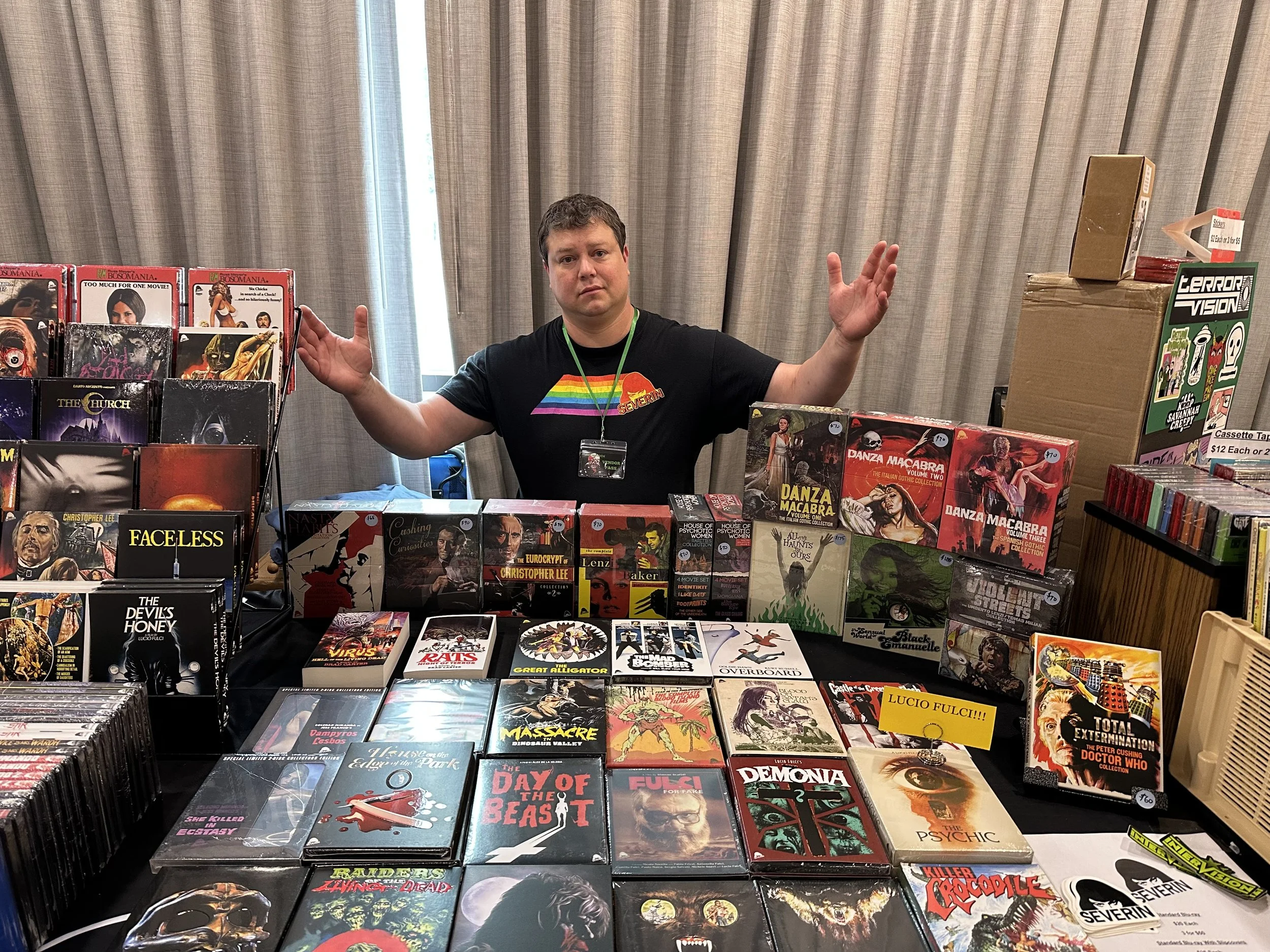
Will is now one of the public faces for companies like Severin and Terror Vision at conventions around the United States, which gives him the chance to share his love of these movies directly with fans.
The bulk of my research is finding interviews, finding reviews, and also finding background production info. That is really important, and I think it comes through most of all in the work that we've done for Deaf Crocodile. So many of the films we've done with them have needed research about international history, looking up what was going on in those countries at that time.
For instance, we just did a piece for this Lithuanian rock opera called The Devil's Bride, and I found out that this was made in the context of protest against Soviet rule. I was finding out the particulars of how rock and roll served specifically in Lithuanian protesting. We just did a piece for a Hungarian film that was made during World War II, after Hungary had gone to the axis-power side, so I was getting out of the field a little bit and doing straight up historical research. I've read more books of European history and East Asian history in the past couple years than probably in the decade previous, which has been great. What a gift. I got to read this 600 page book for work. That's what I got to do today.
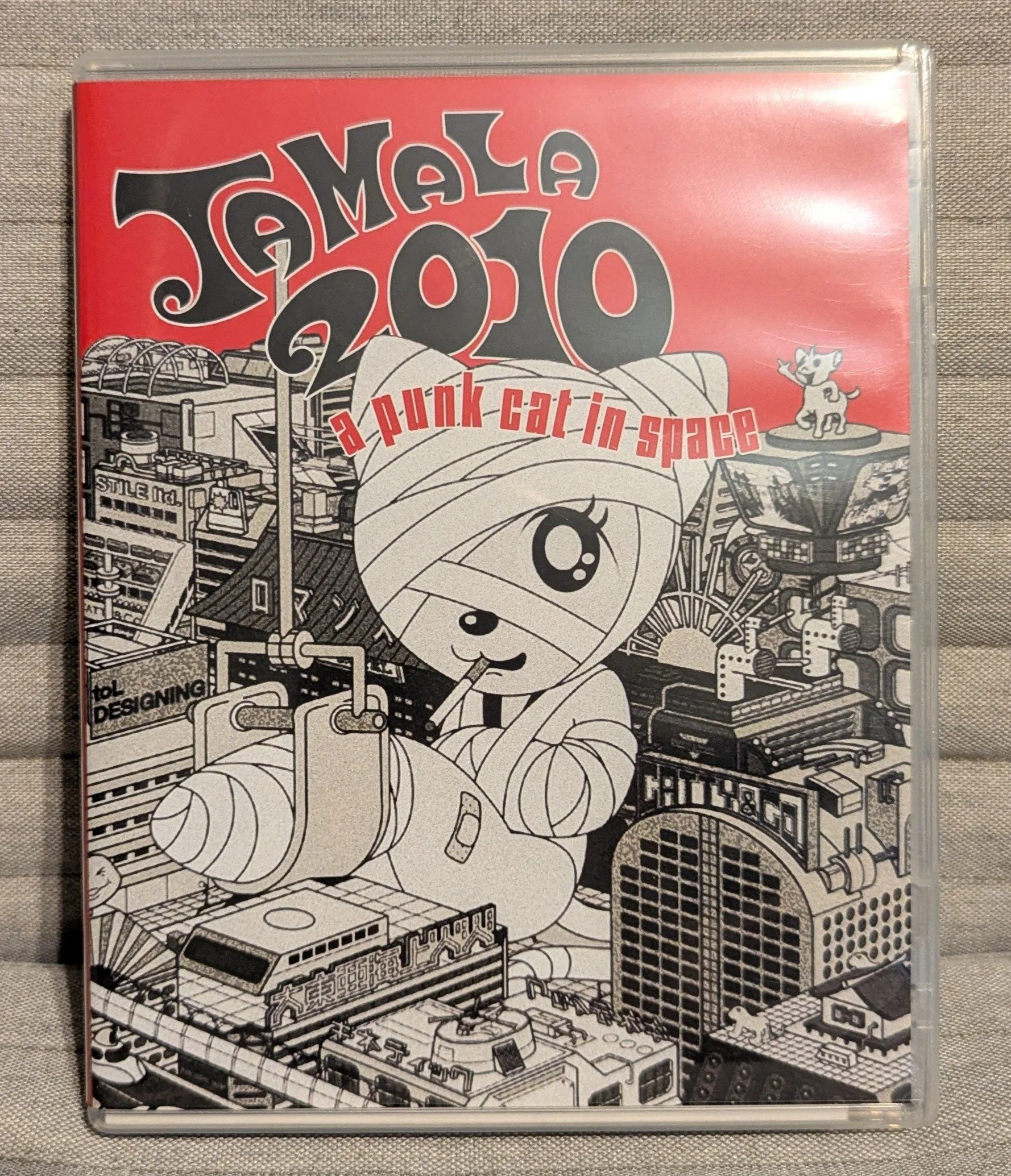
“Tamala 2010 is a good example… The film itself was not explicitly a critique of capitalism, but it was very much in those conversations about commodity and materialism, and that's part of the point of the movie.” - Will Dodson
After you’ve done your research, how do you decide on what you're going to focus on for your visual essay or other work?
To be honest with you, I will watch a movie a couple of times and something sticks out at me. Tamala 2010 is a good example. We wrote a lot about economic history and theories of economics. The film itself was not explicitly a critique of capitalism, but it was very much in those conversations about commodity and materialism, and that's part of the point of the movie. It just so happened that the literary critic Fredric Jameson passed away at the time we were writing. He wrote some really fascinating and ambiguous treatises on what capitalism as a system does to those of us who grow up within it and experience life through its invisible structures.
In this case, I wanted to write about the materialism theme, and we got into analyzing specific images and motifs of the film, and then the gears started turning. But inspiration for a topic is still mysterious. I generally start with an idea and pitch it to Ryan, we talk about it a little, and then I get to work. Some of these have literally started out in dreams. Sometimes I'm at a loss and the deadline's coming, and then suddenly there's a thread.
Whenever we make something, we know there's probably going to be a commentary, so we do a visual essay about something that I don't think will be covered in the commentary or won't be covered in this way, but I have to guess. A lot of times, we don't know who the other contributors are. With Tamala 2010, it turned out Samm Deighan was doing the commentary and I was like, “I hope this is different from what she said.” Thankfully, it jelled pretty well, but we were distinct. That's happened a couple times.
“When they’re successful, each visual essayist becomes a brand... Hopefully with us, you’ll start thinking of history, thematic interpretation, some puns, and definitely as many visual jokes as we can get in.”
With some movies, especially the obscurities being released by Deaf Crocodile, you almost need to release supplements ahead of the movies to get people to understand what it is they’re considering buying.
Something that is difficult about the whole supplemental features thing is that they're part of the advertising in the sense that there's a list, here's what's on the disc, and here's who made it, if they're important enough to have their names listed. The first several things we made, they didn't put our names on them. They were just visual essays. Sometimes we get Someone's Favorite Productions, or we get our names, but the subject matter doesn't get promoted, it’s just “visual essay by Will and Ryan.” But what's the visual essay about?
When they’re successful, each visual essayist becomes a brand.You see Samm Deighan's name, you're going to get some in-depth historical analysis that's very focused on the film. Alexandra Heller-Nicholas, you're going to get a little more theoretical approach to stuff. Hopefully with us, you'll start thinking of history, thematic interpretation, some puns, and definitely as many visual jokes as we can get in.
Something else that I noticed is that very few review sites spend much time on reviewing the supplementals, which I wish would change because they do add value. And like you're saying, there's potential for some of these things to make the movies more commercially interesting.
I don't know the answer to it other than a massive influx of cash that allows for more pay all the way around for the reviewers, for the producers, for the boutiques. It's ironic that during the heyday of DVD, when millions of units could be sold of something, there wasn't a whole lot of attention paid to supplements. You'd have a commentary, maybe a slapped together behind-the-scenes thing.As the market for consumers has shrunk, the quality and complexity of the supplements has increased, but the money to support the producers of all this stuff, including the people who run the boutique level labels themselves, has shrunk. I mean, nobody's becoming a millionaire. Even the top companies are one quarter away from shedding employees.
“I’m under no illusions that there will ever be a large-scale consumer interest, but I do hope that the next 10 years continue to develop the way the past 10 years have in terms of the quality and variety of supplements.”
Earlier this year, through partnership with my university and the Cary Theater, I brought Samm Deighan down as a guest speaker to introduce a couple of films. We did Zerograd and she selected Come and See for some unsuspecting undergrads who were just walking in after dinner getting ready to see a movie. But it was so great because at each screening, there were two people who ran up with copies of Samm's book to sign and were like, “Oh my god, you are the best,” which she deserves to hear. It's cool to see that there are people really into it.
I'm under no illusions that there will ever be a large-scale consumer interest, but I do hope that the next 10 years continue to develop the way the past 10 years have in terms of the quality and variety of supplements because this is really the main avenue for public scholarship. And like we were saying, for many films, they're being released now and that's it. So whatever is on that disc, that's what there is to say about it.
How do you and Ryan go about collaborating on your various projects together?
Our roles as collaborators really complement each other. I'm really good at research and writing, and he's really good at editing and communicating with other human beings, which is really important because you can write all you want, but if you can't give it to anybody to publish… So he sets up the deals and we collaborate, but we also have other people that we work with who are constantly producing stuff.
If you really want to nerd out about it, there are subtle distinctions in the credits for each one. Sometimes I'll write the piece and record the vocal and I'll have the exact images that I want lined up, so I'll get a director credit for that and he's the one who physically edits. Other times, I'll just give him the script and say, “Do what you want,” so he'll get the director credit. Sometimes I'll have some images I want, but then have some things I don't know I want, and so he'll fill them in, and we do them by conversation.
“He’s really one of those rare, incredibly genuine, authentic people, and I think that people respond to that.”
We don't record the visual essays as a team, mainly just because of the reality of the production schedule. A lot of times we'll have two or three visual essays due back. He's got all his interviews, I've got my work schedule, so I write and record on my own, then he takes the file and goes with it. We have a style guide we use from Erica Shultz, who's been in the business for a long time and does great work. She really taught us at the beginning of this. She gave her time to show us how she writes visual essays, how she produces them.
With the commentaries, I do the bulk of the writing and then we divide up who's going to speak to what. When we record, we adapt and ad lib, as that goes. He's such a good and precise editor that a lot of times I'll have an idea, or sometimes I won't have any idea at all, and he'll find the perfect image. It hasn't been announced yet, but I can say that he did do his first visual essay where he did the narration and I just wrote, and I think there'll be more of that to come. We've been really lucky to have been heart attack busy from the start of this. It's because of the success of the show, but also because he's so authentic and genuine and has formed these real relationships that are not based on any kind of transactional “hey, do this for me” or “I'm friends with you because I want to get what you have.” No, he's really one of those rare, incredibly genuine, authentic people, and I think that people respond to that.
What timelines are you generally working under? Does it depend on the company or is there a general amount of time it usually takes?
Some companies, like Deaf Crocodile, give us long lead times, which is great, and then some companies will be like, “Hey, we've got this great title that you can't believe you're being offered, but you have to get it done in a week,” and so we have to be ready to move things around really fast. Time management is something we're still working on.
I think this is true in life in general: If you say no to an opportunity, they quit coming. They’ll move on to the next person and that becomes their top person, so we don't want to say no to anything unless we have to, or we want to be able to say, “I can't do it, but I know somebody who can,” and help bring other people into the conversation and help other people get a chance to diversify their work.
It could all end tomorrow, but it's been really, really busy since we started, and I feel really lucky about that. And then some days, I wake up and I'm just like, I want to quit. I quit. I could watch all three Batman’s today.
If I can ask, do you feel more stressed out or satisfied with where you're at the moment?
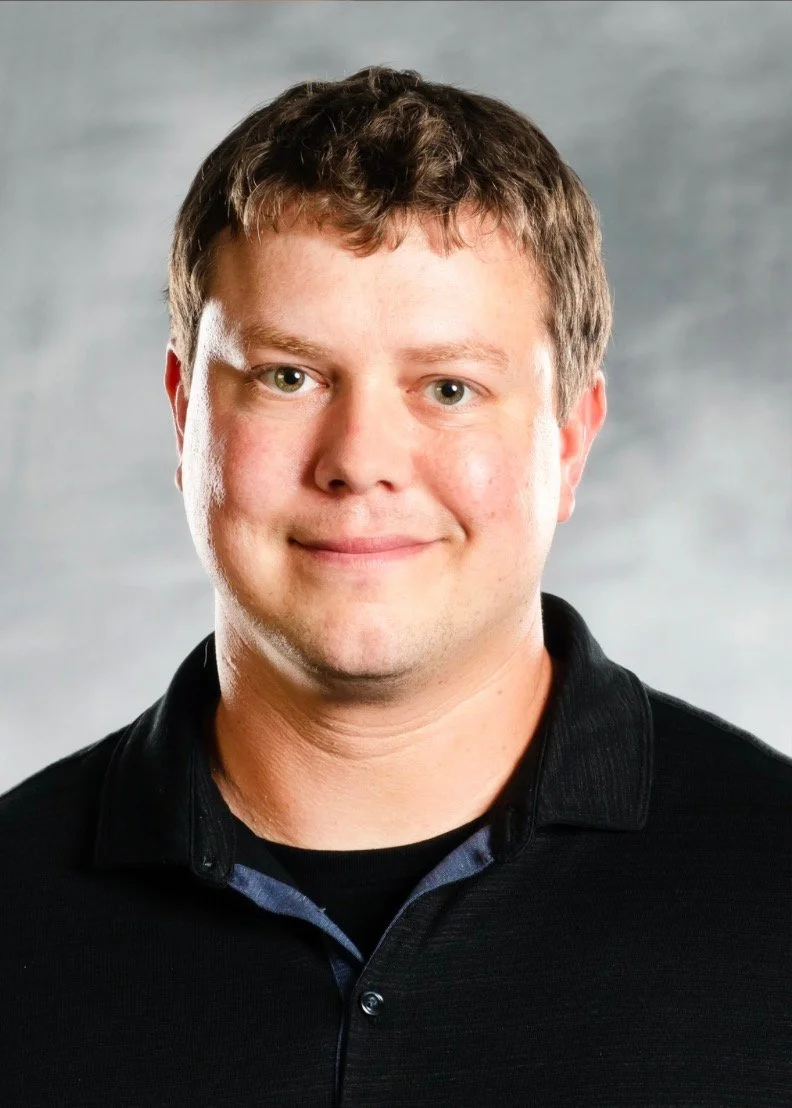
Will has distinguished himself as a scholar on everything from the golden age of Hollywood to exploitation classics and the obscurities of Deaf Crocodile, always delivering excellently researched work without removing his propensity for jokes.
That's a big question. I mean, creatively, I feel really not satisfied because I think our work has gotten better and better, but I still don't think we've done our best work, partly because of the time constraints of everything. Then again, if you have a year to make something, are you really gonna have the discipline? It's like when I was talking about the first commentary, pressure is good when it's productive pressure.
I'm really happy with the trajectory that we've gone on because if the work sucked, we wouldn't get asked back. This is a case where you're not going to get a free pass. You don't get a lot of validation in the academic world or the professional world, so getting validation for this creative work and this research is really nice. Doing the work is really fulfilling. It's definitely a source of happiness. Getting to learn about new films and new film industries is really exciting for nerds like me. And making friends, for middle-aged men, it ain't easy.
I wish you guys the best of luck with Someone's Favorite Productions. From the outside, I believe you have a great brand that people have grown to trust, and it’s fantastic that between the two of you, you can cover everything from visual essays and commentaries to text.
Ryan's really built a little micro empire just in a couple years with this network of podcasters and producers and writers and editors. I'm grateful to have met him and for us to have formed this partnership because I certainly couldn't have done this on my own. Ryan might have found somebody else, but we work together really well. And it's nice, too, because we really take collaboration seriously as a value. We want to be able to share any name recognition we have with other people who also do quality work, who maybe have their own profile but haven't had a chance to get a spotlight. We can help bring them in. That's something that's really, really important to us too, because otherwise, you're just kind of cold and lonely. Nobody wants that.
Hopefully the right projects continue to find you.
I think I've worked on close to 40 or maybe 50, which is crazy. You have to be careful because you don't want to go so fast that the quality suffers, but thankfully, it's not the same as writing a book. You're able to focus on a clearly demarcated topic and really do a good job with the limited time you have, and then move to the next one. That's a lot of fun.
The other people I've mentioned, people like Samm and Erica and Alexandra, they're up here where I'm nowhere near that level yet. I do not consider myself their peer. I want to get there, but there's a long way to go. But thus far, everybody that I've met and worked with has been really nice, open, and collaborative. It makes a person hopeful. It reminds you how good people can be when you're working in high pressure, low compensation stakes. People are nice to each other and we'll help each other out, we'll share resources and share time and just take the time to say, “Hey, nice to meet you.” That means so much.
I've been in so many work environments where the last thing you'd want is anyone to see you in the office, and it's ironic, because we're all spread out all over the country and the office is the computer screen, but it's just so nice to be able to make, like I said, genuine connections with people. The marketplace of ideas, the academy, sharing our love for art and making our own art in response to it, that's what we're supposed to do. It's why we have these thumbs and the ability to look at the stars and say, “What are those things?”
We're all on this earth for a brief moment and when somebody tells a story, it's important to see what story they're telling and why.
Those are the kinds of philosophical questions I brought to our commentary on The Nail Gun Massacre.
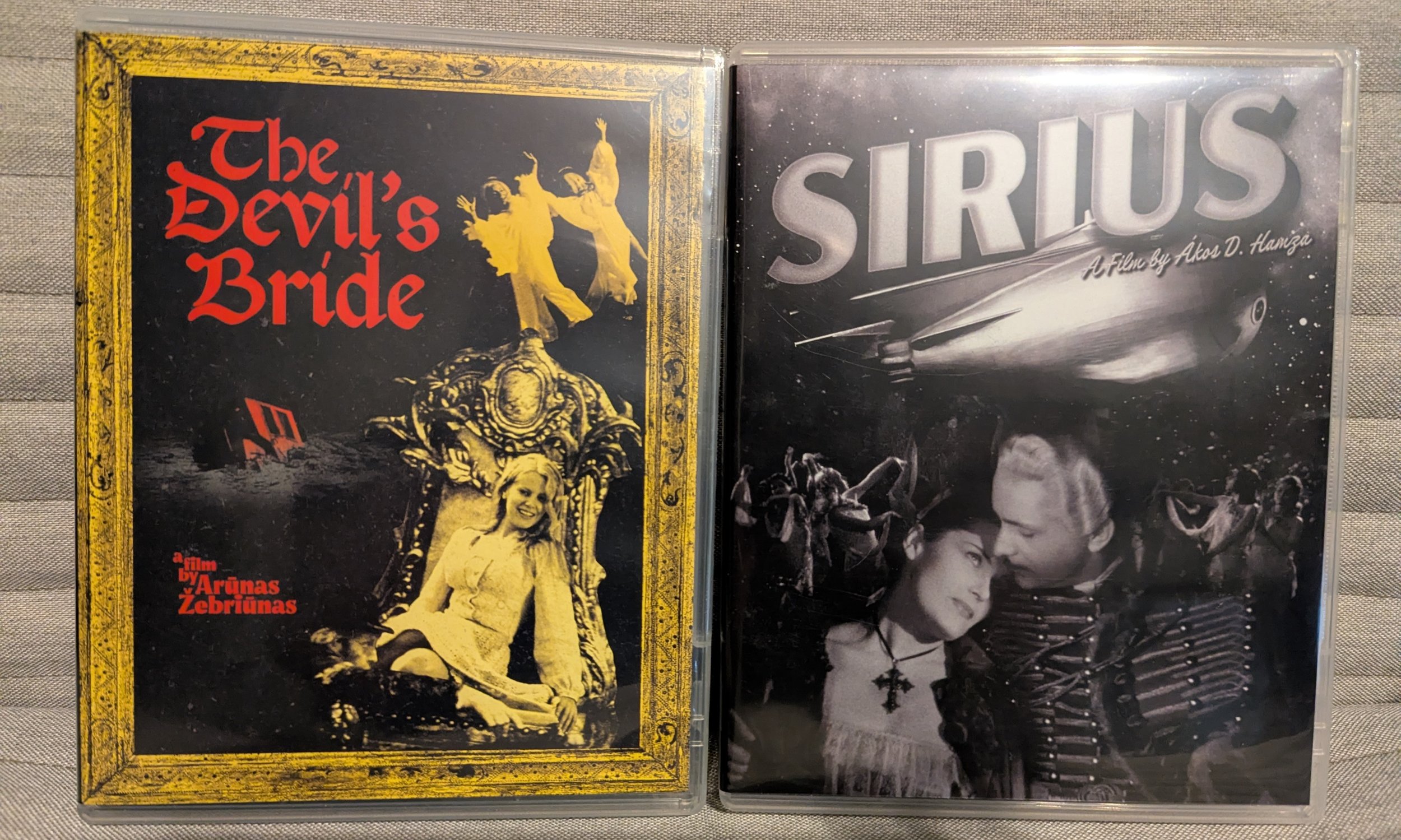
“As far as me and Ryan’s collaborations, I'm really proud of our work together on Sirius (1942) and The Devil's Bride (1973).” - Will Dodson
Do you have one or two pieces that you're most proud of, or that you feel like you did your best work on?
I'm very fond of “#RestoreTheWynorskiverse” for Popatopolis. I think the visual essay we did for Kin Dza-Dza! is really, really good. As far as me and Ryan’s collaborations, I'm really proud of our work together on Sirius and The Devil's Bride.
One that I think is really useful to the movie was a short visual essay that was a technical breakdown of a scene in Door II: Tokyo Diary for Terror Vision. I thought that went really well. But gosh, we've done so many. We've worked the most for Deaf Crocodile and Terror Vision, but we have worked for almost 20 companies at this point. There's a few that we haven't yet worked for that we really hope to, so hopefully that'll be coming.
Thank you again for taking your time to explain all that and go into such detail.
Yeah, thanks for letting me yap and be a part of this project.
Will Dodson can be heard the first Thursday of each month on Re-Connected, the live show that is part of Disc-Connected.
Will’s book American Twilight: The Cinema of Tobe Hooper is available directly from UBC Press and University of Texas Press or ask your local bookstore to order a copy for you.
The interview was recorded using Google Meet in September 2025.
The transcript was edited by Matt Long, with additional copy editing by Anthony Nijssen of APT Editing.